Tattoo Shop Payment Options: What to Accept and Why
Tattoo shop payment options, from cards and wallets to deposits, financing and tips, and how shop owners can accept them without losing a day's income.
A tattoo shop that takes only cash loses clients at the counter. A shop that takes cards but runs on an unstable account can lose a week of deposits to a freeze. The best payment setup for a tattoo shop accepts cards, mobile wallets and online deposits, and sits on a merchant account built for how tattooing is actually paid: large deposits, big single tickets, tips and cancellations. We built our card processing around that kind of payment pattern, with a dedicated account manager for each merchant.
This guide is for shop owners and artists who decide what to accept. It covers what shops take today, how deposits work, whether to pass on card fees, how financing fits, and how to handle tips.
Keep Tattoo Payments Steady
ChargeAct tailors payment processing for high-risk merchants, with a dedicated account manager focused on risk management and operational stability.
Get A QuoteTL;DR
- Most shops combine cash, major credit and debit cards, tap-to-pay wallets such as Apple Pay, and an online deposit at booking.
- Deposits protect the artist's time. Shops publish amounts, credit them to the final price and state the refund rule up front.
- Some shops add a 3% card surcharge. Whether that is allowed and how it must be disclosed depends on the card brand rules and your state, so confirm before you add one.
- Buy-now-pay-later plans let clients spread a large piece over several installments while the studio is paid upfront.
- A stable merchant account matters as much as the methods you list. Deposits and large tickets are the kind of volume that gets flagged on generic accounts.
Table of Contents
- What tattoo shops accept today
- Deposits: the payment every tattoo shop handles
- Card fees: surcharge, price in, or absorb
- Payment plans and financing
- Tips
- Why the merchant account matters
- Setting up your shop's payments
- Get a payment setup built for your shop
- FAQ
- Sources
What tattoo shops accept today
Shop FAQ pages show a clear pattern. A Washington, D.C. studio, Fattys Tattoos, accepts cash, Visa, Mastercard, American Express, Discover and NFC mobile wallets (Apple Pay, Google Pay, Samsung Pay), and requires a deposit to book that is applied to the tattoo price. Good Omen Tattoos lists cash, all major credit cards, PayPal, Venmo, Cash App, Apple Pay and its own gift cards. Studio Thirteen adds Google Pay and pay-over-time options.
A few shops still run cash-heavy. Canvas Tattoo & Art Gallery takes cards or cash for the booking fee but asks for the balance and tip in cash on the day, and notes that some artists take Zelle or Venmo. That model survives, but it narrows who can book you: a client flying in for a back piece rarely carries several hundred dollars in bills.
The practical menu for most shops looks like this:
| Method | Best use | What to watch |
|---|---|---|
| Cash | Balance, tips | Needs deposits and bookkeeping discipline |
| Credit and debit card (chip, swipe) | Deposits and final payment | Processing fees, chargebacks |
| Tap-to-pay wallets | Walk-ins, fast checkout | Needs a terminal or reader that supports it |
| Online payment link or booking deposit | Securing the appointment | Clear refund terms |
| Peer-to-peer apps | Tips, small balances | Personal vs. business account rules |
| Installment plans | Large, multi-session work | Provider approval and fees |
Why the cash-only habit exists
Cash-only shops usually cite tips, fees and old processor refusals. Those are real pressures, but they are solvable. Tips can be left by cash or by a tip prompt, and fees can be handled through pricing. Processor refusals are the part most worth fixing, because they usually come from a mismatch between the account and the business, not from the business itself.
Deposits: the payment every tattoo shop handles
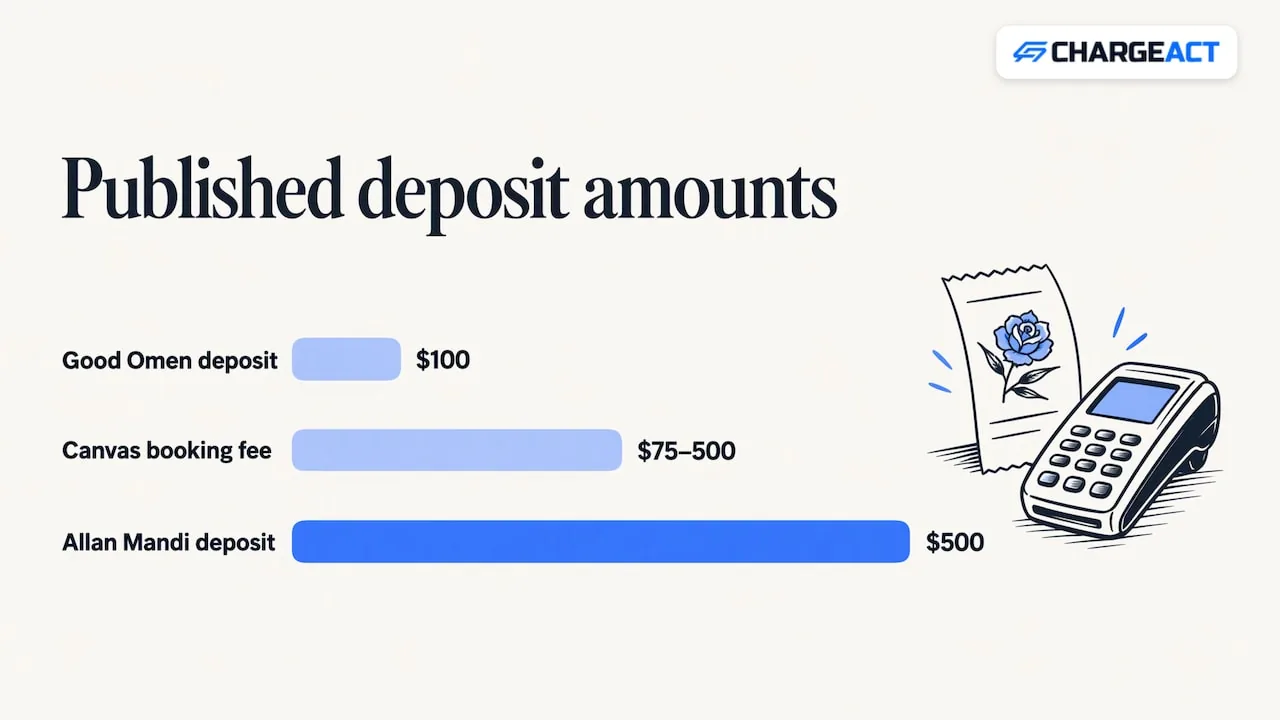
A deposit is the first payment a tattoo client makes, and it is where card acceptance starts. Published amounts vary widely: Good Omen asks $100 per session on multi-session pieces, Canvas lists non-refundable booking fees from $75 to $500, and Allan Mandi Tattoo takes a non-refundable $500 per session, credited toward the work.
Whatever you charge, write down four things and show them at booking:
- The amount and whether it is credited to the final price.
- Whether it is refundable, and until when.
- What happens if the client reschedules.
- Which method the client can use to pay it.
Written terms are also your best position if a client later disputes the charge with their bank. A dispute is a chargeback, where the card issuer pulls the money back pending review. Some booking platforms spell out the same logic: Venue's client terms say a deposit charge or authorization hold may be placed before the appointment and that cancellation fees may equal the full charge.
If you are writing a policy from scratch, a short guide on a deposit refund policy walks through how to word what happens when an appointment changes or is canceled.
Card fees: surcharge, price in, or absorb
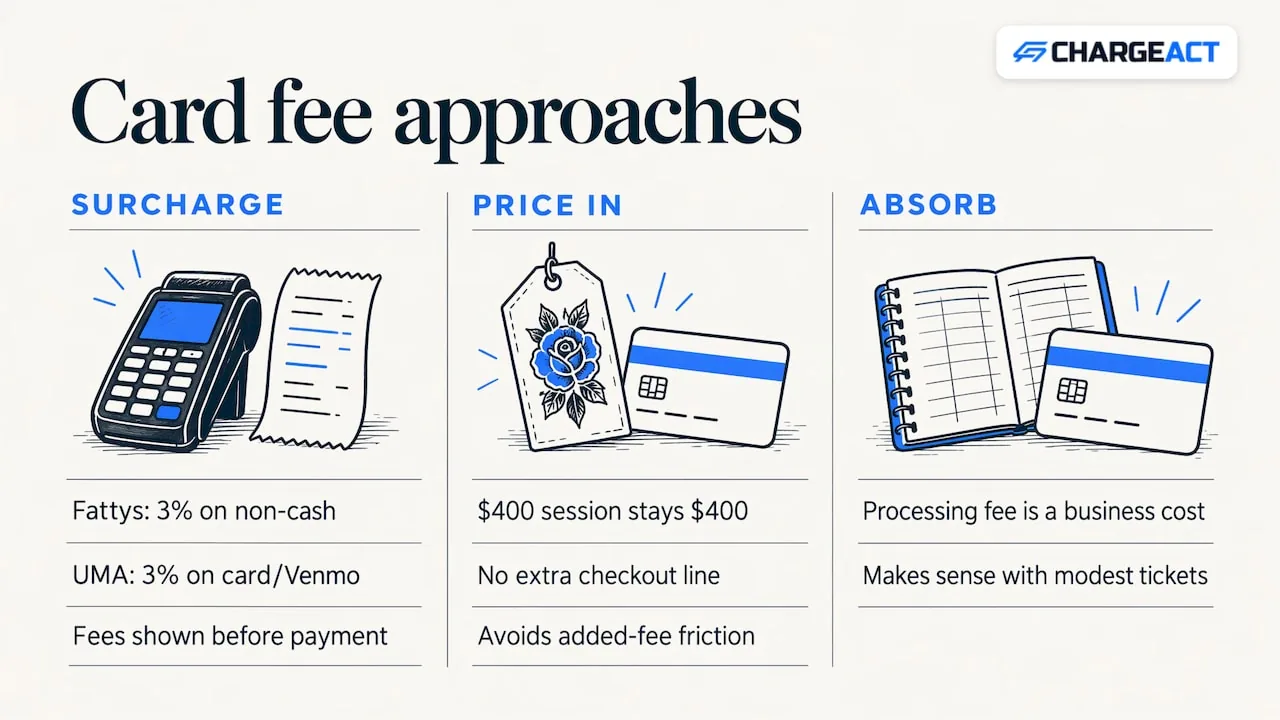
Card acceptance has a cost, and tattoo shops handle it three ways.
The first is a surcharge. Fattys applies 3% to all non-cash transactions, and UMA Tattoo Studio lists 3% on in-studio card and Venmo payments while Cash App, Zelle and cash carry none, with fees shown before payment. Urban Ink also charges 3% and encourages cash or Zelle.
The second is to build the cost into your rates, so a $400 session is $400 however the client pays. This keeps checkout clean and avoids the friction of an extra line.
The third is to absorb it as a cost of doing business, which makes sense when your average ticket is modest.
Surcharging is regulated by card brand rules and by some state laws, so confirm the current requirements with your processor before you add one. Your account manager at a processor is the right person to ask, and with us that is the dedicated manager assigned to your account. Pricing is a conversation about your own volume and ticket size, so ask our sales team for a quote for your shop rather than assuming a number.
Payment plans and financing
Tattoo work is often priced like a project: a sleeve, a back piece, a cover-up over several sessions. Clients ask whether they can pay over time, and a growing number of shops say yes through installment providers.
The mechanics, as shops describe them: the provider pays the studio upfront and the client repays. King 'Afa's booking page explains that with Klarna, Affirm or Afterpay the client repays over four months at 0% interest, with a 6% + $0.30 fee added to the tattoo budget, so a $2,000 tattoo becomes $2,120 in four installments. That is a useful model: the fee is disclosed and the client sees the full price before committing.
Terms differ by provider and by client. Urban Ink's policy notes that Affirm rates run 0% to 36% APR, that options may not be available in every state and that a down payment may be required. Approval and terms are the provider's decision, so shops that offer plans say so plainly. Allan Mandi Tattoo takes the same approach.
A few ways shops structure it:
- Third-party installments. Klarna, Affirm, Afterpay or Sezzle, as at Studio Thirteen.
- Studio-run plans. Certified Tattoo Studios requires payment in full before service but offers a flexible payment plan and monthly session packages where the client picks an artist tier and frequency.
- Deposit plus scheduled sessions. Each session is paid when it happens, with a deposit per sitting.
If a client is weighing borrowing costs, a reference on financing and prepayment rules shows how loan terms vary by state, which is why shops send clients to the provider for their exact terms.
Tips
Tipping is part of tattoo culture, and it shapes the payment setup. Zebra's FAQ says tipping is not mandatory but appreciated and lists cash, Apple Pay, Zelle, Cash App and Venmo as common options. If you want clients to tip by card, put a tip prompt on your terminal or send a payment link after the session. Tell clients in advance how tips are handled, since some shops route them to the artist and others pool them.
Tax treatment of tips and artist income differs for employees and independent contractors, so talk to your accountant, and see the IRS pages on tip reporting for the federal rules.
Why the merchant account matters
Choosing methods is the easy part. The harder part is keeping them working.
Tattoo shops have an unusual payment profile. Deposits arrive weeks before the service. Single tickets are large. Cancellations produce refunds. Busy conventions and flash days create spikes. Generic processors score that pattern as risk, and the consequence can be a reserve on your funds, a freeze or a closed account at the worst possible time, such as the week before a guest artist arrives.
A merchant account underwritten around your actual operations avoids that mismatch. Our positioning is exactly this: personalized underwriting based on how your business operates, not just a category label, with customized risk management and backup placements designed for industries that traditional processors decline. We cannot promise approval, and every application is reviewed on its own merits, but the approach is built for shops that have been dropped, frozen or held.
A setup that covers a shop end to end usually includes:
- A credit card machine and POS for the counter.
- Mobile card readers for conventions and guest spots.
- Apple Pay and digital wallets for tap-to-pay clients.
- Online payments and gateway integration for booking deposits.
- Fraud and chargeback protection for disputed deposits.
- MOTO payments for deposits taken over the phone.
Other appointment businesses with similar deposit-and-ticket patterns, such as nail salons, lash studios and hair salons, run on the same kinds of tools.
Setting up your shop's payments
- Decide your menu. Cash, cards, wallets, an online deposit and, if you want it, installments.
- Choose your fee approach. Surcharge, built into pricing or absorbed. Check the rules for your state first.
- Write your deposit policy. Amount, credit toward the price, refund rule, rescheduling.
- Put it everywhere. Booking form, FAQ, confirmation message and the counter.
- Set up a merchant account that fits. Get a quote for your own volume and ticket sizes so pricing reflects your shop.
- Plan for disputes. Keep signed consent, the policy and the appointment record together so you can answer a chargeback quickly.
Get a payment setup built for your shop
If your shop was dropped, frozen or held by a general-purpose processor, or you are opening and want accounts that will not surprise you, our merchant account and payment solutions are designed for businesses with higher payment complexity. A dedicated account manager handles your account, and our sales team gives you a quote based on your shop.
Rates depend on your business, so request a quote through our site and we will price it for your specific shop.
FAQ
Can you do a payment plan on a tattoo?
Often, yes. Many shops offer installments through providers such as Klarna, Affirm or Afterpay, where the provider pays the studio and the client repays over time. Approval and terms come from the provider, and a fee may be added to the tattoo price, as King 'Afa's page describes.
Is it common to pay a deposit for a tattoo?
Yes. Shops commonly require a deposit to book, often credited toward the final price. Published amounts range from $75 to $500 or more, depending on the studio and the size of the piece.
Do tattoo shops charge extra for paying by card?
Some do. A 3% fee on card payments is common on shop FAQ pages, and cash, Zelle or Cash App are often fee-free. Shops that surcharge should confirm the current card brand and state rules and show the fee before payment.
How should I tip on a tattoo?
Tipping is appreciated rather than required. Cash is the most widely accepted way, and many shops also take Apple Pay, Zelle, Cash App or Venmo. Ask the shop beforehand how it handles card tips.
Sources
- Tattoo FAQs, Fattys Tattoos & Piercings
- F.A.Q., Canvas Tattoo & Art Gallery
- Payment and Installment Policy, Urban Ink
- Book Polynesian Tattoo Los Angeles, King 'Afa
- Allan Mandi Tattoo
- Certified Tattoo Studios FAQ
- Studio Thirteen FAQ
- Good Omen Tattoos FAQ
- Venue Client Terms of Service
- UMA Tattoo Studio payment page
- Zebra FAQ
Recommended
How it works
Call us
Tell us where things stand today - your current processor, your rates, and what's not working.
We review where you stand
A real underwriter looks at your statements and account history - no black-box scoring.
You hear what's possible
We lay out your options in plain terms, including what we can and can't do for your business.
Why ChargeAct
We underwrite the businesses others decline
High-risk isn't a dirty word to us - it's the merchant category we specialize in every day.
A human reviews your account, not just an algorithm
Statements get read by people who understand your industry, not auto-rejected by a risk score.
A dedicated manager who knows your account
When something comes up, you call a person who already knows your business - not a queue.
Stop guessing what your processor will do next.
Talk to a real underwriter about where your business stands - no obligation, no runaround.
(888) 329-5717