Alternative Payment Methods for Online Stores and High-Risk Merchants
Digital wallets, pay-by-bank, ACH, MOTO and installments: how each alternative payment method works, what it costs in risk, and how to build a stable stack.
The best alternative payment methods for a US online store are digital wallets, pay-by-bank and ACH transfers, phone and mail orders, and installment options. They work best as additions to a stable card-processing account, not as replacements for one. Card payments still carry most US retail volume, so the account behind your cards decides whether the rest of your checkout keeps running. For firearms, CBD, wellness, subscription and high-ticket sellers, that account is where revenue is won or lost. It is also where freezes and held funds happen. We built our merchant accounts, backup placements and dedicated account managers around that problem, and the sections below show how to layer alternatives on top of it.
Keep Your Payment Foundation Stable
ChargeAct tailors payment processing for high-risk merchants, with dedicated account managers focused on operational stability and risk management.
Get A QuoteTL;DR
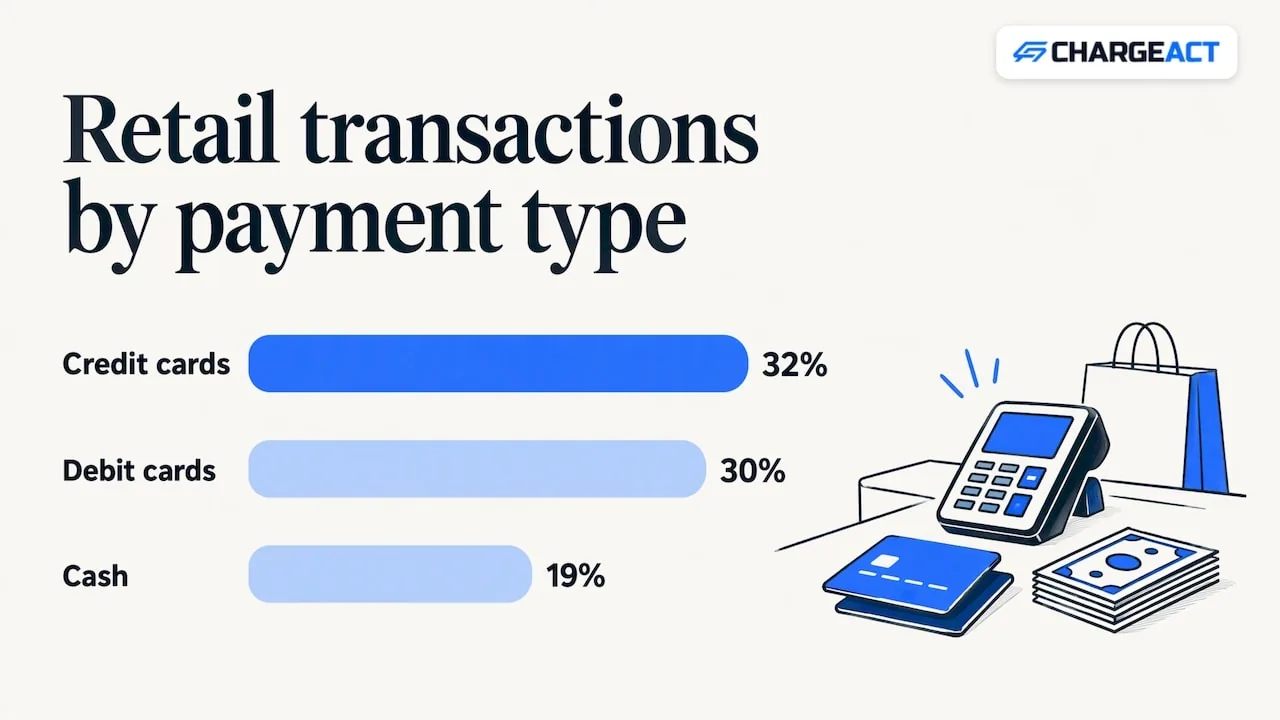
- Cards still dominate US retail: the Federal Reserve's 2023 consumer survey put credit cards at 32% of transactions, debit at 30% and cash at 19%.
- Digital wallets and mobile payments mostly sit on top of your existing card processing, so they raise conversion without adding a new risk profile.
- Pay-by-bank and ACH move money over bank rails, with different fees, settlement times and dispute rules than cards. Pricing depends on provider and volume.
- High-risk and subscription merchants should add methods in an order that protects cash flow: a stable merchant account first, then wallets, then bank-based options.
- Chargeback control and a backup placement matter more than the number of payment buttons at checkout.
Table of Contents
- What counts as an alternative payment method
- Why the card account stays the foundation
- Digital wallets and mobile payments
- Pay-by-bank and ACH
- Phone and mail orders
- Installments and buy-now-pay-later
- Which methods fit which merchant
- Chargebacks decide how stable you are
- A sensible order for adding methods
- How we fit in
- FAQ
- Sources
What counts as an alternative payment method
In practice, "alternative" means anything other than a customer typing a card number into a form that your processor authorizes the old-fashioned way. The list for a US online store usually includes bank transfers, direct debits, cash vouchers, digital wallets, mobile payments and delayed or installment payments. A support guide on alternative payment methods describes how they differ: bank transfers pay from a bank account, direct debits pull from it, cash vouchers are paid at participating retailers, wallets store funds in a third-party account, mobile payments reuse saved card and address details, and installments spread the price over scheduled amounts.
The useful split for a merchant is not the label but the rail. Some methods ride on card networks, so they behave like cards. Others ride on bank networks, so they behave very differently. The Federal Reserve's July 2025 FEDS Note on pay-by-bank explains that these transfers originate in the customer's bank account, travel over ACH or instant-payment rails and settle directly into the merchant's bank account, while card payments pass through card-network intermediaries.
That rail question drives everything else you care about: what a sale costs, how fast you are paid, how a customer can dispute it, and which of your partners can pull the plug.
Why the card account stays the foundation
The same Federal Reserve note reports that in the 2023 Survey of Consumer Payment Choice, credit cards made up 32% of retail transactions by count, debit cards 30% and cash 19%. Most of your customers will still reach for a card, or for a wallet that sits on one.
For a low-risk florist, a card account is a utility. For a firearms retailer, a CBD brand or a subscription business, it is a dependency with a single point of failure. General-purpose payment platforms often apply blanket industry policies, and the result is a frozen balance or a closed account in the middle of a sales spike. Adding a pay-by-bank button does not fix that, because your card volume, usually the bulk of revenue, is still exposed.
That is why our approach starts with the merchant account. We build high-risk merchant accounts around your actual operations rather than a category label, assign a dedicated account manager, and set up backup placements so a single decision does not stop your checkout. If you want the background first, our guide to what makes a merchant high risk covers the factors underwriters weigh.
Digital wallets and mobile payments
Wallets and mobile payments are the easiest alternative to add, and for most stores the first one worth adding. A shopper taps to pay with saved card details instead of typing sixteen digits and a shipping address, which shortens checkout, especially on a phone. Because the underlying credential is still a card, the transaction runs through your merchant account and gateway.
That has two practical consequences. First, wallets do not need a separate risk assessment the way a bank-based method might, so they inherit the stability of the account they run on. Second, they are subject to the same chargeback rules as cards, so your fraud and dispute discipline carries over.
We support digital wallets as part of our digital payments offering, and mobile payments and card readers for merchants who sell at events, on delivery routes or at a counter. Floral shops, event planners, boat rental operators and tow companies tend to get the most from this, since the sale often happens away from a fixed register.
Pay-by-bank and ACH
Bank-based payments appeal because they sidestep card fees. The Federal Reserve's note is careful here, though: published savings estimates of 40% to 85% versus cards are estimates, not a guaranteed merchant price, and provider, integration, subscription, transaction and receiving-bank charges can apply. ACH and instant-payment operators generally charge participating financial institutions per transaction, while card interchange is typically a percentage of the sale. So the cost on a $40 order and a $4,000 order can look very different, and your total depends on value, type, volume and provider pricing.
Speed is the other variable. Per an American Bar Association Business Lawyer article, standard ACH credits may settle on the next banking day, and Same Day ACH can settle within one banking day, subject to a per-item limit. That limit was raised to $1 million, effective March 18, 2022, according to the Treasury's final rule in the Federal Register. If you are weighing standard and Same Day ACH settlement, those two facts, timing and ceiling, are the ones to map against your cash-flow needs.
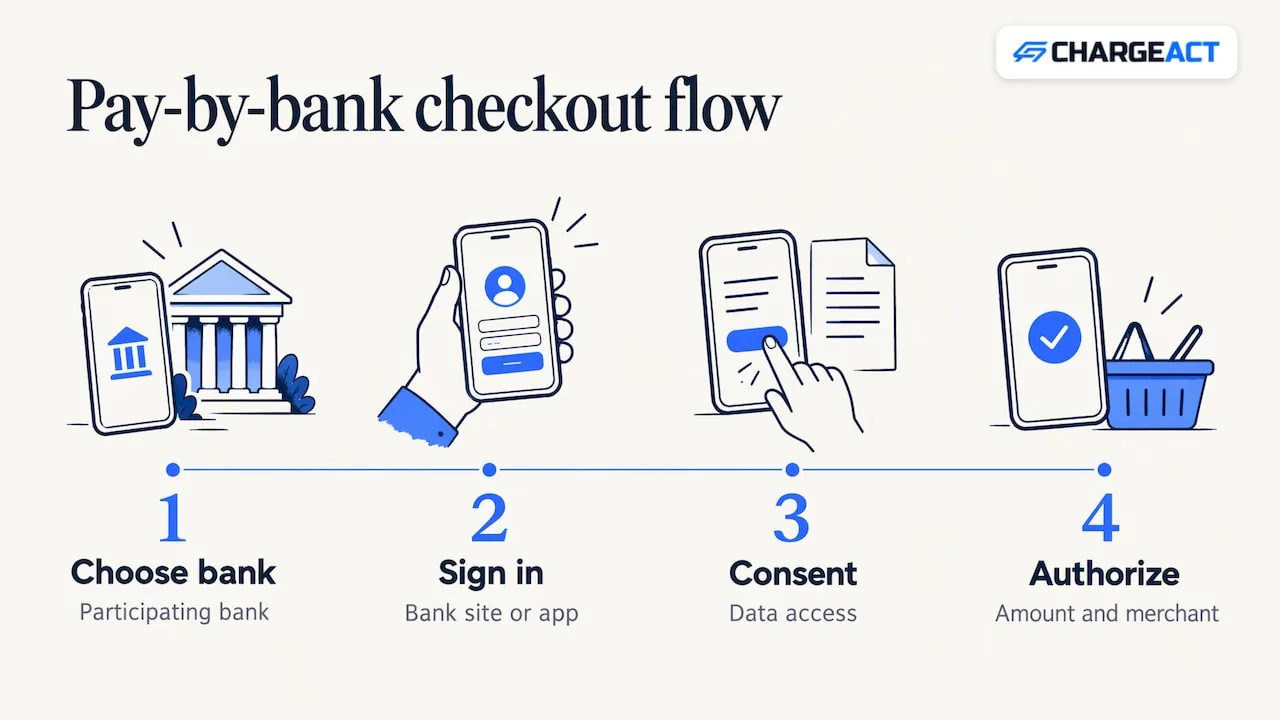
The checkout experience also differs. In a typical pay-by-bank flow, the customer picks a participating bank, signs in through the bank's own site or app, consents to data access and authorizes the amount and merchant. Per the Fed note, open-banking connections do not require sharing bank login credentials with the third party. That is a smoother story than it sounds, but it is still a few more steps than tapping a wallet.
Disputes work differently on bank rails
Don't assume that moving off cards removes dispute exposure. It changes the rules. The same ABA article says a consumer has 60 calendar days from settlement to report an unauthorized ACH debit, while a non-consumer receiver's written statement is due within 24 hours of settlement. Consumer electronic transfers are also covered by the Electronic Fund Transfer Act and Regulation E, according to the Consumer Financial Protection Bureau's EFT FAQs, which note that a financial institution must promptly investigate a reported error and correct it within one business day after determining it occurred.
The practical lesson for a merchant: a 60-day return window on a bank debit is not a smaller exposure than a card dispute window by default. Plan reserves, refund policy and customer communication for both.
Phone and mail orders
Mail order and telephone order (MOTO) is the oldest alternative on the list and still the most relevant for high-ticket sellers. A customer who is buying a boat rental deposit, a gym annual plan or a custom event package often prefers to talk to a person and read the card number aloud. A virtual terminal lets your staff key that payment into a browser instead of a physical device.
For merchants in this position we offer MOTO payment processing alongside the rest of the stack, so phone orders run through the same account and reporting as your web sales. Keying cards manually carries elevated fraud exposure, which is why pairing it with fraud tooling matters. Our fraud prevention and chargeback protection is built for exactly this.
Installments and buy-now-pay-later
Delayed and installment payments let a shopper split a large purchase into scheduled amounts. For high-ticket ecommerce, that can lower the barrier to a first order. The support guide above also flags a checkout detail worth knowing before you launch: some alternative methods redirect the shopper to the provider and back to your store, and features such as delayed capture or control-panel refunds may not be supported for those orders. If your operations depend on authorizing now and capturing at shipment, as many firearms and made-to-order sellers do, confirm that first.
Which methods fit which merchant
| Merchant type | Methods worth adding first | What to watch |
|---|---|---|
| Firearms and FFL ecommerce | Cards through a stable account, MOTO, wallets | Account continuity, backup placement |
| CBD, hemp, wellness, nutraceutical | Cards, wallets, subscriptions billing | Chargebacks, reserve terms |
| Subscription brands | Cards and wallets for recurring billing, bank debit as a second option | Failed renewals, dispute windows |
| Phone-order and high-ticket sellers | MOTO with a virtual terminal, installments | Manual-entry fraud, capture timing |
| Event, floral, boat rental, tow, gym | Mobile payments, wallets, card readers | Deposits, refunds, seasonal spikes |
The order matters more than the count. Every method you add is another settlement schedule, another dispute process and another integration to maintain.
Chargebacks decide how stable you are
A merchant's ability to keep an account often turns on chargeback history. The OCC's Comptroller's Handbook on merchant processing notes that chargebacks can arise from technical, clerical, quality or fraud issues, and that banks are advised to monitor high-volume and high-risk merchants, including their industry concentration and chargeback history. Acquirers may also hold part of a merchant's funds in reserve when they see excessive chargeback risk and release it after the dispute period, as a Congressional Research Service report on card swipe fees explains. That same report puts the typical merchant discount rate for card acceptance at roughly 1% to 3% of transaction value, with clearing and settlement usually taking one to three business days.
The Federal Trade Commission's 2026 order involving a payment processor shows how closely regulators watch this area: it requires monitoring of covered merchants' chargeback rates and unusual transaction patterns, with specific triggers for investigation. It binds that defendant and its covered clients, but it illustrates what scrutiny of chargeback activity looks like.
Two habits keep disputes low regardless of method: clear billing descriptors and refund terms, and a response process for every dispute. We cover the routine in our chargeback prevention playbook, and our team offers chargeback defense as part of our services.
A sensible order for adding methods
- Stabilize the card account. Confirm your merchant account matches your real business model, and that there is a backup placement if the primary is ever interrupted.
- Turn on wallets and mobile payments. They ride on the same account and shorten checkout.
- Add MOTO and a virtual terminal if you take phone orders or high-ticket deposits.
- Test a bank-based option for large or recurring orders, once you have modeled per-transaction fees against your average order value and checked how refunds and returns work on that rail.
- Review monthly. Compare chargeback rate, authorization rate and settlement timing by method, and keep what earns its place.
Before you add any method, verify that your gateway supports it for your country and currency, and walk through the full redirect-and-return flow yourself. Our gateway integration support for ecommerce stores is there for exactly that setup work.
How we fit in
Our role is the layer under all of this. We provide merchant accounts tailored to risk profiles, credit card and digital payment infrastructure, fraud protection, chargeback defense and gateway integration for ecommerce and retail, with a dedicated account manager for each merchant. Underwriting looks at how your business actually operates, not only its category. Pricing is interchange plus and aligned to volume; for a quote on your specific business, talk to our sales team.
If your processing has been frozen, limited or held in reserve, or you want a more stable base before adding new payment methods, see our payment solutions or the ecommerce payment processing page. Approval depends on each merchant's underwriting.
FAQ
What are alternative payment methods?
They are ways to pay other than a standard card entry: bank transfers, direct debits, cash vouchers, digital wallets, mobile payments and installment plans. Some, like wallets, run on card rails. Others, like pay-by-bank, settle over bank networks.
Do alternative payment methods cost less than cards?
Not always. Card acceptance typically costs a percentage of the sale, while bank rails often charge per transaction, plus provider fees. Savings depend on order value, volume and provider pricing, so model your own numbers. For card pricing on your business, request a quote from our sales team.
Which methods suit a high-ticket or subscription store?
Cards and wallets cover most buyers, MOTO suits phone-led high-ticket sales, and bank debits or installments can be a second option for large or recurring orders. Check capture, refund and redirect behavior before launch.
Can adding methods protect me from account freezes?
More buttons do not change who holds your funds. A processing account built around your real business, with a backup placement and a dedicated account manager, is what supports continuity.
Sources
- Federal Reserve FEDS Note on pay-by-bank and the merchant payments use case
- Introduction to alternative payment methods (support guide)
- Congressional Research Service: credit card swipe fees and routing restrictions
- Treasury final rule on Same Day ACH limit, Federal Register
- American Bar Association: the architecture of ACH
- CFPB Electronic Fund Transfers FAQs
- OCC Comptroller's Handbook: Merchant Processing
- FTC stipulated order on chargeback monitoring
Recommended
How it works
Call us
Tell us where things stand today - your current processor, your rates, and what's not working.
We review where you stand
A real underwriter looks at your statements and account history - no black-box scoring.
You hear what's possible
We lay out your options in plain terms, including what we can and can't do for your business.
Why ChargeAct
We underwrite the businesses others decline
High-risk isn't a dirty word to us - it's the merchant category we specialize in every day.
A human reviews your account, not just an algorithm
Statements get read by people who understand your industry, not auto-rejected by a risk score.
A dedicated manager who knows your account
When something comes up, you call a person who already knows your business - not a queue.
Stop guessing what your processor will do next.
Talk to a real underwriter about where your business stands - no obligation, no runaround.
(888) 329-5717