Chargeback Prevention: A Practical Playbook for Merchants
Chargeback prevention for high-risk and high-ticket merchants: how to stop disputes before they are filed, what protection can and cannot do, and where to start.
Chargeback prevention is a stack of small controls, not one tool: clear billing and policies, verification at the point of sale, evidence you keep for every order, and a processor that watches your dispute pattern before the card networks do. For merchants in firearms, CBD, wellness, subscriptions and high-ticket sales, the stakes are higher than a lost sale, because a dispute pattern can lead to reserves, held funds or a frozen account. That is why we build fraud protection and chargeback defense around each merchant's actual operation, with a dedicated account manager who looks at your risk profile instead of your category label.
This guide covers why disputes happen, the controls that stop them for each way you take payments, how to read chargeback protection honestly, and what to do the week a dispute lands.
TL;DR
- A chargeback is a dispute filed through the cardholder's bank, so prevention means removing the reasons a customer would file: confusion, fraud and unresolved complaints.
- The controls that matter most are a recognizable billing descriptor, clear refund and cancellation terms, verification on suspicious orders, and an evidence file for every sale.
- Online, subscription, phone-order, high-ticket and in-person sales each have different weak points, so one generic checklist leaves gaps.
- No tool or service can promise a merchant zero disputes. Chargeback protection works best as a layer inside a sound processing setup.
- If a processor has frozen, limited or dropped you, the dispute pattern behind it is the first thing to fix.
Table of Contents
- Why chargebacks happen and why they cost more than the sale
- Is there a way to prevent chargebacks entirely?
- The prevention controls that apply to every merchant
- Prevention by sales channel
- What chargeback protection can and cannot do
- Monitor your chargeback pattern like a metric
- What to do when a dispute is filed
- When disputes have already cost you an account
- Where ChargeAct fits
- FAQ
- Sources
Why chargebacks happen and why they cost more than the sale
A chargeback starts when a cardholder asks their issuing bank to reverse a payment instead of asking you. The funds are pulled back from your account while the dispute is reviewed, and you pay a fee on top, so even a dispute you win costs time and money.
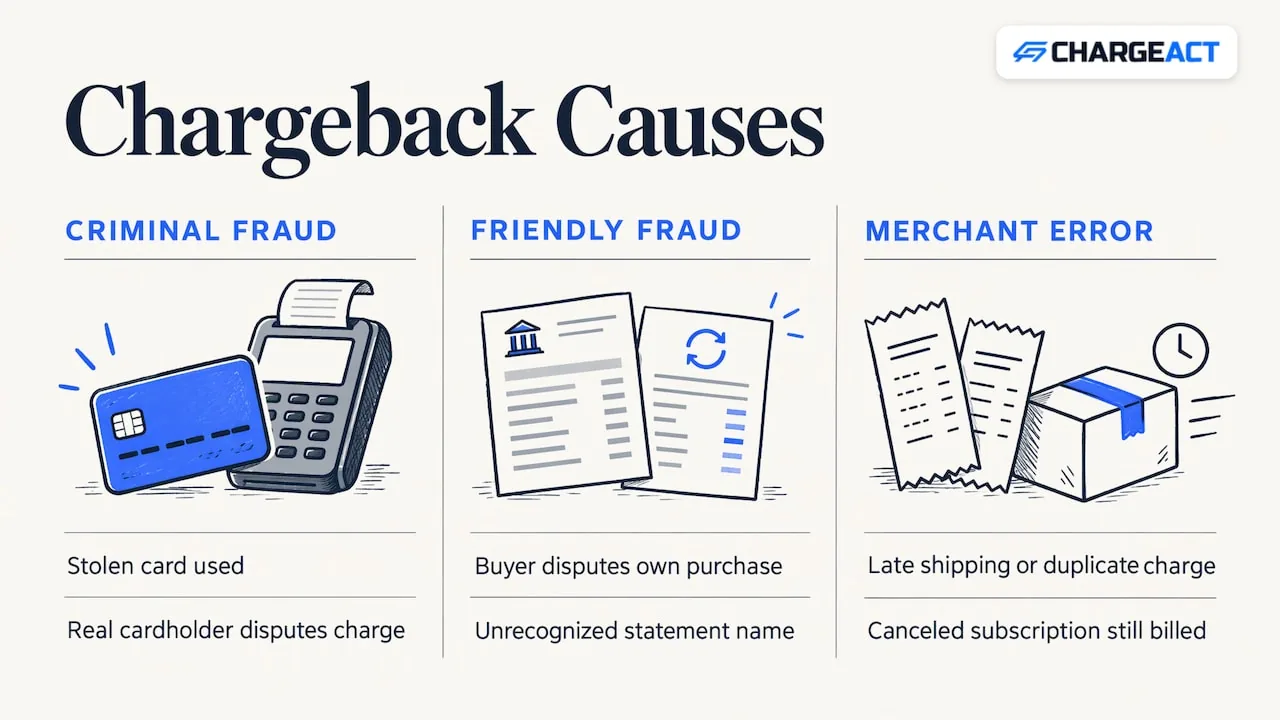
The reasons fall into three buckets, and the bucket decides the fix.
Criminal fraud. A stolen card is used on your site, over the phone or at your counter. The real cardholder disputes the charge, and you have shipped product to a thief.
Friendly fraud. The customer made the purchase but disputes it anyway, sometimes because they do not recognize the name on their statement, sometimes because they forgot a subscription, sometimes because they simply prefer a bank dispute to a return process.
Merchant error. Late shipping, a duplicate charge, a canceled subscription that kept billing, or a product that did not match the description. These are the most preventable disputes, because the cause is entirely inside your business.
The cost goes beyond the transaction. Card networks and processors watch your dispute activity relative to your sales, and a pattern can trigger monitoring, higher reserves or account termination. We explain how that monitoring works in our article on VAMP and excessive chargebacks. If you have already seen your account limited without a clear warning, the signals that get you silently flagged show what processors tend to notice first.
Is there a way to prevent chargebacks entirely?
Not entirely. Any merchant who accepts cards will see some disputes, including ones that have nothing to do with how well the business is run. The realistic goal is a low, stable and explainable dispute pattern, and a documented response to the disputes that do arrive.
That framing matters for high-risk merchants in particular. Your processor's underwriters read your history, so a steady, well-managed pattern with clear causes is far easier to support than a spike with no explanation. Our approach to high risk merchant processing starts from that idea: stability comes from managing the pattern, not from hoping it stays quiet.
The prevention controls that apply to every merchant
These controls work whatever you sell. Treat them as the base layer.
Make the charge recognizable
A customer who cannot match a line on their statement to a purchase will often call the bank. Your billing descriptor should show a business name customers know, ideally with a phone number or web address that reaches support. Put the same name on receipts, confirmation emails and packaging so the statement line never surprises anyone.
Publish refund, return and cancellation terms where customers see them
Policies hidden in a footer do not help you in a dispute and do not stop one. Show the terms at checkout, repeat them in the order confirmation, and require an explicit acceptance for recurring billing. For subscriptions, send a reminder before each renewal and a confirmation when someone cancels. A customer who can cancel in two clicks has no reason to call the bank.
Make it easy to reach you first
A chargeback is often the last step after a customer failed to get an answer. Put your support email and phone number on the site, answer within a business day, and give your team the authority to issue a refund quickly. A refund costs you the sale. A chargeback costs you the sale, a fee and a mark on your record.
Verify suspicious orders before you ship
Flag orders with mismatched billing and shipping addresses, unusually large first orders, rushed shipping requests or several failed card attempts. Visa recommends that merchants have written procedures and regular staff training for handling suspicious transactions. For e-commerce orders it advises calling the customer on a phone number you found independently, not the one supplied with the order, and explaining that the call is a fraud-protection step. That one call can settle a discrepancy before product leaves your warehouse.
Keep an evidence file for every sale
If a dispute arrives, you typically have a limited window to answer, and the answer is only as good as your records. Keep the order confirmation, billing and shipping details, delivery confirmation with signature where appropriate, the customer's acceptance of your terms, and every support exchange. Visa notes in its dispute management guide for merchants that its recommendations are reference guidance and do not replace Visa Rules or your agreement with your acquirer, so your merchant agreement is the document to read for your exact deadlines and requirements.
Prevention by sales channel
Each channel breaks in a different place. Match your controls to how you actually take money.
Online and ecommerce stores
Online sales carry the most exposure to criminal fraud because the card is not present. Layer your defenses: address and card security code checks, velocity limits that catch repeated attempts, and 3-D Secure authentication on higher-risk orders. When authentication succeeds, responsibility for fraud disputes can shift away from you, which is why a message like "successful liability shift for enrolled card is required" deserves attention. Our walkthrough on fixing that liability shift error covers the integration side. For the broader view of how these checks combine, see our layered ecommerce fraud prevention playbook.
Gateway setup also matters. A checkout that fails to pass the right data to your processor weakens every fraud tool downstream, which is why we offer gateway integration support for ecommerce stores.
Subscriptions and recurring billing
Subscription disputes are mostly friendly fraud and billing confusion, not stolen cards. The fixes are operational: a clear trial-to-paid disclosure, renewal reminders, an obvious cancel button, and prompt refunds for customers who say they forgot. Failed-payment retries (dunning) should be spaced and logged, because repeated attempts on a card that keeps declining can look like a billing error to the customer and to the issuer. Watch your own pattern by cohort: if disputes cluster in the first renewal, your trial messaging is the problem, not your fraud screening.
Phone and mail orders
MOTO sales (mail order and telephone order) have no chip, no PIN and no browser to check, so the call itself is your control. Read back the order, confirm the billing address, record the customer's agreement to terms where your rules allow it, and log the call. Ship to the verified billing address when you can, and treat requests to send an expensive order to a new address as a reason to verify again. If this is a large part of your revenue, our MOTO payment processing is set up for exactly this kind of order.
High-ticket sales
One disputed order can matter as much as fifty small ones. Slow down where it counts: verify identity on large first orders, confirm delivery with a signature, and send a written confirmation of the specifications and the delivery timeline before you ship. For firearms and other regulated goods, where the transaction may also involve a licensed transfer, keep the paperwork that documents completion of the sale with the order record. Detailed, dated documentation is what turns a dispute into a straightforward response.
In-person sales
In the store, the card network's guidance is concrete. Visa advises in-person sellers to prefer chip processing where available, keep the chip card in the terminal until the transaction completes, obtain authorization, and check card security features where possible. It also says you may ask for identification, but you must still honor the card if the cardholder lacks or declines to show it. If the names do not match, you decide whether to accept the sale. Train every register employee on those rules, because the weak point in a retail dispute is usually a rushed counter, not the terminal.
What chargeback protection can and cannot do
"Chargeback protection" covers several different things, and it helps to know which one you are buying.
Pre-dispute alerts and screening. Tools that flag a suspicious order before shipment, or notify you of a customer complaint so you can refund before a formal dispute is filed. These reduce the number of disputes.
Dispute response support. Help assembling and submitting evidence once a dispute is filed. This improves how many of the disputes you do receive are resolved in your favor, and it saves your staff hours.
Processing-level protection. The account structure around you: underwriting that reflects how your business really operates, monitoring that spots a trend early, and backup placements so a problem with one account does not stop your revenue.
None of these removes disputes altogether, and no honest provider can guarantee a result on any individual dispute, because the issuing bank and the card network make the final call. Protection works best when it sits on top of the base controls above, not instead of them. We design our fraud protection and chargeback defense as layers of the same system, and we discuss the outcomes for your specific business with you directly, since results depend on your products, your customers and your volume.
Monitor your chargeback pattern like a metric
Treat disputes the way a subscription business treats churn: a number you review on a schedule, not an event you react to.
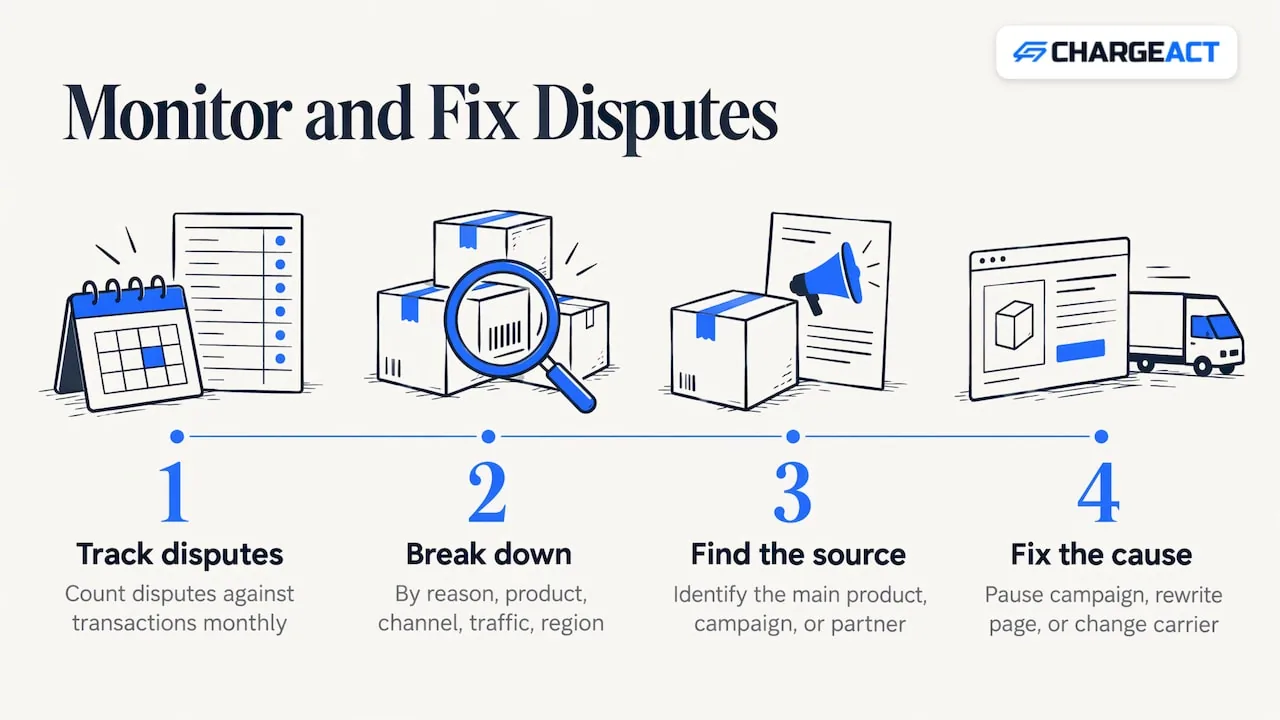
Track your dispute count against your transaction count, month by month, and break it down by reason, product, channel, traffic source and shipping region. A single product line, ad campaign or fulfillment partner is often responsible for most of the problem. When you find it, fix it at the source. Pause the campaign that attracts mismatched expectations, rewrite the product page, or change the carrier.
Also watch the timing. Disputes can arrive weeks or months after a sale, so a spike in your dispute reports usually reflects decisions made well before. Ask your processor how and when it reports disputes to you, because early visibility is what gives you room to act before a monitoring threshold becomes a conversation about your account. Your merchant agreement and your card-network program rules set the actual thresholds, and your account manager should walk you through where you stand.
What to do when a dispute is filed
- Read the reason code and the deadline. The reason tells you which evidence matters. The deadline is set by your acquirer agreement and the network's rules.
- Decide whether to fight or refund. If the customer is right, an immediate refund or acceptance can be cheaper than a response. If the order was legitimate, build the response.
- Assemble the evidence file. Match the evidence to the reason: delivery proof for "not received", acceptance of terms and usage logs for subscription disputes, authentication results for fraud disputes.
- Submit once, cleanly. A short, organized response with labeled documents beats a long narrative.
- Fix the cause. Log the dispute against your pattern tracking and change whatever allowed it.
This routine is exactly where a dedicated account manager and chargeback defense save time: your team spends its hours running the business, not formatting evidence packets.
When disputes have already cost you an account
Many merchants find us after a general-purpose processor froze funds, held a reserve or ended the relationship, often with little notice. Those processors apply broad category rules, and a firearms, CBD, supplement or high-ticket business can be flagged on category alone. A merchant account built for your risk profile changes that: underwriting that looks at your actual operations, pricing that is transparent and tied to your volume, and backup placements designed for industries that mainstream processors decline.
If you want the background first, read what a high risk merchant is and how high risk credit card processing works. Supplement and wellness brands can see how this applies to them on our nutraceutical merchant account page.
Where ChargeAct fits
We provide payment processing for high-risk merchants, including high-risk merchant accounts, fraud protection, chargeback defense, MOTO payments, online and retail processing, and gateway integration support. Every merchant has a dedicated account manager, and our risk management is shaped around your business, including preparing for volume spikes and regulatory shifts. Pricing is interchange plus. For a quote specific to your business, talk to our sales team; we do not publish rates because they depend on your risk profile and processing needs.
If disputes are putting your processing at risk, start with our fraud protection and chargeback protection page or contact us through the main site. Approval is subject to underwriting, and we review each application on its own merits.
FAQ
Is there a way to prevent chargebacks?
You can reduce them substantially but not eliminate them. Clear billing descriptors, visible policies, fast customer support, verification of suspicious orders and good records address most avoidable disputes. Layered fraud screening handles much of the rest.
What is chargeback protection for merchants?
It is a set of tools and services that reduce disputes before they are filed, help you respond to the ones that are, and keep your processing account stable. It supports your own controls and does not guarantee the outcome of any single dispute.
How do I stop friendly fraud?
Make the purchase memorable and the exit easy. Use a recognizable descriptor, send clear receipts and renewal reminders, make cancellation simple, and refund quickly when a customer reaches out. Keep proof of delivery and of the customer's acceptance of your terms for the cases that still escalate.
Do I need different chargeback prevention for phone orders?
Yes. Phone orders have no chip or browser data, so verification, a read-back of the order and logged call records do the work. Verifying a suspicious order with a phone number you found independently is a step Visa recommends for e-commerce merchants too.
Sources
Recommended
How it works
Call us
Tell us where things stand today - your current processor, your rates, and what's not working.
We review where you stand
A real underwriter looks at your statements and account history - no black-box scoring.
You hear what's possible
We lay out your options in plain terms, including what we can and can't do for your business.
Why ChargeAct
We underwrite the businesses others decline
High-risk isn't a dirty word to us - it's the merchant category we specialize in every day.
A human reviews your account, not just an algorithm
Statements get read by people who understand your industry, not auto-rejected by a risk score.
A dedicated manager who knows your account
When something comes up, you call a person who already knows your business - not a queue.
Stop guessing what your processor will do next.
Talk to a real underwriter about where your business stands - no obligation, no runaround.
(888) 329-5717