High Risk Payment Declines: Why They Happen and How to Stop Them
Why high-risk merchants see payment declines, how to read what a decline means, and what steady processing looks like for firearms, CBD, wellness and subscription sellers.

A high risk payment decline is rarely random. It usually traces back to three things: how your business category is classified, how your chargebacks and transaction patterns look to the acquiring bank, and whether your processor was built for your category in the first place. A processor that underwrites your actual operations and assigns a dedicated account manager can keep approvals steady through volume spikes and policy shifts. That is how we build high-risk accounts at ChargeAct, and this guide shows you why that approach matters.
TL;DR
- Declines come from two places: the card issuer saying no to a single transaction, and your processor or acquiring bank restricting your account. They need different fixes.
- Category, chargeback levels, sudden volume spikes and fraud alerts are the signals card networks and banks watch most closely.
- False declines cost merchants real revenue, so retry timing, clean transaction data and fraud tools matter as much as the processor itself.
- Firearms, CBD, wellness and subscription sellers do best with a merchant account underwritten for their model, with backup placements and a named account manager.
- Rates depend on your business, so pricing always comes from a quote from our sales team.
Table of Contents
- Two kinds of decline, two different problems
- Why high-risk merchants get declined more often
- Reading a decline: what the code is telling you
- What false declines cost you
- Practical steps that reduce avoidable declines
- Why the processor you choose decides how many of these you face
- Who this matters most for
- How ChargeAct fits
- Where this leaves you
- FAQ
- Sources
Two kinds of decline, two different problems
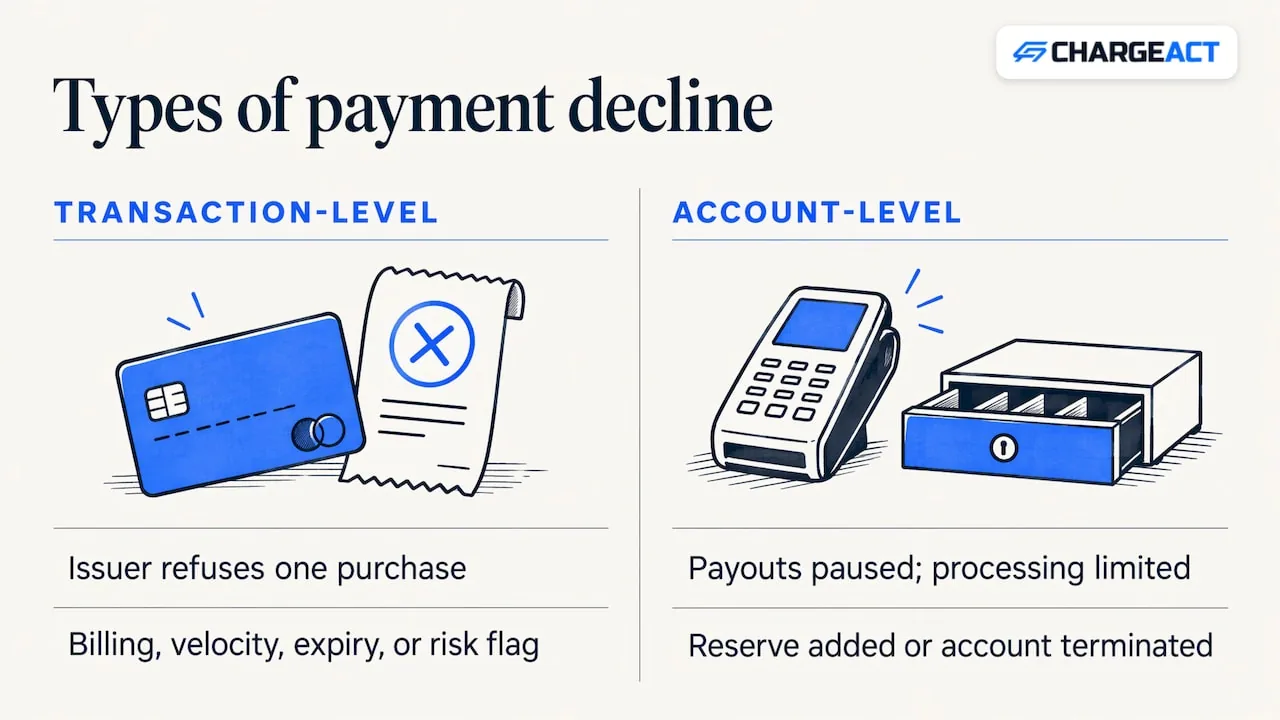
When merchants say "my payments keep getting declined," they usually mean one of two situations that look alike on a dashboard.
The first is a transaction-level decline. A customer's issuing bank (the bank that issued their card) refuses one purchase. The reason could be a mismatched billing address, a velocity flag, an expired credential or a risk model that dislikes the merchant category. Your processor passes along a response code, and the customer sees "card declined."
The second is an account-level action. Your processor or its sponsor bank pauses payouts, adds a reserve (money held back against future chargebacks), limits processing or terminates the account. This is the one that stops revenue entirely. Merchants dropped by general-purpose payment platforms experience it most often, and our guide on what to do when a platform pauses your payouts walks through the first steps.
The two are connected. A pattern of issuer declines and disputes can trigger the account-level action, and an account placed with the wrong processor can lead to more issuer declines. Fixing the account is usually the higher-leverage move.
Why high-risk merchants get declined more often
Category classification
Card networks sort merchants by category codes. Visa's risk guide for payment facilitators identifies certain card-absent merchant types as high-brand risk because of elevated disputes or brand and reputation concerns, notes they are typically highly regulated, and says some are illegal in certain jurisdictions. Its examples include specific merchant category codes for cigar stores, pharmacies, betting, telemarketing and travel arrangements. Your own category may not appear on that list, but the logic is the same: banks apply tighter screening wherever dispute or regulatory exposure is higher.
A label is only a starting point, though. Two CBD stores can look very different to an underwriter, depending on product, fulfillment, refund practices and dispute history. That is why we underwrite based on how your business actually operates, not just the category on your application.
Chargebacks and dispute activity
The Office of the Comptroller of the Currency's Merchant Processing handbook says an acquirer's risk management should detect merchants with high chargeback levels and notes that card associations may fine banks with high levels of chargebacks. It also warns that banks may lack the experience or infrastructure to process safely for high-risk merchants. Put plainly, a bank without the right tools will often choose to restrict rather than manage.
Volume spikes and fraud alerts
Visa's guide lists the seller behaviors that trigger restrictions: sudden spikes in sales volume or transaction size, elevated dispute activity tied to unsound acceptance practices or deceptive marketing, and elevated fraud advices that often precede fraud disputes. For a firearms retailer running a hunting-season promotion, a CBD brand with a viral post or a subscription business launching a new tier, a spike is normal business. To a risk system that has not been told about it, it looks like a warning sign. Telling your processor in advance matters, and a dedicated account manager is the person who can plan for it.
Regulatory pressure on banks
The FDIC's Payment Processor Relationships guidance, revised in February 2026, says banks should monitor high-risk processor accounts for increases in unauthorized returns, chargebacks, suspicious activity and consumer complaints, and should assess whether reserves are adequate to cover chargebacks. It also says institutions that manage these relationships poorly may be viewed as facilitating a merchant's fraudulent or unlawful activity. This is a main reason generic processors tighten policies on whole industries at once, and why enhanced underwriting and monitoring are standard for high-risk accounts.
On the policy side, in March 2026 the FTC sent warning letters to four payment providers about denying access to payment services on certain grounds. The details concern those providers' own conduct, not your underwriting, so the practical takeaway is simply that account access remains an active policy topic.
Reading a decline: what the code is telling you
Every declined card payment comes back with a response code from the issuer through the card network and your processor. You do not need to memorize them, but you do need to sort them into groups.
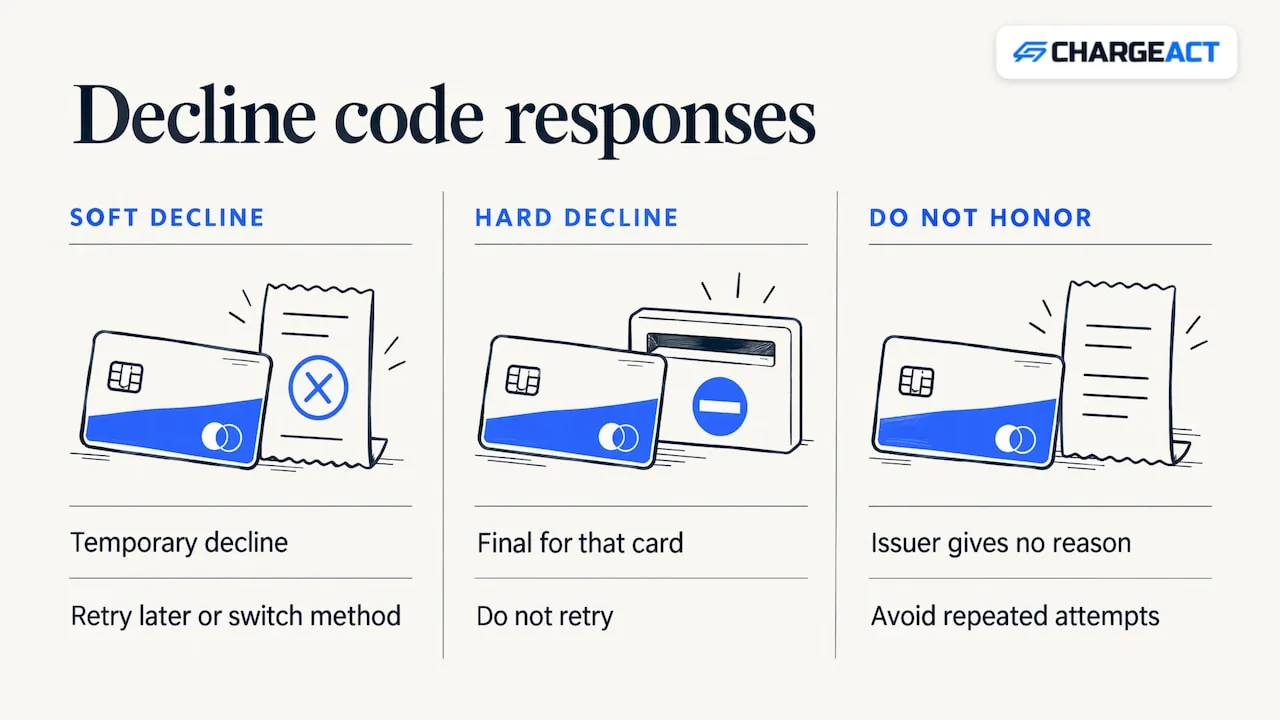
Soft declines are temporary: insufficient funds, a velocity limit, a request for additional authentication. A retry at a sensible time, or a different payment method, can succeed. Hard declines are final for that card: a closed account, a lost or stolen flag, an invalid number. Retrying those only adds noise. A generic "do not honor" response sits in between: the issuer declines without saying why, often because of its internal risk model. Do not hammer it with repeats.
Two habits make codes useful. First, log the code with every failed attempt, along with the card type, ticket size, billing and shipping match, and time of day. Patterns appear quickly: one issuer declining your high-ticket orders, one product line failing more than others, one gateway setting causing mismatches. Second, separate fraud-related declines from technical ones, since a data formatting problem is fixable on your side while a risk flag calls for a different response.
If declines cluster by issuer or amount rather than by customer, the cause is more likely your merchant profile or transaction data than the individual buyers. This is where a processor that reviews your decline reports with you saves the most time.
What false declines cost you
Not every decline is justified. A false decline is a legitimate purchase refused. Visa and Datos Insights research estimates the industry average false decline rate at 1.51% of e-commerce sales, nearly $175 billion in lost sales in 2024. The same research finds 74% of U.S. merchants track false declines as a KPI, and that among U.S. merchants, approval rates of 90% or higher rose from 33% to 57% between 2022 and 2023, so the benchmark for good performance keeps moving.
The customer side is just as costly. Mastercard reports that more than four in 10 consumers say they would never shop with a business again after a false decline. For a subscription seller, that is lost lifetime value, not one lost sale. For a high-ticket seller, it is a single order that may represent a large share of the week.
If you track one metric this quarter, track your approval rate by card brand and by order value. It shows you where the leakage is before it shows up in churn.
Practical steps that reduce avoidable declines
The steps below apply whether you sell online, by phone or at a counter. They are ordered by how often they fix the problem.
1. Send complete, clean transaction data. Mastercard says its Adaptive Authorization can enrich transaction information in real time, including updating expired card credentials and improving how data elements are populated. Merchants benefit when their gateway passes address verification, card security code and descriptor data consistently. Our gateway integration support for e-commerce stores covers this layer, so your checkout sends what issuers expect to see.
2. Time your retries. For subscriptions, Mastercard's Payment Alerts help merchants choose when to retry after a financial decline. Retrying too soon may fail again, while retrying too often may contribute to more declines. Build a retry schedule spread over days, not minutes, and pair it with dunning emails that let the customer update their card.
3. Keep chargebacks low, not just defended. Prevention beats representment. Clear billing descriptors, visible refund terms, fast shipping updates and prompt support responses reduce disputes before they become a ratio your bank notices. Our layered ecommerce fraud prevention playbook goes deeper on tools and sequencing, and our chargeback defense service handles the disputes that still come through.
4. Tune fraud rules to your real customers. Overly aggressive rules cause false declines, and loose ones raise fraud and disputes. Review blocked-order samples monthly, and adjust for your seasonality, average ticket and shipping geography. Our fraud protection tools are built for exactly this balance.
5. Warn your processor before known spikes. Product drops, seasonal promotions, trade shows and new subscription plans should be flagged ahead of time. A processor that knows your calendar can set expectations with the bank instead of reacting after the fact.
6. Match the payment method to the order. Phone-order sellers should use a proper MOTO setup, in-person sellers a POS with the right terminal configuration, and online sellers digital wallets alongside cards. Each channel carries its own authentication and risk profile, so a mismatch invites declines.
Why the processor you choose decides how many of these you face
Most declines that hurt a business are not issuer declines on single orders. They are the account-level restrictions that follow a general-purpose processor deciding your category sits outside its comfort zone. Industry-wide policy changes can sweep up firearms, FFL, CBD, hemp, supplement and high-ticket accounts in the same week, regardless of how well each business runs.
A processor built for these categories approaches the relationship differently. The merchant account is shaped around your risk profile, the underwriting looks at how you really operate, and a named account manager watches your ratios and volume alongside you. Backup placements add a second path if one banking relationship changes its appetite. Our high-risk merchant account is designed around that stability, and our guide to choosing a high-risk payment processing partner lays out what to look for.
Already holding funds under a heavy reserve? The same approach applies: a merchant account tailored to your profile and a plan that anticipates chargeback exposure gives you a way to rebuild predictable cash flow.
Who this matters most for
Firearms and FFL retailers face scrutiny on both the regulatory and the card-network side, so an account built for that category and an account manager who understands the sector reduce surprises. CBD and hemp stores contend with changing platform policies and need processing that does not disappear overnight. Wellness and nutraceutical brands, especially those with recurring billing, depend on healthy authorization rates and tight chargeback control. High-ticket and phone-order sellers need MOTO and virtual terminal capability that behaves consistently. Event venues, gyms, boat rentals, floral shops and tow companies often have deposits, advance bookings or seasonal surges that general processors misread as risk.
If you want a fuller picture of how the category works, start with our explainers on what makes a merchant high risk and high-risk credit card processing.
How ChargeAct fits
We provide customized payment processing for high-risk merchants: merchant accounts tailored to your risk profile, credit card and digital payment infrastructure, MOTO and mobile payments, POS systems, fraud protection, chargeback defense and gateway integration support for e-commerce stores. Every merchant has a dedicated account manager, and our risk management strategies are designed to anticipate volume spikes and regulatory shifts. Pricing is transparent interchange plus, and because every business differs, rates come from a quote from our sales representatives for your specific situation.
See the full list of high-risk solutions or explore high-risk merchant services for every industry. Approval depends on your business and underwriting review, and we cannot promise any specific outcome in advance.
Where this leaves you
Treat declines as data. Sort them into issuer-level and account-level, log the codes, protect your approval rate by card brand and ticket size, and keep chargebacks under control. Then make sure the account underneath all of it was built for your category, so that your revenue does not depend on a generic platform's next policy update. That combination is what steady high-risk processing looks like in practice.
FAQ
Why are my payments declined if the customer has enough money?
The issuing bank may flag the transaction for reasons unrelated to funds: a velocity limit, an address mismatch, a security setting or its own risk model. Review the response code and the transaction data you send, and offer the customer a second payment method or a chance to retry later.
Is a high risk decline the same as an account freeze?
No. A decline refuses a single transaction, while a freeze, hold or reserve affects your account and payouts. Both can stem from chargebacks, volume changes or category policy, so review your dispute ratio and processor communications when either appears.
How often should I retry a declined subscription payment?
Space retries across days rather than minutes. Mastercard notes that retrying too soon may fail again and retrying too often may contribute to more declines. Combine a retry schedule with notices asking the customer to update their card.
Can a processor guarantee my payments will never be declined?
No processor can, because issuers make the final call on each transaction. What a well-matched processor can do is improve your data quality, monitor your ratios, and keep your account stable. Approval of any merchant account depends on underwriting.
How do I find out what pricing I would pay?
Pricing depends on your business, products, ticket size and dispute history. Request a quote from our sales representatives, who can price it for your specific operation.
Sources
- Visa Payment Facilitator and Marketplace Risk Guide
- OCC Comptroller's Handbook: Merchant Processing
- FDIC Payment Processor Relationships Revised Guidance
- Visa Acceptance and Datos Insights: E-Commerce Fraud Landscape and Trends
- Mastercard: Payment optimization
- Holland & Knight: FTC debanking warning letters
Recommended
How it works
Call us
Tell us where things stand today - your current processor, your rates, and what's not working.
We review where you stand
A real underwriter looks at your statements and account history - no black-box scoring.
You hear what's possible
We lay out your options in plain terms, including what we can and can't do for your business.
Why ChargeAct
We underwrite the businesses others decline
High-risk isn't a dirty word to us - it's the merchant category we specialize in every day.
A human reviews your account, not just an algorithm
Statements get read by people who understand your industry, not auto-rejected by a risk score.
A dedicated manager who knows your account
When something comes up, you call a person who already knows your business - not a queue.
Stop guessing what your processor will do next.
Talk to a real underwriter about where your business stands - no obligation, no runaround.
(888) 329-5717