Payments for Pawn Shop Business: Setting Up Card Acceptance
How a pawn shop can take card, phone and in-store payments for retail sales and loan repayments, and keep funds flowing without freezes or holds.
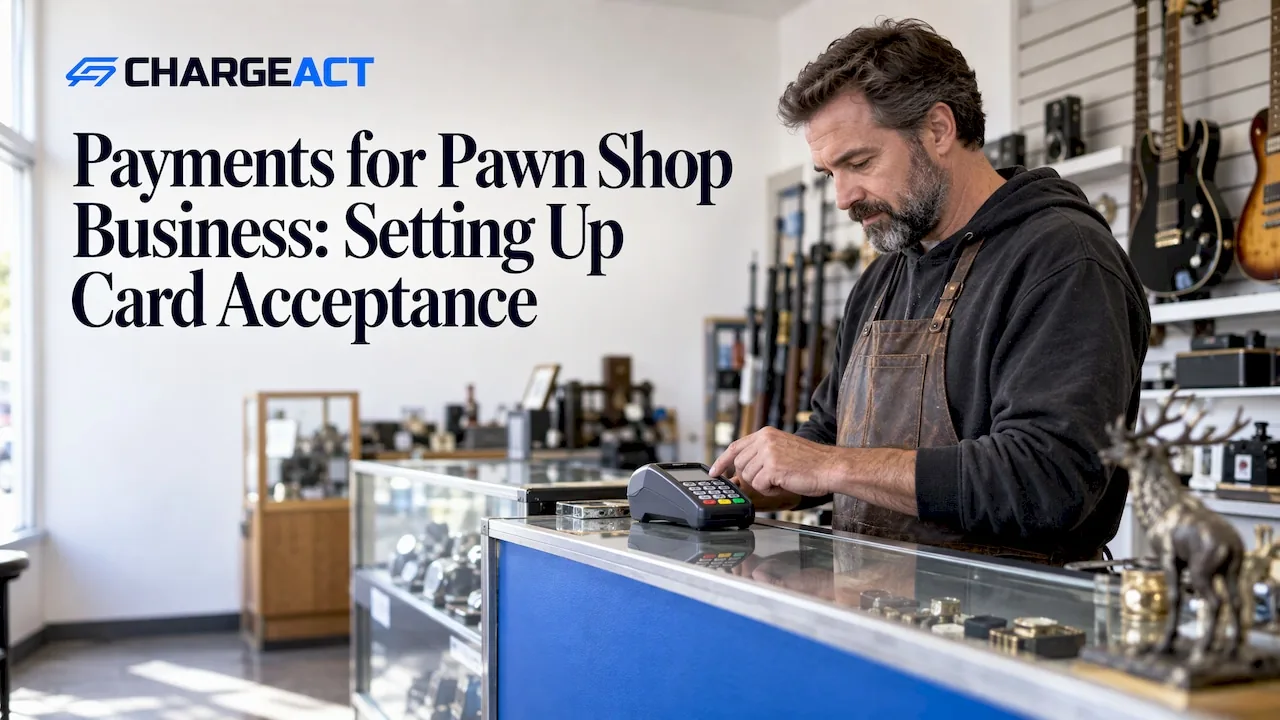
A pawn shop runs two businesses under one roof: a retail counter that sells jewelry, tools and electronics, and a lending desk that collects loan repayments, interest and redemption fees. Card networks, processors and underwriters treat those two kinds of money differently, and that is where pawn shops get into trouble. The stable setup is a merchant account underwritten around how your shop actually operates, with loan repayments and retail sales each handled the way the card rules expect. That is what we build at ChargeAct through merchant accounts and payment processing services matched to the real shape of a business, rather than a generic signup form.
TL;DR
- Retail sales and loan repayments are different transaction types. Visa's rules restrict using a credit card to repay a debt in the US, so how you code and accept repayments matters from day one.
- Processors that freeze funds or close accounts usually do so because the business did not match the profile it was approved under. Describe both sides of your shop accurately at application.
- Cash still dominates many pawn counters, so Form 8300 reporting for cash over $10,000 stays part of your payments routine.
- Phone payments, redemptions and layaways need a virtual terminal and clear card disclosures, not improvised workarounds.
- Pricing should be a quote built for your shop, with chargeback tools and a named account manager behind it.
Table of Contents
- Why pawn shop payments are not a standard retail setup
- Which payments a pawn shop actually takes
- The cash rule you cannot skip: Form 8300
- Surcharges, cash discounts and card disclosures
- State and federal rules that touch customer payments
- Fees, holds and chargebacks: what to plan for
- Choosing a processor that fits your pawn software
- How ChargeAct supports a pawn shop
- A practical setup checklist
- FAQ
- Sources
Why pawn shop payments are not a standard retail setup
A typical retailer sells an item and gets paid. A pawn shop does that and also lends against collateral, extends terms, collects interest and sometimes accepts partial payments to renew a loan. Each of those flows has its own risk profile.
Processors approve accounts based on what they believe you do. If the application says "retail" and the transactions look like repeat small payments tied to loans, the mismatch can trigger a review, a reserve or a freeze. Merchants who have been through a sudden payout hold on a general-purpose payment app know how quickly that cuts into working capital, and our guide on what to do when payouts are paused covers the recovery steps.
The fix is not complicated, but it has to happen before you process: be precise about the mix of sales and loan activity, and choose a provider that underwrites the business you really run. Our approach is personalized underwriting based on actual business operations, not just category labels.
Which payments a pawn shop actually takes
Think of the counter in four lanes, each with different mechanics.
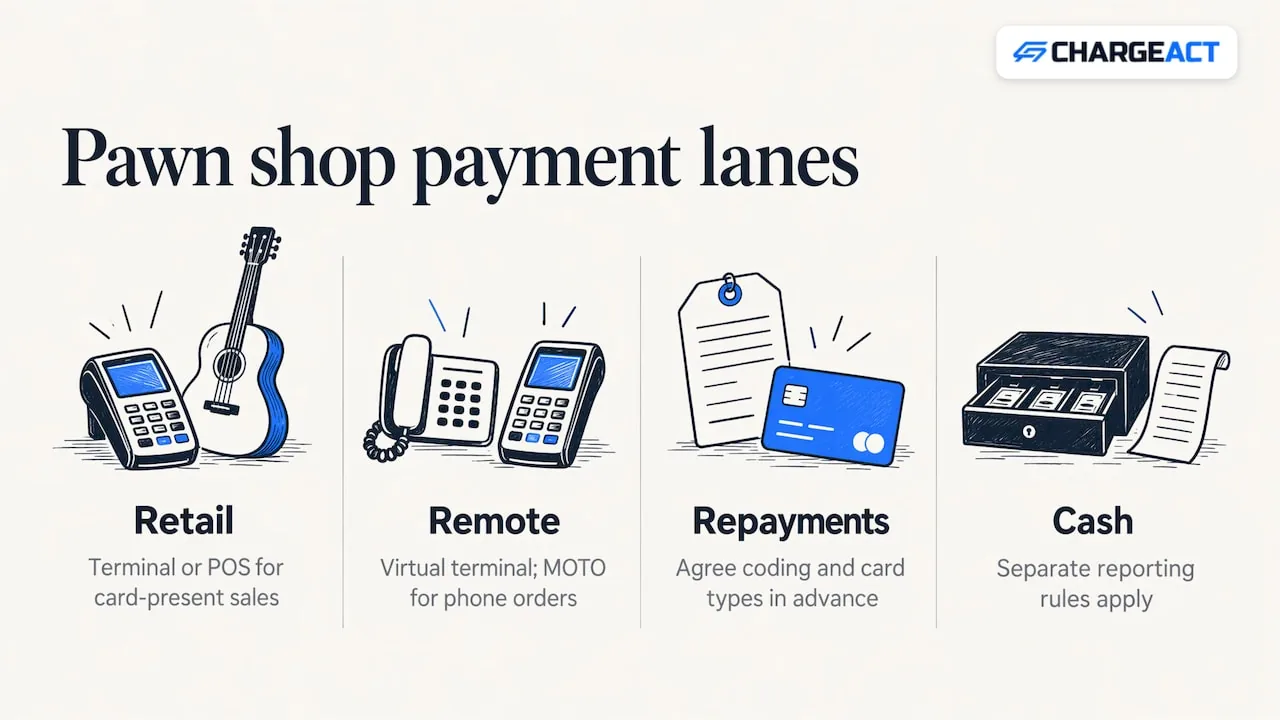
Retail sales in person. A customer buys a guitar or a ring. This is ordinary card-present processing through a terminal or POS. Our retail payments solutions cover card machines and POS for this lane, and mobile payments cover readers for events, flea markets or off-site buys.
Remote sales and layaway payments. Customers who phone in to pay on a held item need card-not-present acceptance. A virtual terminal handles that, and MOTO payment processing is built for exactly this mail-order and telephone-order pattern. If you sell online, gateway integration support connects your inventory site to the account.
Loan repayments, interest and fees. This is the lane that needs care. Visa's public Core Rules prohibit using a credit or charge card for debt repayment, with exceptions listed only for France and the United Kingdom. Debt-repayment transactions must carry a debt repayment indicator in the authorization and clearing record and use specific merchant category codes (6012, 6051 or 7322), and in the US the payment is completed as a purchase transaction. In practice, you should settle with your processor in advance how repayments will be coded and which card types you will accept for them, instead of running them as ordinary sales and hoping nobody looks.
Cash. Many customers still pay cash, particularly for loan redemptions. Cash has its own reporting rule, covered below.
The cash rule you cannot skip: Form 8300
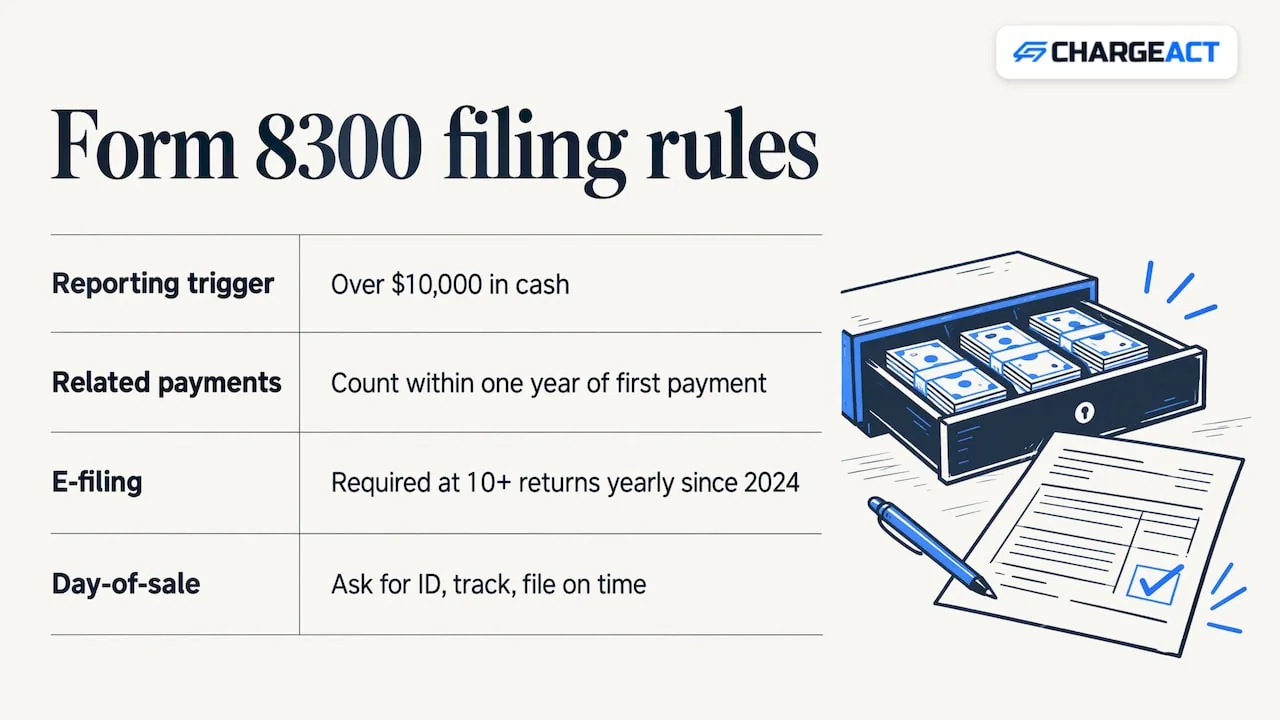
If your shop receives more than $10,000 in cash in a single transaction, or in related payments within a year, federal law requires you to report it. The IRS explains that trades and businesses file Form 8300 for cash payments over $10,000, including installments that push the total past that amount within one year of the first payment. A high-value watch or a large redemption can reach that level quickly.
Since January 1, 2024, businesses that file at least 10 information returns in a year must file Form 8300 electronically, and penalties for failure to file apply per return. A day-of-sale routine helps: ask for ID, track related payments, and file on time. A Form 8300 day-of-sale checklist written for vehicle dealers shows how a counter team can build that habit, and the same logic applies to a pawn counter handling large cash.
This is a compliance matter for your own accountant or attorney to confirm for your shop, and it is separate from card processing. It matters here because a clean, documented cash and card record also makes underwriting and account reviews easier.
Surcharges, cash discounts and card disclosures
If you price differently for cards, the rules are local and specific. New York City's Department of Consumer and Worker Protection, in its pawnbroker inspection checklist, says that when a pawnbroker charges extra for card purchases, the highest total card price must be displayed for each item. It also says a cash discount may not be advertised without the higher card price, and that card limitations, such as a minimum purchase amount, must be posted at or near each entrance and in all advertising that says cards are accepted.
Other states and cities have their own pawn and consumer-protection rules, so check your local licensing authority before you set any card pricing. Whatever you choose, post it plainly: clear signage and receipts reduce the disputes that later become chargebacks.
State and federal rules that touch customer payments
Pawn lending is regulated mostly at the state level. States set caps on charges and rules for redemption. New Mexico's Pawnbroking Act bill text, for example, caps the pawn service charge at 25% of the amount financed per 30-day period and gives the pledgor 30 days after maturity to redeem the goods. Your state will have its own numbers, and your licensing office is the place to confirm them.
Federal rules apply in narrower cases. The CFPB's 2017 rule on payday, vehicle title and certain high-cost installment loans, published in the Federal Register, includes a limit on attempting to withdraw payment after two consecutive failed attempts without new authorization. It applies to covered short-term loans, so whether it reaches any product you offer is a question for your attorney. If you ever pull repayments automatically from a customer's account, though, building a two-failed-attempts stop into your process is a sound habit either way.
The practical point for payments: your processor's underwriting team reads your business through these rules. A shop that can explain its licensing, its transaction mix and its repayment collection method is easier to underwrite than one that cannot.
Fees, holds and chargebacks: what to plan for
Three issues cause most of the pain for pawn shops, and all three are manageable when planned for.
Pricing structure. Interchange-plus pricing separates the card networks' own costs from the processor's markup, so you can see what you are paying for. We do not publish rates because the right quote depends on your ticket sizes, your card-present versus phone mix and your shop's profile. Ask our sales team for a quote for your specific business.
Reserves and held funds. Holds tend to appear when volume jumps, when average ticket size changes or when transactions do not match the application. High-ticket sales are normal at a pawn counter: a diamond ring or a gold chain is a large single swipe. Tell your processor about that pattern up front. Our model pairs each merchant with a dedicated account manager and a risk strategy designed to anticipate volume spikes, such as holiday jewelry sales, so a good month does not look like an anomaly.
Chargebacks. Resold goods carry dispute risk: "item not as described," lost-card fraud on expensive pieces, and disputes over layaways. Strong documentation is your defense: photos, receipts, signed terms, ID records and a clear return policy. Fraud protection and chargeback defense tools support this, and we offer backup placements so a single processing relationship does not become a single point of failure.
Choosing a processor that fits your pawn software
Most shops run pawn management software that tracks loans, pledged items, inventory and sales. Your payments should work alongside it, not force double entry. Before you sign, walk through these points:
- Account type. Confirm the processor underwrites shops that combine retail and lending, and that the account is approved for the transaction types you run. Approval depends on underwriting, and no provider can promise it in advance.
- Repayment handling. Ask how loan repayments will be coded and which card types are accepted for them, in light of the Visa debt-repayment rules above.
- Channels. In-store terminal or POS, a virtual terminal for phone payments, mobile readers for off-site work and an online gateway if you list items on the web.
- Integration. Check that your gateway or POS connects to your inventory and loan records. Our gateway integration support for ecommerce stores covers the online side.
- Funding and reserves. Understand settlement timing and any reserve terms in writing.
- Support. A named person who knows your shop is worth more than a ticket queue when a payout stalls.
How ChargeAct supports a pawn shop
We provide customized payment processing for merchants that general-purpose processors often decline or restrict: merchant accounts tailored to the risk profile, credit card processing, POS systems, MOTO and virtual terminal payments, mobile payments, digital wallets, fraud protection and chargeback defense. Each merchant gets a dedicated account manager, and our underwriting looks at how your business operates rather than relying on a category label.
If you want the whole stack in one place, start with our solutions overview, then talk to our sales team about a quote for your shop. We do not guarantee approval, which depends on underwriting, but we will give you a straight read on how your business fits.
Merchants in other regulated categories use the same playbook. Our guides on firearms card payments and firearms payment compliance show how a heavily scrutinized retailer documents its operations for a processor, and the lessons carry over to a pawn counter.
A practical setup checklist
Before applying, gather your state pawn license, a description of your retail and lending mix, average and maximum ticket sizes, expected monthly volume, your return and layaway policies, and a recent processing statement if you have one. Describe the loan side honestly, including how and when repayments are collected. Applications that match real activity are the ones that tend to stay stable afterward.
After go-live, review your statement monthly. Watch for rising dispute counts, unexplained holds and changes in average ticket. Raise anything unusual with your account manager early, since a conversation in week one costs less than a frozen payout in week six.
FAQ
Can a pawn shop accept credit cards for loan repayments?
Visa's rules prohibit using a credit or charge card to repay a debt in the US, with listed exceptions only in France and the United Kingdom. Debt-repayment transactions also carry a specific indicator and merchant category codes. Confirm with your processor how repayments are set up and which card types are allowed before you take them.
Do pawn shops need a special merchant account?
Many shops do better with an account underwritten for their combination of retail sales and lending, because a standard retail profile may not match what the transactions show. Approval depends on underwriting and cannot be promised in advance. Our team can discuss how your shop fits.
How do pawn shops take payments over the phone?
They use a virtual terminal with card-not-present processing, often called MOTO. It lets staff key in a card for a layaway payment or a held item. Pair it with fraud tools and written terms so the sale is documented if a dispute arises.
What cash payments must a pawn shop report?
Cash received in a trade or business totaling more than $10,000 in one transaction or related payments within a year is reportable on IRS Form 8300. Ask your accountant how it applies to your shop.
How do I get a quote for my pawn shop?
Rates depend on your ticket sizes, channel mix and business profile, so we quote each business individually. Contact our sales team through chargeact.com to get pricing for your shop.
Sources
- Visa Core Rules and Visa Product and Service Rules
- IRS Form 8300 reference guide
- NYC DCWP Inspection Checklist: Pawnbrokers
- New Mexico Pawnbroking Act bill text, HB0300
- CFPB final rule, Federal Register, November 17, 2017
Recommended
How it works
Call us
Tell us where things stand today - your current processor, your rates, and what's not working.
We review where you stand
A real underwriter looks at your statements and account history - no black-box scoring.
You hear what's possible
We lay out your options in plain terms, including what we can and can't do for your business.
Why ChargeAct
We underwrite the businesses others decline
High-risk isn't a dirty word to us - it's the merchant category we specialize in every day.
A human reviews your account, not just an algorithm
Statements get read by people who understand your industry, not auto-rejected by a risk score.
A dedicated manager who knows your account
When something comes up, you call a person who already knows your business - not a queue.
Stop guessing what your processor will do next.
Talk to a real underwriter about where your business stands - no obligation, no runaround.
(888) 329-5717