Firearms Card Payments: How Gun Merchants Get Paid
How card payments work for gun stores and FFL ecommerce sellers: merchant category codes, marketplace rules, account stability, and what to look for in a processor.
A firearms business can accept card payments in store, by phone and online, but only through a merchant account underwritten for the business it actually runs. Consumer payment apps and general-purpose checkout tools are built for low-risk sellers and often fail gun retailers. The practical path is a processor that treats firearms as a known category, assigns the right classification, and keeps a backup in place. At ChargeAct, we build high-risk merchant accounts around a merchant's real operations, and every merchant gets a dedicated account manager.
This guide explains how firearm card payments move, how purchases are classified, what marketplaces require of sellers, and how to protect your revenue from the freezes and terminations that hit gun merchants hardest.
TL;DR
- Firearms sellers need their own merchant account with a processor that accepts the category. Peer-to-peer apps and wallets are not a payment method for gun sales.
- Your merchant category code (MCC) is assigned through your acquiring bank, and it shapes how card networks and banks see your transactions.
- Marketplaces set their own payment rules, including how debit cards and surcharges are handled.
- Stability comes from honest underwriting, clean documentation, fraud controls and a backup placement, not from the lowest advertised price.
- Rates and reserves depend on your business profile, so request a quote from a sales representative rather than relying on published ranges.
Table of Contents
- How card payments for firearms actually work
- Why gun businesses lose processing
- Merchant category codes and firearm purchases
- Selling through marketplaces: what the payment rules say
- What underwriters look at
- Fees, reserves and contract terms: what to ask about
- Keeping the account stable once it is live
- Card-present, phone and online: set up each channel properly
- When to switch processors
- How we help firearms merchants
- FAQ
- Sources
How card payments for firearms actually work
A card sale involves several parties. The customer's issuing bank approves the purchase, the card network routes it, and your acquiring bank, working through a processor and a gateway, settles the funds to you. Your merchant account is the agreement with the acquirer that allows this to happen.
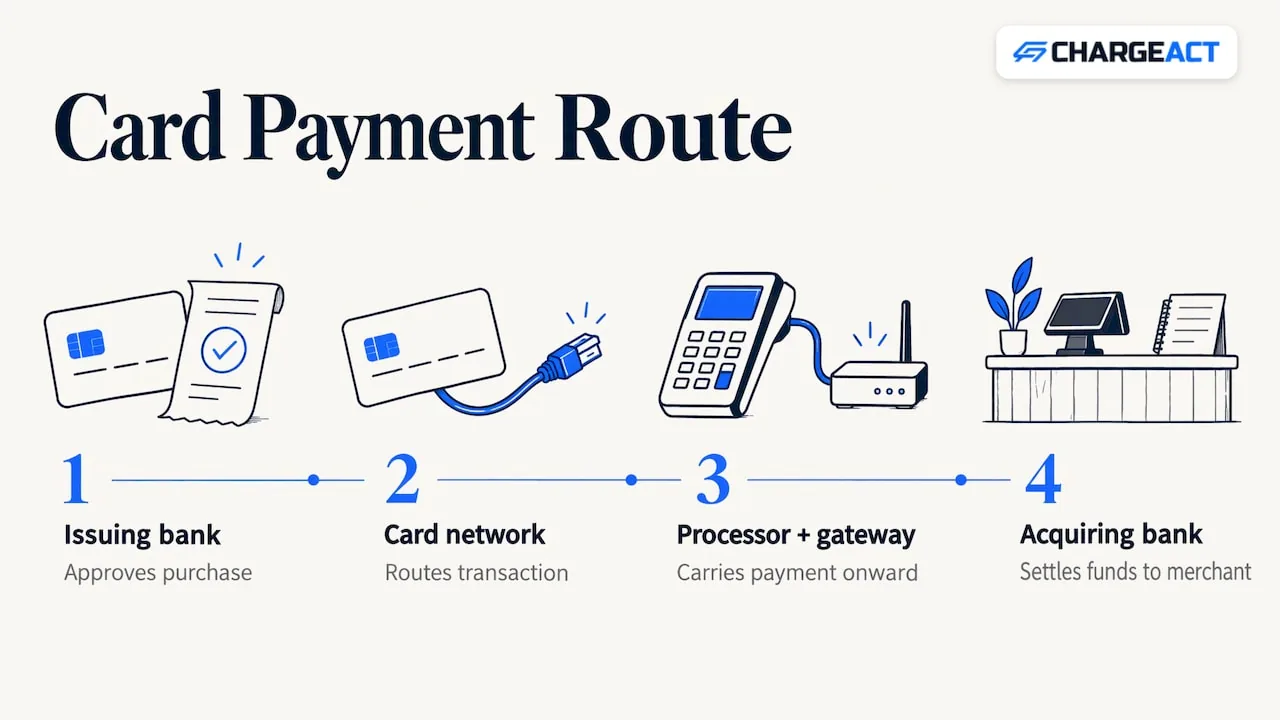
For a gun store, that chain looks the same as for any retailer, with one difference: each party along the way decides whether it is willing to carry firearms volume. Many general processors and payment apps are not. When they discover a firearms business after onboarding, the typical result is a frozen balance, a held reserve or a closed account, often with little warning. That is the pattern behind the many merchants searching for a stable option after being dropped by a mainstream provider.
The fix is to start with a provider that underwrites firearms deliberately. In-person sales run through a terminal or POS system. Phone and mail orders run through a virtual terminal, which is a secure web page where staff key in card details. Online sales run through a gateway connected to your store. We support each of these: retail payments, MOTO payments for phone and mail orders, and gateway integration support for ecommerce stores, all under one high-risk merchant account.
Why gun businesses lose processing
Banks and processors group firearms with other categories they consider higher risk, so the business is often reviewed more closely than a typical retailer. Our guide to what makes a merchant high risk covers the general factors: industry, chargeback exposure, ticket size, sales channel and processing history.
For firearms specifically, trouble usually shows up in three ways:
- Misclassification. A gun seller set up as a general sporting goods merchant looks like a mismatch the moment the underwriter reviews real products. The account may be closed even though the business did nothing wrong.
- Platform policy. Payment apps and all-in-one checkout tools publish prohibited-business lists, and a firearms seller who signed up under a vague description can be removed when the policy is applied.
- Volume spikes. A seasonal rush, a restock announcement or a large order can look like unusual activity to a processor that does not know your business, which is when funds get held.
None of this is a reason to avoid card payments. It is a reason to be upfront with the underwriting team and to choose a processor whose model anticipates these events instead of reacting to them.
Merchant category codes and firearm purchases
Every card merchant is tagged with a four-digit merchant category code. According to the California Department of Justice, these codes classify a business for purposes that include interchange rates and transaction-risk assessment, and before a firearm-specific code existed, gun and ammunition retailers could be filed under miscellaneous or sporting goods categories.
A dedicated code for firearms retailers was approved in 2022. The New Jersey Attorney General described its purpose as helping financial institutions detect and report suspicious activity tied to firearm and ammunition purchases at standalone gun stores.
Who assigns the code to your business? The National Shooting Sports Foundation explains in its April 2025 fact sheet that MCCs are assigned to merchants by their acquiring bank, and that a merchant selling firearms may be categorized as sporting goods, durable goods or general merchandise depending on the business.
What this means for you in practice:
- The code on your account is a product of your application and your acquirer's decision, so the description of your business needs to be accurate and consistent across your application, website and statements.
- A mismatch between the code and what you really sell is a common trigger for later review.
- Several states have passed their own laws about firearms codes. Ohio's statute, for example, defines a firearms code and separately addresses how financial institutions may treat it. State rules differ and change, so confirm how they apply to your business with your own attorney.
Selling through marketplaces: what the payment rules say
If you sell through an online gun marketplace, the platform sets payment rules on top of your processor's. GunBroker's seller policy is a clear example. According to its accepted payment method policy, sellers need their own merchant bank account and payment processing service to accept credit cards. The policy requires sellers to either block debit and prepaid cards before authorization or accept them with no surcharge. It also names peer-to-peer services and wallets, including PayPal, Zelle, Venmo, Cash App, Apple Pay and Google Pay, as prohibited for firearm transactions, and payments made that way are not eligible for Buyer's Protection.
The same page is specific about debit. A debit card stays a debit card when the customer picks "credit" or skips the PIN, and relabeling a surcharge as a processing, handling or convenience fee does not change that.
The takeaway is that your processing setup has to be configured to the marketplace's rules from day one. That means a gateway or terminal that can distinguish card types, a checkout that does not add fees where they are not allowed, and a merchant account that is already approved for firearms rather than one that will be questioned after your first large sale.
What underwriters look at
Underwriting is where firearms merchants most often get stuck, so it pays to prepare. Typical review areas include the nature of your business (retail storefront, FFL transfer services, online sales or all three), the products you sell, your sales channels, your processing history, your refund and chargeback history, and how you fulfill orders. We list the document categories in Firearms Merchant Account Requirements: What Underwriters Ask For.
A few habits make the application cleaner:
- Describe the business as it is. If you sell firearms, accessories and ammunition, say so, and make your website match.
- Keep your policies visible: shipping, returns, transfer procedures and customer service contacts.
- Make sure the business name on your site, your application and your bank account line up.
- Explain seasonality. If hunting season or a product launch doubles your volume, tell the underwriter before it happens.
Our approach is personalized underwriting based on how your business actually operates, not just the category label. We cannot promise any application will be approved, but a complete and accurate file is the strongest position you can be in.
Fees, reserves and contract terms: what to ask about
Published fee ranges for firearms processing vary widely, and most of them describe other businesses' pricing, not yours. Your cost depends on your sales channel, average ticket, card mix, chargeback history and how your account is structured. For that reason we do not publish rates. A sales representative will quote your specific business.
What matters more than any single number is understanding the structure of the quote. When you review a proposal, check these points:
- Pricing model. Interchange-plus pricing separates the card network's cost from the processor's markup, which makes the markup visible. We use transparent interchange-plus pricing aligned to volume.
- Reserves and holds. Ask whether a reserve applies, how it is sized, when it is released and what triggers a hold.
- Setup and recurring fees. Merchant accounts carry setup fees and ongoing processing fees. Ask for every line item in writing.
- Term and exit. Know the contract length and what happens if you want to move.
- Chargeback handling. Learn what tools exist to respond to disputes and who manages them.
High reserves and held funds are among the most common complaints from merchants who come to us after leaving general processors. Raising these questions upfront is how you avoid a repeat. Our guide to high-risk credit card processing goes deeper on how these terms work.
Keeping the account stable once it is live
Getting approved is half the work. Staying live depends on daily operations.
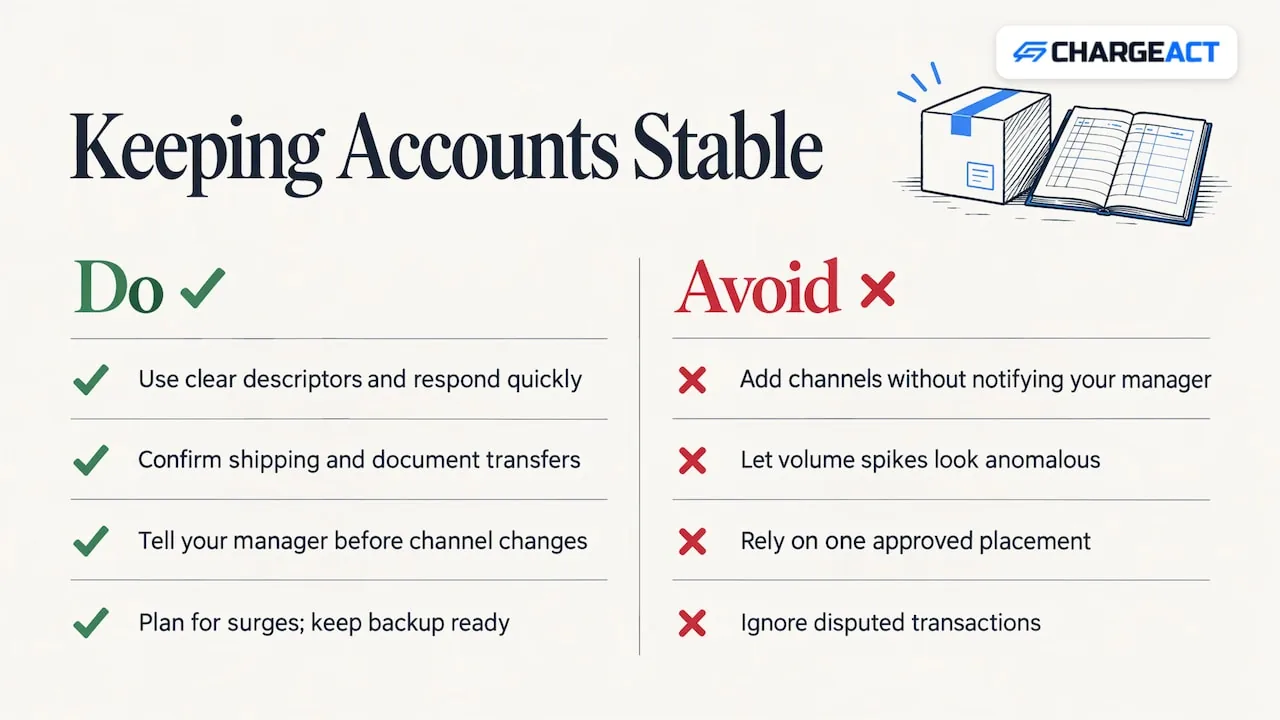
Watch chargebacks. A chargeback is a forced reversal of a sale after the cardholder disputes it. Firearms sales are high-ticket, so each one stings. Clear descriptors, prompt shipping confirmation, a documented transfer process and fast customer service all reduce disputes, and our chargeback defense and fraud protection tools are there for the ones that still arrive. For a broader view of controls, see our layered ecommerce fraud prevention playbook.
Keep processing consistent with your application. If you add product lines, a second storefront or a new sales channel, tell your account manager first. Surprises, not growth, are what cause freezes.
Plan for spikes. Sales events, new inventory and seasonal demand can multiply volume in days. A dedicated account manager who knows your calendar can flag expected surges so they do not look like anomalies.
Hold a backup placement. Even a well-run firearms business can be affected by a bank's policy change. A backup placement means a second approved path is ready if the primary one is interrupted. Backup placements are part of what we build for merchants in industries traditional processors decline, so revenue does not stop while a problem is resolved.
Card-present, phone and online: set up each channel properly
At the counter. A countertop terminal or POS system handles most gun store sales. Chip and tap payments are quick, and an integrated POS ties payments to inventory. Our credit card processing for small business and POS offerings cover this setup.
By phone. Many shops take deposits and complete sales by phone. A virtual terminal supports mail order and telephone order sales while keeping card data out of your notes and email. Because card-not-present sales carry more fraud exposure, your processor should give you address and security-code checks and other screening.
Online. Ecommerce firearms sellers, including FFL-based shops that ship to a licensed dealer, connect a gateway to their storefront. The gateway has to be one your acquirer approves for the business. Switching processors after launch often means rebuilding checkout, so settle the question before development, not after.
On the move. Gun shows, range events and mobile sales call for card readers that run on the same merchant account, so every sale appears in one place. See our mobile payments page.
When to switch processors
If any of these describe your situation, a move is worth planning now rather than after the next hold:
- Your processor has frozen funds, applied a rolling reserve or sent a termination notice.
- You are running on a payment app or general checkout that lists firearms among restricted businesses.
- Your account is classified as a business you are not.
- You have one processor and no fallback.
- You are about to scale, add an online store or take on larger tickets.
In each case the safest order of operations is to apply for the new account before closing the old one, so sales continue through the handover.
How we help firearms merchants
ChargeAct provides merchant accounts tailored to the risk profile of firearms businesses, with credit card processing, online and retail payments, MOTO, fraud protection, chargeback defense, gateway integration support and backup placements. Each merchant works with a dedicated account manager who builds a payment strategy around spikes in volume and regulatory shifts.
If you are ready to set up or move an account, start with our high-risk merchant account page or the full list of solutions. Approval is determined by underwriting and is never guaranteed, and pricing is quoted by a sales representative for your specific business.
FAQ
Can a gun store accept regular credit card payments?
Yes, with a merchant account from a processor that accepts firearms businesses. The sale itself runs on the same card networks as any retail purchase. What differs is underwriting and how your account is classified.
Can I use a payment app or digital wallet to sell firearms?
Usually not as your main method. Marketplaces such as GunBroker prohibit peer-to-peer services and wallets for firearm transactions, and general payment apps often restrict the category. A dedicated merchant account is the dependable route.
Why do firearms merchants get frozen or dropped?
The most common causes are misclassification, platform policies that exclude the category, and sudden volume changes the processor did not expect. Accurate underwriting, open communication about growth and a backup placement reduce the risk.
What will processing cost my firearms business?
It depends on your sales channel, ticket size, card mix and processing history, so there is no single figure that fits every shop. Contact our sales team for a quote built on your specific business.
Sources
- Sellers - Accepted Payment Method Options, GunBroker
- Attorney General Bonta: Credit Card Codes for Firearms, California Department of Justice
- AG Platkin Leads Multistate Support for a New Merchant Code, New Jersey Office of the Attorney General
- Second Amendment Privacy Act fact sheet, National Shooting Sports Foundation
- Ohio Revised Code section 1349.84
- Ohio Revised Code section 1349.85
Recommended
How it works
Call us
Tell us where things stand today - your current processor, your rates, and what's not working.
We review where you stand
A real underwriter looks at your statements and account history - no black-box scoring.
You hear what's possible
We lay out your options in plain terms, including what we can and can't do for your business.
Why ChargeAct
We underwrite the businesses others decline
High-risk isn't a dirty word to us - it's the merchant category we specialize in every day.
A human reviews your account, not just an algorithm
Statements get read by people who understand your industry, not auto-rejected by a risk score.
A dedicated manager who knows your account
When something comes up, you call a person who already knows your business - not a queue.
Stop guessing what your processor will do next.
Talk to a real underwriter about where your business stands - no obligation, no runaround.
(888) 329-5717