Firearms Merchant Account Requirements: What Underwriters Ask For
What a firearms merchant account application needs: your FFL, business file, sales channels and account terms to check, so your processing stays stable.
A firearms merchant account application comes down to three things: a current Federal Firearms License (FFL) that matches your business, a complete and consistent business file, and a clear description of how you take payments, in the store, online or by phone. Get those right and you give an underwriter, the person who reviews your application for the processing bank, what they need to evaluate your actual operation. At ChargeAct, we work with firearms dealers and FFL ecommerce merchants through payment processing built for firearms dealers, and we pair every merchant with a dedicated account manager so the file is prepared around how the business really runs.
This guide is for gun shops, FFL dealers, online ammo and accessory retailers, and merchants who were dropped or frozen by a general-purpose processor and need to rebuild a stable setup. No provider can promise approval, and this article does not. It shows what the review looks for so you apply with a file that stands up.
TL;DR
- Underwriters start with your FFL, so the license type, name, address and status must match every other document you submit.
- Expect to describe your products, sales channels (in person, online, phone), average ticket and how shipping or transfers work.
- Consistency matters: the same legal name, address and owners across your license, bank records, website and application.
- Before signing, read the terms on reserves, funding timing, transaction limits, fees and termination, and get a quote for your specific business.
- If a processor already froze or dropped you, gather the notices and records before you reapply.
Table of Contents
- Why firearms merchants get a different review
- Requirement 1: a current FFL that fits your business
- Requirement 2: the business file
- Requirement 3: how you take payments
- Requirement 4: volume, ticket size and growth
- What to check in the agreement before you sign
- Practices that put an account at risk
- If a processor already froze or dropped you
- Where ChargeAct fits
- FAQ
- Sources
Why firearms merchants get a different review
Processors sort merchants into risk tiers. Firearms land in the higher tier for reasons that have little to do with whether you run a clean shop: card-not-present sales, high-ticket orders, deposits and layaways, and the way some banks and card programs write policy around the category. General-purpose payment platforms often apply those policies automatically, which is how a legitimate dealer ends up with a frozen balance after a good month.
That is the practical meaning of "high risk" in your world: not a verdict on your business, but a signal that the account needs underwriting by people who read the whole file. If you want the fundamentals first, our explainer on what a high risk merchant is covers the classification in plain terms.
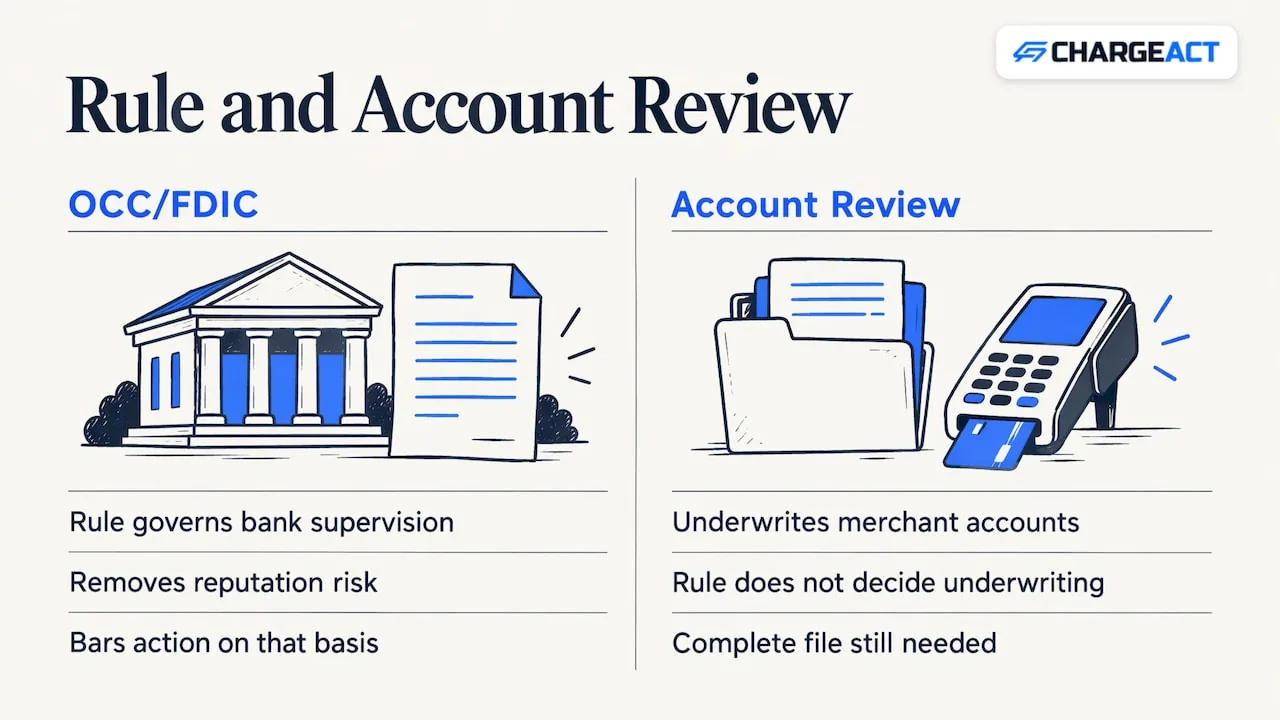
One development is worth knowing. On April 7, 2026, the OCC and FDIC issued a final rule that removes reputation risk from their supervisory programs and bars those agencies from criticizing or taking adverse action against an institution on that basis. The agencies also cited Executive Order 14331, "Guaranteeing Fair Banking for All Americans," as the concern behind the rule. It governs how those two regulators supervise banks. It does not decide how any particular processor or sponsor bank underwrites your account, so you still need a complete file.
Requirement 1: a current FFL that fits your business
The FFL is the anchor document. Underwriters read it to confirm who you are, what you are licensed to do and where. A few facts from the ATF's Application for Federal Firearms License (Form 7/7CR, revised June 2025) shape what your license says about you:
- License type. Type 01 is a dealer in firearms other than destructive devices, with a $200 application fee. Type 07 is a manufacturer of firearms other than destructive devices, at $150. Licenses are issued for a 3-year period.
- Collector licenses are not business licenses. The ATF instructions state that a Type 03 Collector of Curios and Relics license is not a license to conduct business. If you intend to sell as a business, the license on file should be one other than Type 03.
- Premises address. The business address on the application cannot be a P.O. Box, so the physical premises on your license is the address underwriters will expect to see everywhere else.
- Responsible persons. The application requires fingerprint cards and 2x2 photographs for each responsible person (except Type 03-only applicants), and missing items delay processing and can lead to denial.
What this means for your merchant application: if your license says one entity name and your website, bank account and application say another, expect questions. Track your license expiration date too. Letting it lapse while processing is live creates exactly the kind of mismatch that gets accounts reviewed.
Requirement 2: the business file
Processors vary in what they request, but the core package is predictable. Prepare it before you apply, not during the back-and-forth.
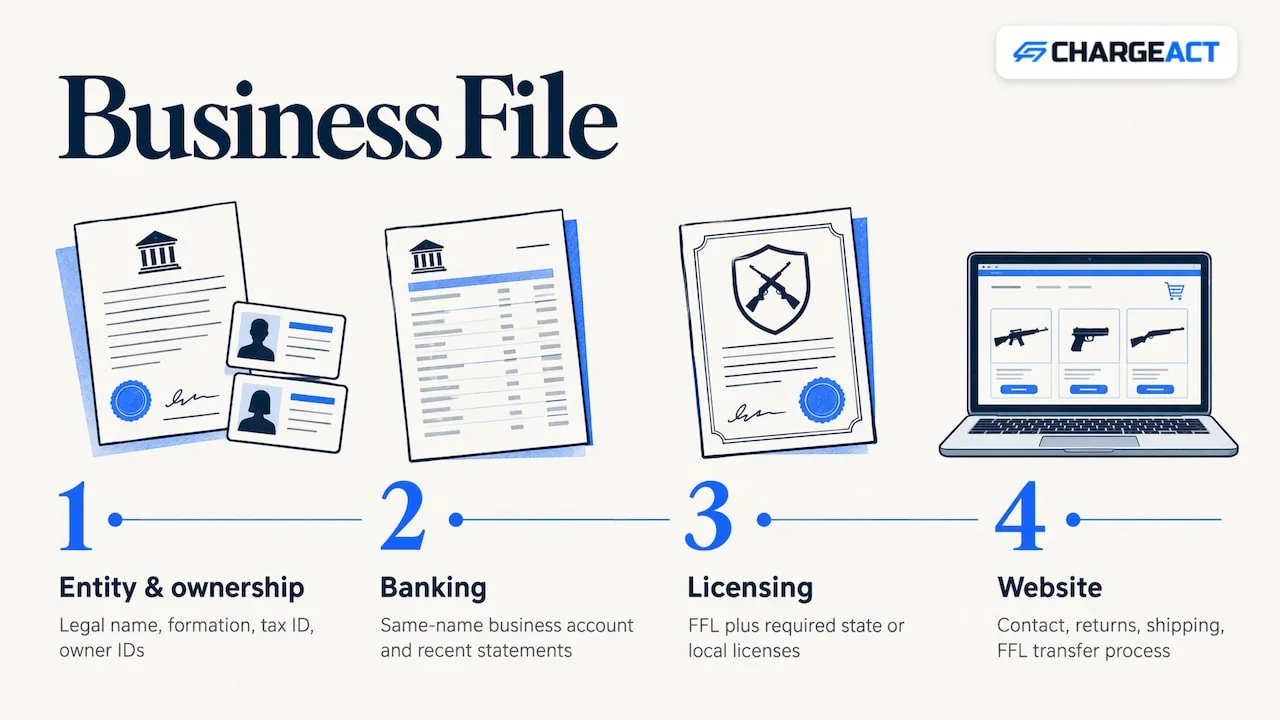
First, entity and ownership records: your legal business name, formation documents, tax ID and a list of owners, with identification for each principal. Second, banking: a business bank account in the same legal name, plus recent statements. Third, your licensing: a copy of the FFL, plus any state or local licenses your location requires. Fourth, your website, if you sell online: clear contact details, a refund and return policy, shipping terms and how FFL transfers work.
The discipline here is consistency. Every document should show the same legal name, address and owners. Small differences, such as a DBA on the website that appears nowhere in your filings, are the kind of thing that slows a review. A good account manager catches these before submission, which is one reason we assign a dedicated manager to each merchant rather than leaving the file to a queue.
Requirement 3: how you take payments
This is where firearms underwriting is most specific. The same FFL can describe very different payment profiles, and a personalized review looks at what you actually do rather than just the category label.
In-store sales
Card-present counter sales are the simplest profile. You will be asked about average ticket, the mix of firearms versus accessories and ammunition, and how you handle returns. If you run a retail counter, our retail payments and POS options are built for that environment.
Online and card-not-present sales
Online orders add a layer of questions: what you list, whether firearms are sold for shipment to an FFL, how a customer's identity and eligibility are checked, and how you describe the process on the site. Under 27 CFR § 478.124, a licensed dealer generally must record a transfer to a nonlicensee on ATF Form 4473, which includes the transferee's identifying details and certifications about prohibited possession. Your site should describe your transfer process clearly, because underwriters read the site to confirm the business model matches the application.
If you take payments through an ecommerce store, gateway compatibility matters from day one. We offer gateway integration support for ecommerce stores so the checkout, the descriptor and the account are set up to match each other.
Phone orders, deposits and layaways
Many dealers take orders by phone, hold deposits on special orders, or run layaway plans. Each is a different transaction type and should be disclosed rather than discovered later. Our MOTO payment processing handles mail and telephone orders, and a virtual terminal is the usual way to key them in. Describe deposit and refund handling in writing: it is the kind of detail that prevents disputes later.
Requirement 4: volume, ticket size and growth
Underwriters want a realistic picture of what will move through the account: expected monthly processing, average and highest ticket, and seasonal spikes. Firearms retail has them: hunting season, holiday gifting, and demand swings tied to news cycles. Telling your processor about these in advance matters more than any single number, because a sudden jump that was never disclosed is a common trigger for a hold.
This is the core of our approach to risk: our account managers build a payment strategy that anticipates spikes in volume rather than reacting after funds are held. Share your last several months of processing history if you have it, and a plain explanation of any unusual months.
What to check in the agreement before you sign
Approval is only half of stability. The agreement decides what happens when something goes wrong. Read these terms line by line:
- Reserves. Does the processor hold a portion of funds or a fixed amount, for how long, and under what conditions is it released?
- Funding schedule. How many days between a sale and the deposit, and can that change?
- Transaction limits. What are the monthly and per-ticket caps, and what is the process to raise them as you grow?
- Pricing structure. Is pricing transparent, with the processor's markup separate from card network costs? We use interchange-plus pricing, which keeps those parts visible. Rates depend on your business, so ask our sales team for a quote for your specific operation.
- Termination and notice. What notice is given before closure, and what fees apply?
- Backup options. Can a secondary processing path be put in place so a problem on one account does not stop your sales? Backup placements are part of how we design stability.
Practices that put an account at risk
Most closures trace back to a short list of causes. Mismatched business details, undisclosed sales channels, vague refund policies, unexplained volume jumps and rising disputes all draw attention. Disputes deserve special care. A rising chargeback ratio is among the quickest ways to lose processing, so documentation of each sale, clear descriptors and fast responses matter. Our fraud protection and chargeback defense tools are there to catch problems early and help you respond to disputes.
Some flags are quieter than a dispute. We cover them in the signals that get you silently flagged, and it is worth reading before you apply.
If a processor already froze or dropped you
A freeze from a general-purpose platform is stressful, but it does not have to define your next application. Collect the termination or hold notice, your account statements, your processing history and any correspondence. Be ready to explain in a few plain sentences what happened and what has changed. Then apply with a complete file for a provider that works with firearms merchants. Our guide to seven things to know about high risk processing explains how the process differs from standard accounts.
Where ChargeAct fits
We build merchant accounts around the way your firearms business actually operates, not only its category. That means personalized underwriting based on your real operations, a dedicated account manager, customized risk management, backup placements and transparent pricing aligned to your volume. You can see how our high risk merchant accounts work, or start from our main site and talk with our team about your specific setup. Every application is reviewed individually, and we cannot guarantee approval.
FAQ
Do I need an FFL to get a firearms merchant account?
If you sell firearms as a business, the FFL is the document underwriters expect to see first. The ATF notes that a Type 03 Collector license is not a license to conduct business, so the license on file should match your activity. Other documents, such as entity records and bank statements, accompany it.
How long does the FFL itself last?
Per the ATF's June 2025 application form, licenses are issued for a 3-year period. Keep track of your expiration date so your merchant file never shows a lapsed license.
Can I sell firearms online and take cards?
Many dealers do, with the account set up for card-not-present sales. You will describe how orders ship to an FFL and how the transfer is handled, and your website should explain the same process. Your account manager can help align the application and the site.
What should I ask about rates?
Rates depend on your business, so request a quote for your specific operation from our sales team. Ask also about reserves, funding timing and transaction limits, since those shape your cash flow as much as pricing does.
Sources
- Application for Federal Firearms License, ATF Form 7/7CR (June 2025)
- 27 CFR § 478.124, Firearms transaction record
- OCC and FDIC final rule on reputation risk, FDIC press release (April 7, 2026)
- OCC news release on the reputation risk final rule (2026)
Recommended
How it works
Call us
Tell us where things stand today - your current processor, your rates, and what's not working.
We review where you stand
A real underwriter looks at your statements and account history - no black-box scoring.
You hear what's possible
We lay out your options in plain terms, including what we can and can't do for your business.
Why ChargeAct
We underwrite the businesses others decline
High-risk isn't a dirty word to us - it's the merchant category we specialize in every day.
A human reviews your account, not just an algorithm
Statements get read by people who understand your industry, not auto-rejected by a risk score.
A dedicated manager who knows your account
When something comes up, you call a person who already knows your business - not a queue.
Stop guessing what your processor will do next.
Talk to a real underwriter about where your business stands - no obligation, no runaround.
(888) 329-5717