Hemp: Legal Definition, Uses and the 2026 Federal Change
What hemp is, how it differs from marijuana and CBD, what it is used for, and what the November 12, 2026 federal definition change means for hemp sellers.
Hemp is Cannabis sativa L. that stays under a legal THC limit, and it is grown for fiber, seed, oil and cannabinoid extracts. In the United States that limit is changing: the federal definition moves to a total THC standard on November 12, 2026. If you grow, make or sell hemp products online, the new definition touches your catalog, your compliance file and the payment setup that keeps revenue flowing. A processor that underwrites your actual operations, not just a category label, is part of staying stable through the change, and that is the approach we take with hemp and CBD merchants at ChargeAct.
TL;DR
- Hemp is Cannabis sativa L. with no more than 0.3% THC under the current federal definition; above that, the plant is treated as marijuana.
- Hemp and marijuana are the same species, distinguished by chemistry. CBD is one cannabinoid, while hemp is the whole plant and everything made from it.
- Hemp feeds into rope, textiles, paper, building materials, food, body care and cannabinoid products.
- From November 12, 2026, the federal definition counts total THC and excludes certain finished cannabinoid products, so sellers should review their catalogs now.
- Merchants selling hemp-derived products need a payment setup built for regulatory shifts, volume spikes and chargebacks.
Table of Contents
- What hemp is under federal law
- How hemp differs from marijuana
- Hemp versus CBD
- What hemp is used for
- The November 12, 2026 definition change
- What the change means for hemp merchants and their payments
- Payment processing built for hemp sellers
- Hemp benefits and how to think about them
- FAQ
- Sources
What hemp is under federal law
The USDA Agricultural Marketing Service FAQ defines hemp as Cannabis sativa L. and any part of that plant, including seeds and all derivatives, extracts, cannabinoids, isomers, acids and salts, with a THC concentration of no more than 0.3 percent. If the plant contains more than 0.3% THC, it is considered marijuana.
The line between the two was drawn by the Agricultural Improvement Act of 2018. According to the DEA Diversion Control Division, that law decontrolled hemp when it was signed on December 20, 2018, by excluding hemp from the Controlled Substances Act definition of marijuana.
Two practical points follow for anyone in the business.
First, the definition covers the plant and its derivatives, so the 0.3% test is a compliance question about the material, not about a brand or a product name. Second, federal law is a floor, not the whole picture. The federal hemp production regulation says it does not preempt state or tribal laws that regulate hemp production more strictly. A state can run its own hemp program, and the rules for growing, testing and selling differ by state.
Federal production rules are also specific. The same regulation requires that samples for total delta-9 THC testing be collected within 30 days before anticipated harvest, by a sampling agent rather than by the producer. Growers plan their harvest calendar around that requirement.
How hemp differs from marijuana
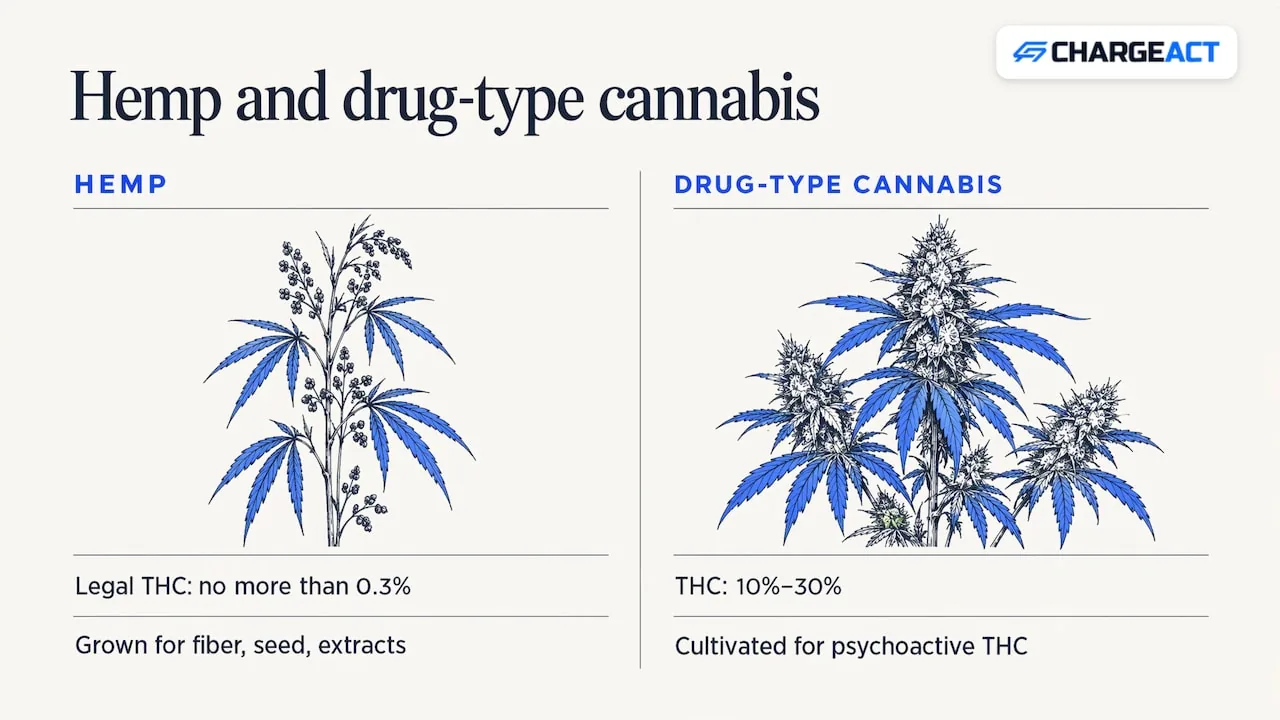
They are not different species. The Pennsylvania Department of Agriculture explains that hemp and marijuana are different varieties of Cannabis sativa. Marijuana is cultivated for the psychoactive chemical delta-9 tetrahydrocannabinol (THC), while hemp is cultivated for fiber, seed and floral extracts.
The University of Wisconsin Extension puts numbers on the gap: hemp is legally cannabis containing not more than 0.3% THC, while drug-type cannabis has been bred to produce THC in the range of 10 to 30 percent. The National Center for Complementary and Integrative Health adds that the cannabis plant contains about 540 chemical substances, and that under U.S. law plants with very little THC are considered industrial hemp rather than marijuana.
For a merchant, the useful takeaway is that the legal difference is a measurement. That makes documentation, such as test results and certificates of analysis, the backbone of any hemp business, and it is the same documentation a payment underwriter will want to understand.
Hemp versus CBD
People search for "hemp" and "CBD" almost interchangeably, but they are not the same thing. Hemp is the plant and everything derived from it. CBD (cannabidiol) is one cannabinoid among the many found in it. The Pennsylvania Department of Agriculture notes that cannabinoids such as CBD are concentrated in the female flower and that CBD does not have the psychoactive effects of THC.
Hemp seed is a separate category. In testimony to Congress, the FDA said that in late 2018 it advanced three hemp seed derived food products through its Generally Recognized as Safe process: hulled hemp seed, hemp seed protein powder and hemp seed oil. It also said hemp seeds do not naturally contain CBD or THC.
That split matters for a store. A shop selling hemp seed hearts, rope and body care sits in a different position from a brand selling cannabinoid tinctures, gummies or vapes, even though all of it may be called hemp. Payment risk, chargeback exposure and card-network scrutiny differ along the same lines, which is why hemp sellers are best served by a processor that reads the product mix rather than the headline label. Our CBD and hemp payment processing page covers how we approach that segment, and our guide to getting a CBD merchant account approved and keeping it live walks through the application side.
What hemp is used for
The University of Wisconsin Extension groups hemp uses by plant part. Seeds (grain) are processed into hemp hearts and used in foods such as granola and hemp milk. Hempseed oil is used in cooking oil, dietary supplements, personal hygiene products, paints, solvents and lubricants. Stalks are harvested for fiber used in hundreds of products, including rope, paper, construction materials, carpeting, textiles, insulation, animal bedding and bioplastics. That answers the common question about rope hemp: it is the fiber from the stalk.
The Pennsylvania Department of Agriculture sorts the same range into three product families: fibrous stem products, seed products and floral or foliar products, which include cannabinoid extracts.
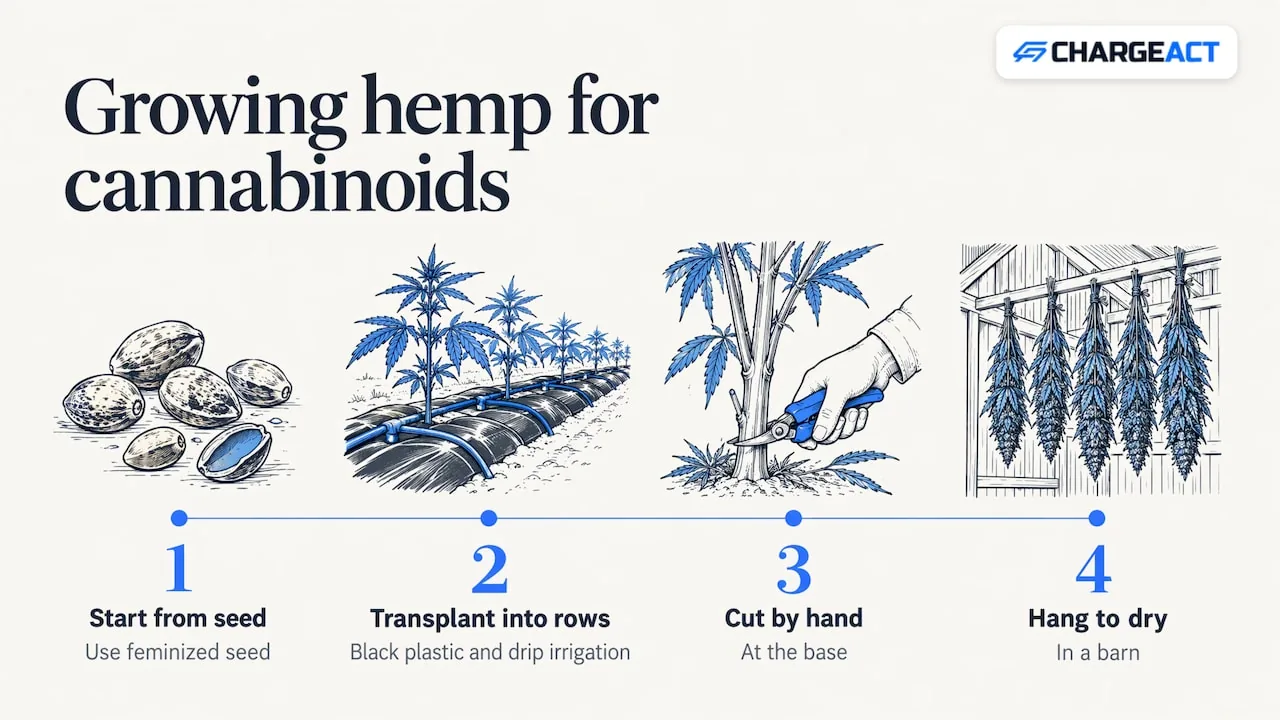
The farming model changes with the end use. The Wisconsin Extension describes hemp grown for cannabinoids as much more labor intensive, akin to a specialty vegetable crop: plants are usually started from feminized seed, transplanted into rows of black plastic with drip irrigation, cut by hand at the base and hung in a barn to dry. That is a capital-heavy operation, from drying space to extraction equipment, and growers often weigh an equipment business loan to spread those costs before the first harvest sells.
On the commercial side, every one of these product families is sold differently. Fiber and seed buyers often invoice other businesses. Consumer hemp brands sell online, by subscription, and by phone order, and they live on authorization rates, recurring billing success and chargeback ratios. That is the point where payment infrastructure stops being a back-office detail and becomes a revenue lever.
The November 12, 2026 definition change
In November 2025, Congress changed the statute. The Congressional Research Service explains in its analysis of the change that P.L. 119-37 amended the definition of hemp in 7 U.S.C. 1639o. The limit becomes a total THC concentration of less than 0.3% on a dry weight basis, rather than delta-9 THC alone, and the new definition takes effect on November 12, 2026. The law also directs the FDA to publish lists of naturally occurring cannabinoids, THC class cannabinoids, and cannabinoids with similar effects to THC within 90 days of enactment.
A second CRS document, Changes to the Statutory Definition of Hemp, spells out what the new definition includes and excludes. It explicitly includes industrial hemp, meaning hemp grown for the stalk, whole grain, oil, cake, nut, hull or other non-cannabinoid derivative of the seeds. It excludes three things:
- Viable seeds from a cannabis plant that exceeds a total THC concentration of 0.3%.
- Hemp-derived cannabinoid products containing cannabinoids that a cannabis plant cannot naturally produce.
- Final hemp-derived cannabinoid products containing more than 0.4 milligrams combined total per container of total THC and other cannabinoids with similar effects.
The same CRS document explains why this happened: some readers of the 2018 farm bill took it to cover products with 0.3% delta-9 THC or less and significant amounts of other psychoactive compounds, and the 2025 amendment moves to a total THC standard. Forbes reported in April 2026 that a bipartisan Senate bill would let states and tribes opt out of the federal approach, and that states have taken widely different approaches to hemp THC products since 2018. Because that is a proposal, watch the official status rather than assuming an outcome.
If you sell finished cannabinoid products, review your catalog against the new definition with a qualified attorney who knows hemp regulation. Fiber, grain and non-cannabinoid seed products sit under the part of the definition that explicitly includes industrial hemp.
What the change means for hemp merchants and their payments
A regulatory shift rarely hits a hemp business as a legal memo. It hits as a payment problem: a processor reclassifies a product line, a reserve appears, a payout is delayed or an account is closed without much notice. Revenue stops while the underlying business is intact.
Three pressures are worth planning for.
Product mix review. Processors look at what you actually sell. A store with fiber goods, seed foods and cannabinoid products has a different profile from one with a single product. Describing your mix accurately, with lab documentation behind it, gives underwriting something concrete to evaluate. Our approach to underwriting is built on your actual operations, not just a category label.
Volume spikes. Hemp brands see launch-day surges, holiday promotions and subscription renewal cycles. Sudden jumps in volume are a classic trigger for holds on generic accounts. A payment strategy that anticipates spikes in volume, and a dedicated account manager who knows your calendar, keeps those moments from becoming disruptions.
Chargebacks and fraud. Subscription and high-ticket orders, phone orders and first-time buyers all carry dispute exposure. A healthy chargeback ratio protects the account itself, which makes fraud screening and dispute handling a stability measure as much as a cost measure. Our fraud prevention and chargeback protection tools are built for that.
Backup placements belong in the same plan. A second processing path, set up in advance, means one underwriting decision does not stop all of your sales. If you want the wider picture, our overview of seven things to know about high risk merchant processing covers how these accounts are reviewed, and the nutraceutical merchant account guide applies to hemp brands that also sell supplements.
The merchants who handle a transition best tend to do four things before it arrives: they confirm what each SKU contains, they keep their testing records current, they brief their processor on upcoming changes, and they avoid depending on a single account. None of that requires guessing at the outcome of pending bills.
Payment processing built for hemp sellers
ChargeAct provides payment processing for high-risk merchants, including CBD and hemp ecommerce, with a dedicated account manager for each merchant. Our high risk merchant accounts are tailored to your risk profile, with backup placements, transparent interchange plus pricing, gateway integration support for ecommerce stores, fraud protection and chargeback defense. We also support online, MOTO, mobile and retail payments, so a brand that sells through a website, over the phone and at a market stall can run it all through one relationship.
Pricing depends on your products, your volume and your risk profile, so rates come from a quote built for your business by our sales team. Approval is decided case by case through underwriting. To see how we handle your situation, start from our solutions overview or the CBD and hemp page.
Hemp benefits and how to think about them
People often ask whether hemp has benefits. The documented, practical benefits are the ones in the use list above: strong fiber for textiles and construction materials, nutritious seed for food, and oil for cooking and personal care. For cannabinoid products, the NCCIH explains that the FDA has approved several drugs containing individual cannabinoids, including Epidiolex, a purified form of CBD. A 2021 scoping review in PMC (Lim et al.) reports that hemp derivatives showed anti-inflammatory and antioxidant potential in pre-clinical work.
For sellers, the point is careful marketing. The FDA told Congress its biggest concern is the marketing of CBD products that make unsubstantiated therapeutic claims to prevent, diagnose, treat or cure serious diseases without new drug approval. Describe what your products are, how they are made and how they are tested, and leave disease claims out of your copy. Clean product pages are also easier for underwriters and card networks to review.
FAQ
What is the difference between hemp and CBD?
Hemp is the plant and everything derived from it, from rope fiber to seed oil. CBD is a single cannabinoid found mostly in the flower of the plant. A hemp product may or may not contain CBD, and hemp seed foods do not naturally contain it.
Will the federal hemp change affect states where hemp products are legal?
Federal law sets the definition from November 12, 2026, and states can regulate more strictly than the federal baseline for production. A Senate bill introduced in April 2026 would let states and tribes opt out of the federal approach to hemp THC products, but it is a proposal. Check your state agriculture department for current rules.
What is rope hemp?
It is hemp grown for its stalk fiber. The fiber is used for rope, paper, textiles, insulation and construction materials. These fiber and grain uses are the industrial hemp the new definition explicitly includes.
Does the 0.3% THC limit apply to everything?
Currently the limit is 0.3% THC on a dry weight basis. From November 12, 2026, it becomes a total THC measure, with added exclusions for certain finished cannabinoid products. Confirm how it applies to your products with a qualified attorney.
Can a hemp business get a merchant account?
Hemp and CBD merchants are a core segment for us at ChargeAct. Every application goes through underwriting based on your real operations, so there is no guarantee of approval, but our team can review your business and give you a quote.
Sources
- USDA Agricultural Marketing Service: Hemp FAQ
- Congressional Research Service: Change to Federal Definition of Hemp
- Congressional Research Service: Changes to the Statutory Definition of Hemp
- DEA Diversion Control Division: Controlled Substances Q&A
- eCFR: 7 CFR Part 990 Subpart B
- Pennsylvania Department of Agriculture: Hemp Program FAQs
- University of Wisconsin Extension: Hemp
- NCCIH: Cannabis (Marijuana) and Cannabinoids
- FDA: Hemp Production and the 2018 Farm Bill
- Forbes: Bipartisan Bill Would Let States Opt Out of Federal Hemp THC Ban
Recommended
How it works
Call us
Tell us where things stand today - your current processor, your rates, and what's not working.
We review where you stand
A real underwriter looks at your statements and account history - no black-box scoring.
You hear what's possible
We lay out your options in plain terms, including what we can and can't do for your business.
Why ChargeAct
We underwrite the businesses others decline
High-risk isn't a dirty word to us - it's the merchant category we specialize in every day.
A human reviews your account, not just an algorithm
Statements get read by people who understand your industry, not auto-rejected by a risk score.
A dedicated manager who knows your account
When something comes up, you call a person who already knows your business - not a queue.
Stop guessing what your processor will do next.
Talk to a real underwriter about where your business stands - no obligation, no runaround.
(888) 329-5717