CBD Merchant Account: How to Get Approved and Stay Live
What a CBD merchant account is, what it costs, what underwriters want to see, and how to avoid declines, reserves and freezes. A guide for US hemp merchants.
A CBD merchant account is a bank-backed account, set up by a processor that underwrites hemp-derived products from day one. It lets you accept card payments without waiting for a mainstream gateway to review your store and shut it down. Hemp-derived CBD is legal to sell under federal law according to the 2018 Farm Bill, which defines hemp as cannabis and its derivatives containing no more than 0.3% delta-9 THC on a dry-weight basis (source), but card acceptance is a separate question, and the banks behind the card networks still treat the category as high-risk. The merchants who get approved quickly and stay live are the ones who bring the right documents, choose a provider built for CBD, and manage disputes before they become a problem.
TL;DR
- CBD needs a high-risk merchant account because acquiring banks price the whole category as a loss risk, not your store individually.
- Expect higher rates than standard merchants pay, often with a rolling reserve. Ask for both in writing before you sign.
- Underwriters buy documents, not promises: lab reports, licenses, a compliant website and clean processing history carry the application.
- Most freezes trace back to chargebacks, miscoded products or claims on your site. All three are manageable.
- A gateway only moves data. The merchant account is what holds and settles your money, so choose the account first.
Table of Contents
- What a CBD merchant account actually is
- Why CBD gets the high-risk label
- How CBD online payment processing works
- Rates, reserves and fees: what to expect
- What to prepare before you apply
- Why CBD accounts get declined, frozen or terminated
- Does a bank account mean a merchant account?
- Choosing a provider: gateways, methods and channels
- Get a CBD account built for your business
- FAQ
- Sources
What a CBD merchant account actually is
A merchant account is the banking relationship that lets a business accept card payments. When a customer pays, the funds are held and settled through that account before they reach your business bank account. A payment gateway sits in front of it. The gateway captures and encrypts payment data at checkout and passes it along, but without a merchant account behind it, no gateway can move money.
That distinction matters when your processing stops. Many CBD sellers assume a gateway problem is a technology problem. More often it is an account problem: the underwriting relationship was never designed for your product, so the first review ended it.
A CBD-specific account is different in three ways. It is underwritten with your product category on file, so the approval reflects what you sell. It is priced for the actual risk. And it comes with monitoring that expects refund and dispute patterns typical of the category rather than treating them as a surprise.
Why CBD gets the high-risk label
Acquiring banks group merchants by expected loss. A category that produces frequent refunds and disputes, or raises legal questions, lands in the high-risk group, alongside firearms, adult content and multi-level marketing. The label is a financial judgment about probable losses applied to the entire category, not a verdict on your store.
The legal backdrop explains why banks stay cautious. The 2018 farm bill defines hemp as cannabis and its derivatives containing no more than 0.3% delta-9 THC on a dry-weight basis, and hemp is no longer a controlled substance under federal law. But the FDA treats CBD differently. It has said that CBD products cannot be marketed as dietary supplements under the federal definition, and it has issued warning letters over CBD in food products. A bank looking at that picture sees regulatory exposure, even when your products are fully compliant.
The practical consequence is that mainstream processors, including many general-purpose payment aggregators and e-commerce platform payment tools, prohibit CBD transactions in the US. If you sell CBD, a dedicated high-risk provider is the infrastructure you need, not an upgrade you might consider later. If you lost a mainstream account without warning, you are in good company, and the fix is to move to an account that was approved for your category from the start.
How CBD online payment processing works
Four pieces work together on every online sale: the storefront, the gateway, the processor and the merchant account at the acquiring bank. At checkout, the gateway encrypts the card data, runs basic fraud checks and forwards the authorization request to the processor. The processor sends it through the card network to the customer’s issuing bank, which approves or declines. The approval returns along the same path in seconds. Settlement, meaning the actual movement of funds into your account, follows later according to your account terms.
Two details matter for CBD sellers. First, the gateway you choose has to be compatible with the processor and the merchant account behind it, and not every gateway supports high-risk accounts. Confirm compatibility with your storefront platform before you commit, not after your developer has built the integration. Second, settlement timing is part of your cash flow. If your account has a reserve, the effective timing on a slice of your revenue is longer, and your working capital plan should reflect that.
If you take orders by phone or mail as well as online, mixed channels are worth raising at the start. Our MOTO payment processing covers mail and telephone orders, and keeping every channel under one underwriting file is simpler than juggling separate approvals.
Rates, reserves and fees: what to expect
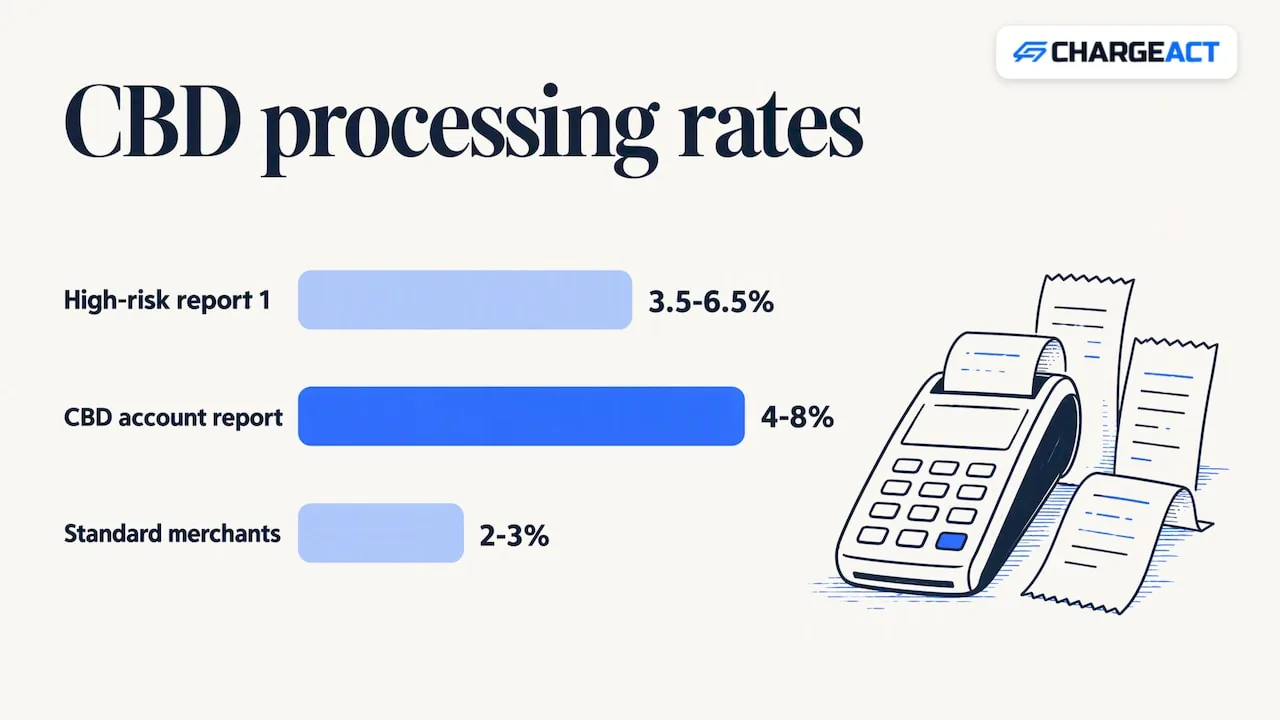
Pricing is where CBD merchants most often feel the high-risk label. Published industry figures vary by source and by merchant profile, so treat them as ranges, not quotes. One recent report puts high-risk processing at 3.5% to 6.5% per transaction plus $0.20 to $0.35 on each sale. Another cites 4% to 8% for high-risk CBD accounts, against 2% to 3% for standard merchants. Your actual rate depends on your volume, average ticket, refund history and how complete your file is.
A rolling reserve is the second cost to plan for. In a rolling reserve, the processor holds a percentage of your sales for a set period as protection against chargebacks. Reports describe 5% to 10% held for 90 to 180 days on most high-risk CBD accounts. The money is yours and is released on a schedule, but it affects cash flow, so model it.
| Cost item | What to ask the provider | Why it matters |
|---|---|---|
| Processing rate | Is pricing interchange plus, or a flat blended rate? | Interchange plus shows you what the card networks charge and what the processor adds. |
| Per-transaction fee | Is it the same for every card type and channel? | Small fees compound on low-ticket orders. |
| Rolling reserve | What percentage, held for how long, and when is it reviewed? | It shapes your cash flow and should be written into the agreement. |
| Chargeback fee | What do you charge per dispute, and what tools reduce them? | Disputes cost more than the fee itself. |
| Setup and monthly fees | What is charged up front and what recurs? | Compare total cost, not headline rates. |
Our approach is transparent interchange plus pricing aligned to volume, with a dedicated account manager who walks you through each line. We do not publish a rate card, because underwriting is based on your actual operations, so your quote reflects your business rather than a category average.
What to prepare before you apply
A CBD application lives on documentation. Underwriters cannot see your products, so they rely on paper that proves what you sell and that you sell it legitimately. Build your file before you apply and you shorten the approval time considerably.
Start with product evidence. Current third-party lab reports (certificates of analysis) should show cannabinoid content and a delta-9 THC level within the federal hemp limit, and each report should match the product listed on your site. A missing or mismatched lab report is a very common reason files stall. Next, gather your business documents: formation papers, EIN, a business bank account, owner identification and several months of bank statements. If you have processed cards before, include processing statements that show your volume, refund rate and chargeback rate.
Then look at your website as an underwriter will. It should show clear contact details, refund and shipping policies, terms of sale, an age restriction notice and accurate product descriptions. Avoid medical or disease-treatment claims. The FDA’s position on CBD in food and supplements is a reminder that regulators scrutinize how CBD is described, and acquirers read your site with the same eye. If your state requires licensing or registration for hemp products, have that documentation ready too.
Finally, make sure your product is coded correctly. The merchant category code assigned to your business drives monitoring and pricing. Industry sources differ on which code fits which CBD product, which is exactly why your provider should assign it based on your real product mix and explain the reasoning. Miscoding can create trouble later, so ask how your account will be classified before you sign.
Why CBD accounts get declined, frozen or terminated
There are four common causes, and each has a counterpart in how you run the business.
Bad Financials. This includes mismatched bank statements, concerns about financial stability, and adherence to specific internal underwriting guidelines.
Category mismatch. A merchant who boards on a mainstream gateway and sells CBD is eventually reviewed and closed. A merchant boarded by a provider that expected CBD faces a lower chance of a sudden freeze, because the product was priced and approved on day one.
Chargebacks. The card networks run monitoring programs that penalize merchants whose dispute ratios climb. Thresholds and fees change over time, so ask your provider for the current figures instead of relying on a number from a blog. What does not change is the direction: lower dispute ratios mean more options and better pricing. Industry forecasts put chargeback growth at 24% between 2024 and 2028, and subscription billing makes the math harder for CBD, since a customer who forgets a renewal or struggles to cancel often disputes the charge rather than contacting support.
Compliance drift. The site claims, product lineup or lab reports change after approval, and nobody tells the processor. Keep your underwriter informed when you add products or formulations.
Termination records. In cases where an account is terminated for cause, the merchant may, under severe circumstances, be placed on the MATCH database. This database tracks businesses and their principals, making it significantly harder to obtain new merchant accounts—even in different industries. Such listings are rare and generally reserved for the most serious violations. It is critical to treat the possibility of being added to MATCH with utmost seriousness and take proactive steps to avoid it. Preventing this outcome involves addressing potential issues early, rather than being surprised by a scheduled periodic review that could lead to termination.
Reducing the risk of disruption
The fixes are operational.
- Use a clear billing descriptor so customers recognize the charge.
- Send order confirmation and shipping notices.
- Make cancellation and refund routes easy to find, because an easy refund costs far less than a dispute.
For subscriptions,
- Send renewal reminders before the charge to reduce payment failures.
- Implement a clean retry schedule for failed payments to prevent soft declines from turning into churn.
- Layer fraud screening on top, including address and card verification.
- Use velocity checks and dispute alerts to detect and prevent fraud.
Our fraud protection and chargeback tools are built for exactly this.
Does a bank account mean a merchant account?
Sellers often ask whether their regular bank will take care of CBD processing. A business checking account and a merchant account are different products. Some banks serve hemp businesses with deposit accounts, but accepting card payments requires an acquiring relationship with its own underwriting. Whether a bank or processor will approve you depends on your product type (hemp-derived rather than marijuana), documentation, processing history, refund and chargeback profile and the policies of the acquiring bank behind the processor. Ask any provider directly which acquiring bank will hold your account, and whether it has a backup in case the primary relationship changes.
Choosing a provider: gateways, methods and channels
When evaluating providers, prioritize understanding the account structure over focusing solely on rates. Your account should be specifically underwritten to fit your business, ensuring complete ownership of your file and control over your processing relationship.
Next, check integration. Confirm that the gateway works with your cart platform and any subscription or fulfillment tools.
Ask which payment methods are supported:
- Major credit cards (Visa, MasterCard, AMEX, Discover)
- Debit cards
- Digital wallets
- POS hardware or mobile readers for in-person sales
Our ecommerce payment processing page covers online stores, and digital wallet options can reduce checkout friction on mobile.
Then inquire about continuity. A backup placement ensures that if your primary processing relationship is disrupted—due to changes in the acquiring bank’s risk tolerance or industry focus—a secondary account with another acquirer is ready to handle your transaction volume. This safeguard distinguishes merchants who weather spikes or reviews from those left with days of unprocessed orders.
Lastly, ask who your point of contact will be. A named account manager who knows your volume pattern, seasonality and product lineup is worth more than any support queue.
Get a CBD account built for your business
ChargeAct provides payment processing options for CBD and hemp merchants, with merchant accounts tailored to your risk profile, fraud protection, pricing structure (interchange plus, tiered, or flat rate) and a dedicated account manager.
If you sell CBD online or in person, see our CBD payment processing and merchant accounts page, or explore our high-risk merchant account for the full picture of how we keep accounts live. You can also read our guide to choosing a high-risk payment processing partner before you talk to anyone.
FAQ
What is the best CBD payment processor?
The best processor is the one that underwrites CBD from the start, offers a dedicated account and gives you written terms on rates and reserves. Compare structure, backup placement, chargeback tools and account support, not only the advertised rate. A provider that explains how your account will be classified and monitored is usually the safer choice.
At ChargeAct, we are committed to delivering comprehensive service that fulfills these essential criteria, reflecting the qualities we expect from leading CBD payment processors.
Can I use a standard payment gateway for CBD?
Most mainstream processors and platform payment tools prohibit CBD transactions, so a standard gateway puts your account at risk of review and closure. Use a gateway that is compatible with a high-risk merchant account and approved for your category. Confirm compatibility with your storefront before you build. Our go-to payment gateway is NMI.
How long does it take to get a CBD merchant account?
Timing depends on how complete your file is. Merchants who arrive with lab reports, business documents, processing statements and a compliant website move faster than those who send documents piecemeal. Ask your dedicated agent for the typical decision timeline and which items you need first.
Why do CBD applications get declined?
Common reasons for application declines include mismatched bank statements, concerns about financial stability, and specific internal underwriting guidelines. Your dedicated account manager should be able to help in ensuring all the correct documentation is collected for the application. For more details, refer to our guide on understanding high-risk credit card processing.
Sources
- Payment Processing for CBD: 2026 Complete Guide
- Why CBD Brands Get Declined by Traditional Payment Gateways
- The 2018 Farm Bill’s Hemp Definition and Legal Challenges to State Laws
- Legal Hotline: Hemp and CBD Ads
- FDA sends warning to food firm with CBD and THC in products
- Payment Gateway vs Payment Processor: What Is the Difference
Recommended
How it works
Call us
Tell us where things stand today - your current processor, your rates, and what's not working.
We review where you stand
A real underwriter looks at your statements and account history - no black-box scoring.
You hear what's possible
We lay out your options in plain terms, including what we can and can't do for your business.
Why ChargeAct
We underwrite the businesses others decline
High-risk isn't a dirty word to us - it's the merchant category we specialize in every day.
A human reviews your account, not just an algorithm
Statements get read by people who understand your industry, not auto-rejected by a risk score.
A dedicated manager who knows your account
When something comes up, you call a person who already knows your business - not a queue.
Stop guessing what your processor will do next.
Talk to a real underwriter about where your business stands - no obligation, no runaround.
(888) 329-5717