CBD Credit Card Processing: How to Get and Keep an Account
How CBD credit card processing works in the U.S., why accounts get frozen, what underwriting reviews, and how to set up stable card acceptance online and in person.
CBD credit card processing means a merchant account and gateway underwritten specifically for hemp-derived products, so your card payments keep settling when general-purpose processors would freeze or close you. The goal is not just getting approved. It is staying live through volume spikes, regulatory shifts and card network policy changes. At ChargeAct, CBD and hemp merchants are matched with a dedicated account manager and underwriting based on what the business actually does, not only its category label.
TL;DR
- CBD is treated as a high-brand-risk category by the card networks, so acquirers apply enhanced due diligence before they contract with you.
- Most shutdowns trace back to the same handful of causes: a mismatched merchant category code, product or marketing claims that contradict your application, and a processor that never explained its policies.
- Federal hemp rules change in November 2026, and card network fees rose in 2026, so your processing setup should be built for both.
- A tailored merchant account, a backup placement and chargeback tools protect revenue better than a generic account ever will.
- Rates depend on your specific business, so you need a quote from a sales representative rather than a published number.
Table of Contents
- Why CBD merchants lose payment accounts
- What the rules around CBD mean for your processing
- How CBD card payments work, by sales channel
- What underwriting looks at
- Fees, reserves and funding terms to expect
- How to keep your account stable
- Switching after a freeze or closure
- What ChargeAct does for CBD merchants
- FAQ
- Sources
Why CBD merchants lose payment accounts
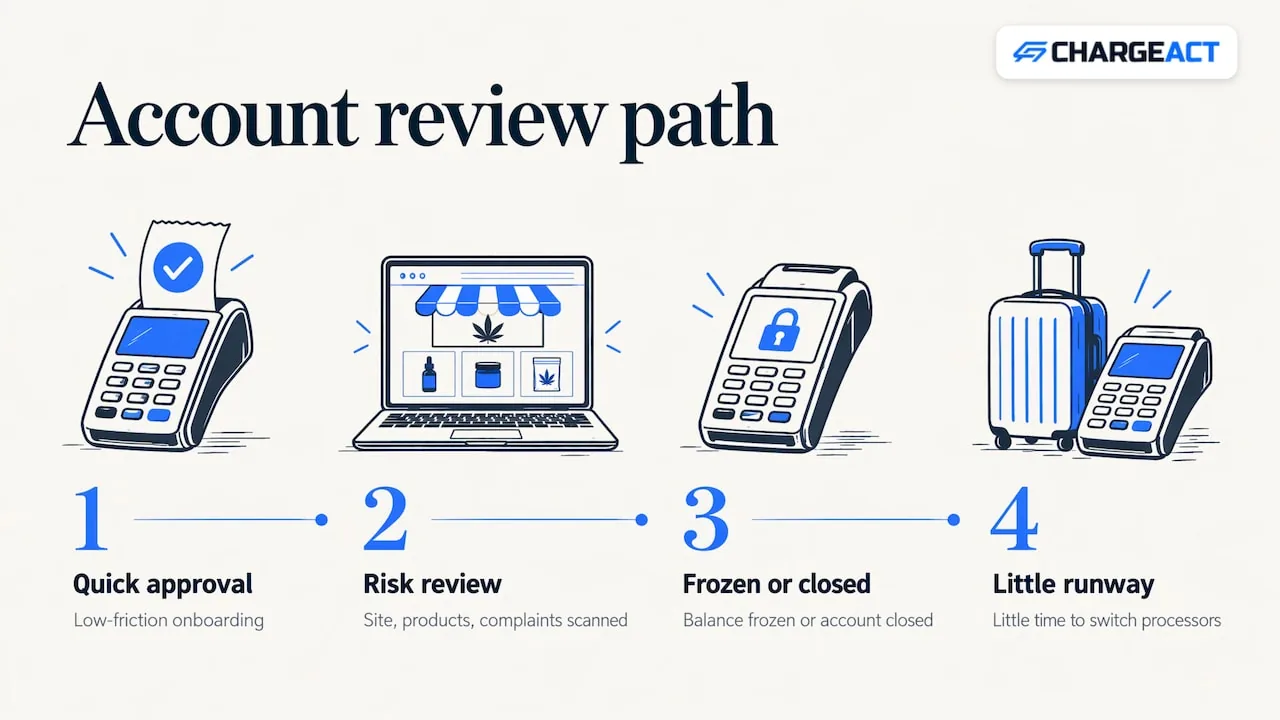
General-purpose payment platforms are built for low-friction onboarding. They approve quickly, then review risk afterward, often by scanning your website, your products and your customer complaints. A CBD store sits in a category that the platform's bank partners may restrict, so the review can end in a frozen balance or a closed account, usually without a long runway to move to another processor.
The underlying reason is how the card networks view the category. Visa's Payment Facilitator and Marketplace Risk Guide states that high-brand-risk merchants carry elevated risk to the payment system and can cause brand or reputation damage if they are not properly vetted, managed and controlled. It calls for enhanced due diligence: a detailed review of the goods or services offered, how they are marketed and sold, validation of the merchant's location and a look at previous processing history.
The same guide says acquirers must obtain a High-Brand Risk Acquirer Registration from Visa before contracting with a high-brand-risk merchant, and that payment facilitators must be registered as a High Risk Internet Payment Facilitator before signing such merchants. In plain terms, a processor that has not set up for this category cannot properly hold your account, which is why a store that signed up with a mainstream platform can be dropped later even if it did nothing new.
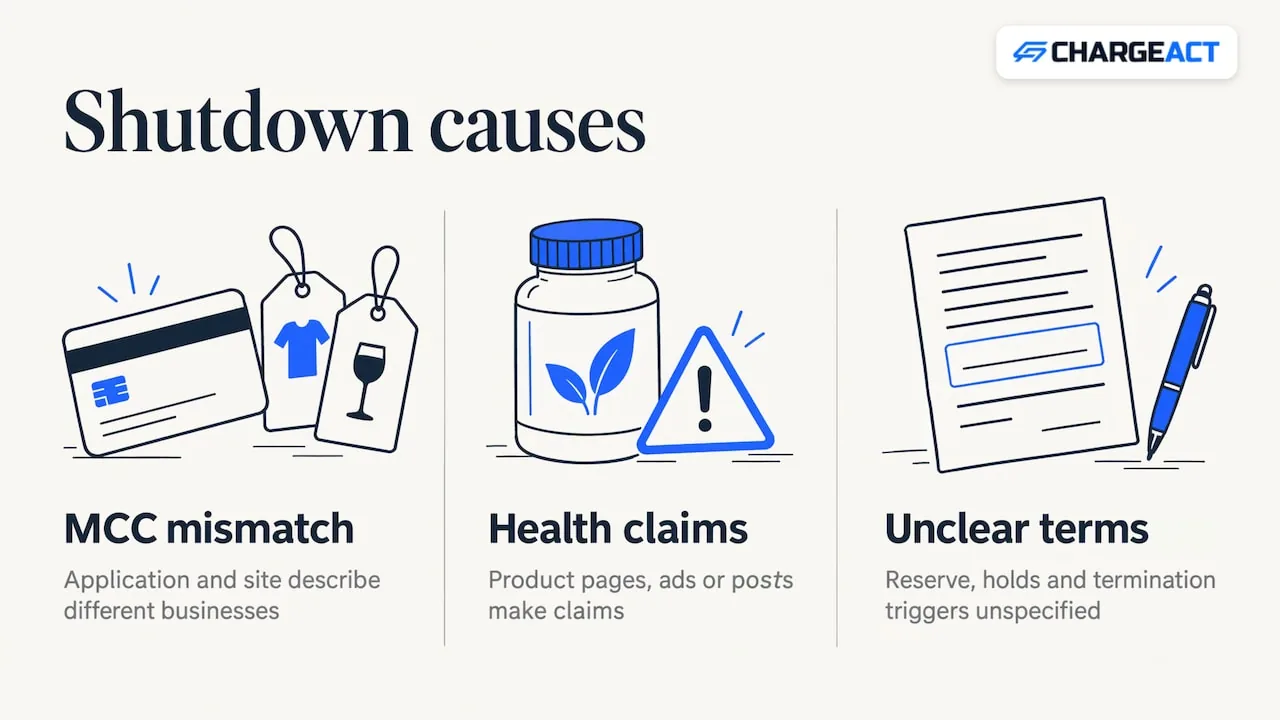
The three causes behind most shutdowns
In our experience of how accounts fail, three patterns repeat. First, a mismatched merchant category code (MCC), the four-digit code that tells card networks what you sell. If your application says one thing and your site says another, the mismatch shows up in monitoring. Second, claim language: product pages, ads or social posts that make health claims create regulatory exposure for the acquiring bank. Third, an unclear relationship with the processor, where reserve terms, fund holds and termination triggers were never spelled out at signup.
All three are preventable. They are preventable at the underwriting stage, which is why the application matters more than any later fix.
What the rules around CBD mean for your processing
Your processor's risk team watches the same regulatory picture you do. Here is the part that affects card acceptance.
Federal hemp definition
The 2018 Farm Bill defined hemp as Cannabis sativa L. and its derivatives, including extracts and cannabinoids, with a delta-9 THC concentration of no more than 0.3 percent on a dry-weight basis, as summarized by the Congressional Research Service. That is the definition most CBD businesses have relied on.
A later law changes it. On November 12, 2025, Congress enacted Section 781 of the continuing resolution package, which moves the hemp definition to total THC (including THCA), excludes synthetic cannabinoids and caps finished products at 0.4 mg total THC per container, according to an Arnold & Porter advisory. The change takes effect one year after enactment, in November 2026, and the CRS notes that certain portions carry later dates. Our hemp guide walks through the definition in more detail.
What this means for payments: product mix matters. If your catalog includes full-spectrum or THCA-rich products, your underwriter will want to see lab results and product details that match the rules in force, and an acquirer that understands the category will ask for them early rather than after a complaint.
FDA position
The FDA states that it has not approved any CBD products other than one prescription drug for rare, severe forms of epilepsy, and that CBD is an unapproved food additive, per its press announcement on warning letters. Its guidance also explains why CBD products fall outside the dietary supplement definition, in the FDA regulation guidance.
For a merchant, the practical point is about wording. FDA warning letters, such as the 2019 letter to Curaleaf, cited products marketed with drug-style claims. Banks and card networks read those letters too. Product pages that stick to what the product is, how it is made and how to use it keep your underwriting file clean.
FDA also issued an April 1, 2026 memo that provides limited non-enforcement for certain orally administered hemp-derived CBD products under specified manufacturing, labeling, contamination, child-marketing and physician-direction conditions, as summarized in the same Arnold & Porter advisory. If that applies to your products, keep documentation of how you meet those conditions alongside your processing file. For specific compliance questions, talk to your own attorney, since this article is not legal advice.
Our deeper walkthrough of CBD payment processing rules covers how these threads connect to underwriting.
Card network fees moved in 2026
Per the Arnold & Porter advisory, Mastercard doubled a registration fee for certain merchants to $1,000 annually on May 1, 2026, with transaction and volume fees starting June 3, 2026. These network-level costs flow through to the processing agreement in some form, which is one reason pricing structure deserves attention (more on that below).
How CBD card payments work, by sales channel
The mechanics are the same as any card payment: a customer's card details travel through a gateway to an acquiring bank, which routes them to the card network and the customer's issuing bank, then settles funds to you. What differs for CBD is who is willing to be the acquiring bank and what monitoring sits on top.
Ecommerce
Online is where most CBD revenue happens, and where most shutdowns happen. You need three things that line up: a store platform that permits hemp products, a merchant account approved for your category and a gateway that connects the two. ChargeAct offers gateway integration support for ecommerce stores, so the checkout on your site is connected to an account underwritten for your products. Underwriters generally review the live site, so policies, product descriptions, refund terms and contact information should be in place before you apply.
Retail and in person
If you run a storefront or a pop-up, you need a terminal or POS system tied to a merchant account that allows CBD in a card-present setting. Our retail payments solutions cover card machines and POS, and mobile payments cover card readers for events and deliveries. Card-present sales typically carry lower fraud exposure than online ones, which underwriters take into account.
Phone orders and virtual terminals
Many CBD brands take orders by phone, particularly for wholesale or repeat customers. A virtual terminal lets staff key in card details through a browser. MOTO payments (mail order and telephone order) are underwritten differently from storefront sales because the card is not present, so tell your underwriter if a share of your orders comes in this way, rather than letting it appear unannounced in your processing data.
Subscriptions
Subscribe-and-save is a common CBD model, and it adds its own pressures: recurring authorizations, failed renewals and disputes from customers who forgot they signed up. Clear billing disclosures, reminder emails and easy cancellation reduce chargebacks and protect your authorization rates. Declining cards that are retried without discipline can push dispute ratios and decline rates in the wrong direction, so ask how your processor handles retry logic and account updater tools.
What underwriting looks at
Because Visa's guidance calls for review of what you sell, how you market it, where you operate and how you have processed before, expect a package like this when you apply.
A business description and product list with sources for your hemp. Certificates of analysis from a third-party lab. Your website, with checkout, policies and contact details live. Marketing samples, including any ad copy and social pages. Bank statements and prior processing statements if you have them, plus the reason a previous account closed, if one did. Identification and business formation documents for owners.
The best preparation is consistency. If the product list, the MCC, the website copy and the lab reports all describe the same business, underwriting moves with fewer questions. ChargeAct's approach is personalized underwriting based on actual business operations, not just category labels, and our CBD merchant account approval guide lays out the flow from application to staying live. No processor can promise approval, and we do not guarantee any application, but a complete and consistent file gives your application its best footing.
Fees, reserves and funding terms to expect
High-risk processing generally costs more than standard processing because the acquiring bank takes on more risk. Beyond the processing fees, three terms shape your cash flow, and each should be written into your agreement.
Pricing model. Interchange-plus pricing separates the card network's cost from the processor's margin, so you can see what is passed through and what is not. Flat-rate bundles hide that split. We use transparent interchange-plus pricing, and your specific pricing depends on your products, sales channels, average ticket and processing history, which is why we ask you to request a quote from our sales team rather than publishing numbers.
Reserves. A reserve is money the acquirer holds back as protection against chargebacks and refunds. It can be a rolling percentage of sales, a fixed amount or none at all. Ask how the reserve is sized, how long funds are held and the conditions under which it is released or adjusted. Merchants frozen by a general platform often meet reserves for the first time as an unexplained hold, so having the terms in writing is the real protection.
Funding speed. Settlement timing varies by account and risk profile. Confirm when funds are deposited after a batch closes and what triggers a delay.
And a few more clauses worth reading: termination notice, chargeback fees, monthly minimum fees, and what happens to held funds if the relationship ends. Our guides on understanding high-risk credit card processing and the seven things to know about high-risk processing go through these terms.
How to keep your account stable
Stability is a system, not a single decision. Each piece below has a job.
- Apply with accurate information. Match your MCC, product list and website. A correct application avoids the mismatch that triggers many closures.
- Keep marketing in line with your file. Review product pages, ads, influencer posts and email copy against your application, and fix claim language before it becomes an underwriting question.
- Watch your chargeback ratio. Clear descriptors, recognizable billing names, fast customer service and visible refund policies reduce disputes. Fraud screening and chargeback protection catch problems before they compound.
- Plan for volume spikes. A sale, a viral post or a new product line can multiply orders overnight. Tell your account manager before it happens so that a spike does not look like suspicious activity.
- Keep a backup placement. A second account, already approved, means a single bank decision does not stop your checkout. ChargeAct offers backup placements for exactly this purpose.
- Track regulatory dates. The November 2026 hemp definition change is a good moment to review your product list and lab reports with your processor, so nothing in your catalog surprises the underwriting team.
Switching after a freeze or closure
If a general platform dropped you or is holding funds, your first move is to gather documentation: the notice you received, your processing history and your product and lab records. Keep the closing processor's reason in the file, since a new underwriter will ask. Then apply for a CBD-ready account and, if possible, line up a backup at the same time, so that you are not rebuilding checkout under pressure a second time. Our guide to finding the right high-risk payment partner lists what to ask before you sign anything.
The same logic applies to merchants outside CBD that face the same pressure, including nutraceutical and wellness brands and other high-risk categories.
What ChargeAct does for CBD merchants
ChargeAct builds payment processing for high-risk merchants, with CBD and hemp among the industries it serves. Each merchant gets a dedicated account manager, a risk management approach built around the actual business and backup placements designed for industries that traditional processors decline. The stack covers high-risk merchant accounts, online payments, POS, MOTO, digital wallets, fraud protection and chargeback defense.
If you are setting up or replacing CBD card acceptance, start with our CBD payment processing page or see everything we offer on the solutions page. Pricing is quoted for your specific business by our sales representatives.
FAQ
Can I accept credit cards for CBD products online?
Yes, with a merchant account underwritten for CBD and a gateway connected to your store. You will need a store platform that permits hemp products and a site with clear policies and product details. Approval depends on underwriting review of your business and is never guaranteed.
Why was my CBD store frozen by my payment platform?
The common causes are a category the platform's bank partners restrict, a mismatch between your application and your site, health claims in your marketing and elevated disputes. Moving to an account built for CBD, with terms written down, reduces the surprise factor.
How much does CBD credit card processing cost?
It generally costs more than standard processing because of the added risk, and the exact cost depends on your products, channels and history. Contact our sales representatives for a quote for your business.
Can I take CBD payments by phone or on a virtual terminal?
Yes. MOTO and virtual terminal processing are available through a merchant account that allows card-not-present sales. Share your expected phone-order volume at application so that underwriting reflects how you really sell.
Do I need a backup processor?
A backup placement keeps your checkout running if one account is paused or reviewed. It is a practical safeguard for any CBD merchant that cannot afford a stretch without card acceptance.
Sources
- Visa Payment Facilitator and Marketplace Risk Guide
- Congressional Research Service: Changes to the Statutory Definition of Hemp
- Arnold & Porter: Major Changes to Federal Regulation of Hemp-Derived Products
- FDA: Warning Letters to Companies Illegally Selling CBD and Delta-8 THC Products
- FDA: Regulation of Dietary Supplement and Conventional Food Products Containing Cannabis
- FDA: Curaleaf warning letter, July 22, 2019
Recommended
How it works
Call us
Tell us where things stand today - your current processor, your rates, and what's not working.
We review where you stand
A real underwriter looks at your statements and account history - no black-box scoring.
You hear what's possible
We lay out your options in plain terms, including what we can and can't do for your business.
Why ChargeAct
We underwrite the businesses others decline
High-risk isn't a dirty word to us - it's the merchant category we specialize in every day.
A human reviews your account, not just an algorithm
Statements get read by people who understand your industry, not auto-rejected by a risk score.
A dedicated manager who knows your account
When something comes up, you call a person who already knows your business - not a queue.
Stop guessing what your processor will do next.
Talk to a real underwriter about where your business stands - no obligation, no runaround.
(888) 329-5717