CBD Payment Processing Rules: What Merchants Must Know
CBD payment processing rules in the US: federal hemp law, FDA claim limits, card network expectations and the documents underwriters ask for.
There is no single rulebook for CBD payments. Your ability to accept cards rests on four layers that stack: federal hemp law, FDA rules on what you can say and sell, the state rules where you ship, and the card network and acquiring bank policies that decide whether a processor will take you on. A CBD merchant who satisfies all four layers, and can show it in documents, is the kind of business a high-risk processor can underwrite and keep live.
This guide walks through each layer in order, explains what underwriters look at, and shows how to keep your position current as the rules move. It is written for CBD and hemp ecommerce owners, retail operators and wellness brands in the United States.
TL;DR
- Federal law treats hemp (under 0.3% THC) differently from marijuana, but FDA rules still limit how CBD can be marketed, which is exactly what card networks check.
- Acquirers expect CBD not to be marketed as food or a dietary supplement, no disease claims on labels, websites or social media, and sales only where legal.
- States layer on age limits, licensing and product rules, so check every state you sell or ship into.
- Underwriting typically rests on lab results, compliant site content and a clean chargeback record; keep these organized before you apply.
- The federal hemp definition is changing, so verify the current effective dates on official pages before you rely on any product line.
Table of Contents
- Why CBD payment processing has its own rules
- Layer one: federal hemp law
- Layer two: FDA rules on products and claims
- Layer three: state rules where you sell and ship
- Layer four: card network and acquirer expectations
- What underwriters ask for
- Keeping a CBD account stable over time
- How to verify whether a rule is current
- How ChargeAct supports CBD and hemp merchants
- FAQ
- Sources
Why CBD payment processing has its own rules
CBD sits in an unusual spot. The 2018 Farm Bill defined hemp as Cannabis sativa L. with a THC concentration below 0.3% by dry weight and removed it from the federal controlled substances schedules. That made hemp-derived CBD commercially possible. It did not make it uniformly acceptable to banks, because the FDA continues to regulate what CBD products can be sold as, and card networks hold acquirers responsible for the merchants they sign.
The practical result is that a general-purpose processor may close a CBD account on its own policy even when your products are lawful in your state. Processors built for this category underwrite the business as it actually operates, which is why a clear picture of your rules exposure is the first step toward a stable account. If you are new to the category, our overview of what makes a merchant high risk explains the classification itself.
Layer one: federal hemp law
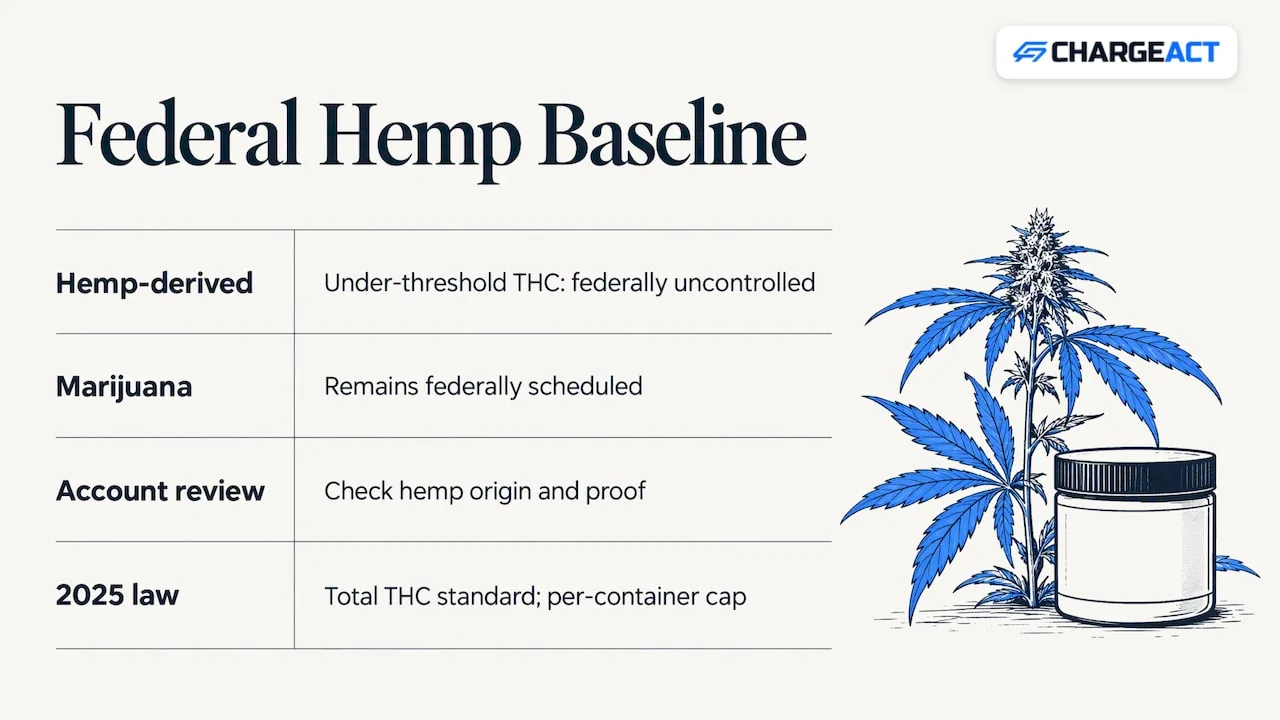
The federal baseline is the hemp definition above. Hemp-derived products with THC under the threshold are not controlled substances at the federal level, while marijuana remains scheduled. For a payment account, this is the foundation underwriters check first: is the product derived from hemp, and can you prove it?
The definition itself is in motion. A 2025 appropriations law redefined hemp using a total THC standard and a per-container cap, and a law firm tracking the change reports that the effective dates have been pushed back in stages by later legislation. Because the schedule has already shifted once, do not rely on a date you read in a blog post, including this one. Confirm the current effective date on an official federal page or with your own counsel before you restructure a product line, and tell your account manager early if any SKU is affected.
Why does a definition change matter for payments? Acquirers enforce the legal status of what you sell. If a product category stops being lawful to sell, a processor that supports it today can be required to drop it tomorrow. Merchants who track the change and adjust their catalog early keep their accounts. Merchants who learn about it from a termination notice do not.
Layer two: FDA rules on products and claims
This is where most CBD accounts run into trouble, because it governs your marketing. The FDA's position, as stated in its published guidance, is that CBD products are excluded from the dietary supplement definition, and that adding CBD to food and introducing it into interstate commerce is prohibited. The agency also states that products intended for therapeutic or medical use are drugs that generally need premarket approval, while cosmetics generally do not require premarket approval, though a cosmetic that claims to treat disease or affect the body's structure or function can be treated as a drug.
The FDA has also warned companies to stop selling CBD products claimed to prevent, diagnose, treat or cure serious diseases, and it notes that only one CBD product, a prescription seizure medicine, has been approved. Public warning letters show the same pattern: the agency has cited sellers of hemp-derived products for adulterated foods and unsafe additives.
For a payments reader, the takeaway is simple. Your product pages, labels and social posts are part of your underwriting file. Three habits keep that file clean:
- Describe topicals, tinctures and pet products in the language of wellness and ingredients, never in the language of disease.
- Do not present CBD as a food additive or a dietary supplement on your site or packaging.
- Remove customer testimonials and reposted social content that make medical claims, since you are answerable for what appears on your channels.
This is a description of what regulators have published, not legal advice. For claims about your specific formulations, talk with a food and drug attorney.
Layer three: state rules where you sell and ship
Federal law sets a floor, and states add their own requirements. Texas shows how much detail this can involve: its law defines a consumable hemp product broadly, prohibits sales to anyone under 21, and requires businesses that make, sell or distribute them to register or hold a license with the state health department. Other states regulate potency, product forms, packaging, testing or licensing differently, and some restrict specific product types.
If you sell online, you are effectively selling into every state you ship to. A workable approach is a state matrix kept in a spreadsheet: one row per state you serve, with columns for age limits, licensing or registration, allowed product forms, labeling requirements and any shipping restrictions, each with a link to the state agency page you used and the date you checked it. It takes an afternoon to build and it answers the question underwriters ask most: where do you sell, and are you allowed to?
Also decide deliberately where you will not ship. A merchant who blocks restricted states at checkout and can show the rule is far easier to underwrite than one who ships everywhere and hopes.
Shipping itself has federal rules too. The postal service publishes its mailing standards for hemp products in Publication 52, which covers what mailers must keep on file. Read the current version directly and keep your lab records for the period it requires, as a carrier or processor may ask to see them.
Layer four: card network and acquirer expectations
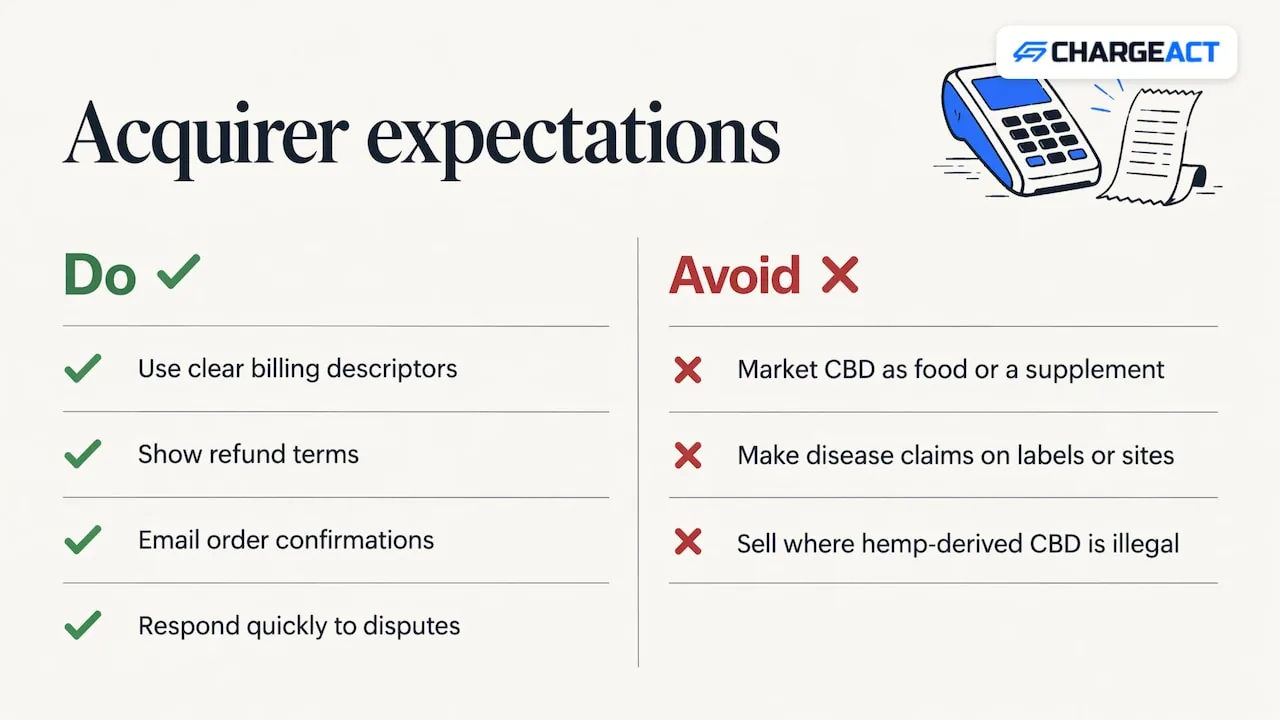
The card brands do not publish a CBD rulebook for merchants to read, but their guidance to acquirers is clear. Visa's summit material on cannabis and hemp-derived products says acquirers must ensure CBD is not marketed as food or a supplement, that disease claims do not appear on labels, websites or social media, and that hemp-derived CBD is sold only where legal. That is the checklist your acquirer is working from, and it lines up almost exactly with the FDA and state layers above.
Two more things shape how acquirers behave with CBD merchants:
Chargebacks. CBD sales are often subscription or repeat-purchase, which raises dispute exposure when customers forget a recurring charge. Card networks monitor dispute and fraud ratios, and acquirers tend to apply internal limits tighter than the published program thresholds, because one weak merchant affects the acquirer's whole portfolio. Our explainer on VAMP and excessive chargebacks breaks down how the ratio works. Clear billing descriptors, visible refund terms, order confirmation emails and a fast response to disputes all protect it.
Facilitator policies. Payment facilitators that aggregate many merchants under one master account write their own acceptable-use policies, and these change. Some have announced they will stop supporting CBD and hemp products, which has left merchants with frozen balances and a short runway to find a new setup. Reserves and held funds are the usual symptom. If you are on a facilitator today, treat a dedicated merchant account as part of continuity planning rather than an emergency fix. Our guide on choosing a high-risk processing partner covers what to look for.
What underwriters ask for
Because an acquirer is vouching for you to the card networks, the application is more detailed than a standard merchant account. Exact requirements vary by bank and processor, but a CBD file commonly includes the following, and having each piece ready shortens the review.
| Document or item | What it shows | How to keep it ready |
|---|---|---|
| Business formation and ownership details | Who is behind the company | Current entity records and IDs for principals |
| Certificates of analysis (COAs) from a third-party lab | THC content and product consistency | One current COA per batch or SKU, stored by lot number |
| Hemp sourcing or license records | Lawful origin of the plant material | Supplier agreements and any state licenses or registrations |
| Website and label review | No disease claims, no food or supplement positioning | Screenshot and date your key pages after each update |
| Shipping and age-verification policy | Sales only where allowed, to adults | A published list of states served and the checkout controls |
| Refund, cancellation and subscription terms | Lower dispute risk | Visible on the site and at checkout |
| Processing history | Chargeback and refund track record | Recent statements from prior processors |
| Security posture | Card data protection | Documented PCI DSS compliance |
Personalized underwriting looks at how the business actually runs, not only the category label. A merchant with clean documents and a sensible catalog often presents a very different risk profile from one with the same product and sloppy paperwork. For a step-by-step view of the process, see our walkthrough on how to get approved and stay live with a CBD merchant account. Approval always depends on the individual business and the underwriting review, and no one can promise it in advance.
Keeping a CBD account stable over time
Getting approved is the first half. Accounts usually run into trouble later, after a change nobody told the processor about. Four routines prevent most of it.
Re-review your site every quarter. Marketing drifts. A new blog post, an influencer repost or a product description rewritten by a freelancer can introduce a health claim. Run a search of your own site and social profiles for words like treat, cure, anxiety, cancer or pain, and fix anything that reads as a medical promise.
Tell your processor before you change the catalog. New product forms, a different THC profile, a new state or a new supplier all change the risk picture. A dedicated account manager can usually adjust the file in advance, where a surprise shows up as a hold.
Plan for volume spikes. Holiday promotions and influencer campaigns can multiply order counts in days. Unannounced spikes look like fraud to risk systems. Warn your processor ahead of a campaign and keep fulfillment fast so disputes stay low.
Keep a backup. Even well-run CBD merchants can lose a bank relationship because of a policy change upstream. A backup placement, set up while your primary account is healthy, keeps revenue flowing if a switch is needed.
How to verify whether a rule is current
CBD rules change faster than most categories, and blog posts age badly. A repeatable verification habit is worth more than any single summary. Use this order:
- Start at the primary source. FDA pages for federal product and claim rules, the relevant state department of health or agriculture for state rules, and the postal service's own publication for mailing.
- Check the date and the scope. Note whether a page states when it was last updated and which products it covers. Non-enforcement memos and narrow policies are easy to misread as broad approvals.
- Confirm with your processor. Acquirers can be stricter than the law. Ask your account manager whether a product or claim fits their current policy.
- Ask counsel for anything product-specific. Formulation, labeling and interstate sales questions belong with a food and drug or cannabis attorney.
- Log what you found. Add the source, date and decision to your compliance file so you can show your diligence at the next underwriting review.
How ChargeAct supports CBD and hemp merchants
Our approach is built for businesses that standard processors decline or drop. Each merchant gets a dedicated account manager, underwriting based on how the business actually operates, fraud protection and chargeback defense tools, and backup placements designed to protect against sudden freezes. Pricing is interchange plus and tailored to your volume, so rates come from a quote for your specific business from our sales team rather than a published number.
If you sell hemp-derived products online, by phone or in person, start with our page on CBD payment processing and merchant accounts, or look at our high-risk merchant accounts. Wellness and supplement brands can also see our nutraceutical merchant account page. Approval is subject to underwriting review.
FAQ
Is CBD payment processing legal in the United States?
Hemp-derived products are treated differently from marijuana under federal law, and many CBD businesses process cards through processors that specialize in the category. What you can sell, and where, still depends on FDA rules and each state's laws. Ask a qualified attorney about your specific products.
Why do regular processors close CBD accounts?
General-purpose processors and payment facilitators set their own acceptable-use policies, and acquirers answer to the card networks for the merchants they sign. When a policy changes or risk rises, accounts can be frozen or closed even without a violation. A processor that underwrites CBD directly reduces that exposure.
What can I say about CBD on my website?
Regulators have published that disease claims and food or supplement positioning are problem areas, and card network guidance to acquirers says the same. Keep descriptions focused on the product, ingredients and use as a wellness item, and have counsel review claims about specific benefits.
What documents do I need to apply for a CBD merchant account?
Expect business and ownership records, third-party lab results for your products, sourcing records, a compliant website, your shipping and age policies, and prior processing statements. Requirements differ by processor, so your account representative will confirm the exact list.
How do I know whether a CBD rule is still current?
Go to the issuing agency's own page, check its date and scope, and confirm with your processor and counsel. Federal hemp definitions are among the rules that have changed timing, so do not rely on secondhand summaries.
Sources
- Consumable Hemp Products, Texas State Law Library
- FDA Regulation of Dietary Supplement and Conventional Food Products Containing Cannabis and Cannabis-Derived Compounds
- FDA Regulation of Cannabis and Cannabis-Derived Products, Including CBD
- FDA consumer update on products containing cannabis or cannabis-derived compounds
- FDA warning letter to STNR Creations, LLC
- Visa Security Summit: Cannabis and Hemp Derived Products
- Federal Hemp Update: Definition Change Delayed
Recommended
How it works
Call us
Tell us where things stand today - your current processor, your rates, and what's not working.
We review where you stand
A real underwriter looks at your statements and account history - no black-box scoring.
You hear what's possible
We lay out your options in plain terms, including what we can and can't do for your business.
Why ChargeAct
We underwrite the businesses others decline
High-risk isn't a dirty word to us - it's the merchant category we specialize in every day.
A human reviews your account, not just an algorithm
Statements get read by people who understand your industry, not auto-rejected by a risk score.
A dedicated manager who knows your account
When something comes up, you call a person who already knows your business - not a queue.
Stop guessing what your processor will do next.
Talk to a real underwriter about where your business stands - no obligation, no runaround.
(888) 329-5717