Firearms Payment Compliance: What FFLs and Gun Retailers Need to Know
Firearms payment compliance explained for FFLs and gun retailers: MCC rules, state laws, processor terms and how to keep card acceptance stable.
Firearms payment compliance is the work of keeping your card acceptance inside the rules of three separate parties: the card networks, your acquiring bank and the states where you sell. It is a different job from your ATF paperwork, and a gap in either one can interrupt revenue. At ChargeAct, we build merchant accounts for high-risk businesses, firearms retailers among them, around how a store actually operates, with a dedicated account manager who watches the account as volume and rules change.
This guide covers what payment compliance means for a gun retailer, how merchant category codes (MCCs) work, what recent state laws say about them, what to verify in a processor's terms, and a routine you can run every quarter.
TL;DR
- Payment compliance is separate from ATF compliance: Form 4473 and background checks govern the sale, while card network rules, your acquirer's agreement and state law govern how the sale is processed.
- Your acquirer, not you, assigns your MCC. Get its written determination and keep it on file.
- More than 20 states have passed laws on firearm-specific MCCs, and the rules differ by state, so review your own state's statute with your attorney.
- General-purpose payment apps often restrict firearms activity in their terms. A processor that underwrites your real business model is the stable route.
- Rates are quoted per business. Ask our sales team for a quote based on your store, your sales channels and your volume.
Table of Contents
- Two kinds of compliance, and why they get confused
- How merchant category codes work for gun retailers
- What state laws say about firearm MCCs
- What to verify in a processor's terms
- Records and controls that support payment compliance
- Why a high-risk merchant account fits firearms retail
- A quarterly routine for staying stable
- Work with a processor that knows firearms retail
- FAQ
- Sources
Two kinds of compliance, and why they get confused
Most FFLs know the first kind well. Before transferring a firearm, a licensee must determine whether the buyer may lawfully receive it and start a background check, and ATF says Form 4473 is the vehicle for those tasks. For online orders shipped to a buyer in another state, ATF explains the firearm generally goes to an FFL in the buyer's state, where the buyer completes Form 4473 and a NICS check before taking possession.
Payment compliance sits on top of that. It answers different questions. How is your business classified by the card networks? Does your merchant agreement describe what you sell accurately? Which of your sales channels (counter, website, phone) does your processor support? What happens to your funds if a bank reviews your account?
The two layers connect in one practical way. An online firearms order often moves in stages: the customer pays by card, the firearm ships to a receiving dealer, and the transfer completes only after the paperwork. If your processor does not understand that sequence, the gap between payment and handover can look like unusual activity. A processor that underwrites your actual operation can account for it up front.
How merchant category codes work for gun retailers
An MCC is a four-digit code that tells the card networks what kind of business a merchant is. It influences risk scoring, pricing and which products a bank will offer. For firearms, the code at the center of the discussion is MCC 5723.
Visa's October 2026 Merchant Data Standards Manual defines that code for guns and ammunition shops, makes its use conditional on a legal requirement, and requires acquirers to assign it to qualifying retailers in California, Colorado and New York. It names MCC 5941 and MCC 5999 as alternatives. The manual also states that the acquirer is responsible for assigning the correct MCC, not the merchant.
Mastercard's June 2026 Quick Reference Booklet lists the same code as "Firearm and Ammunition Stores" and describes its use as conditional on the merchant's primary business and on the acquirer's determination that applicable law requires it. It also distinguishes transaction category codes for face-to-face (R) and non-face-to-face (T) sales, which matters if you sell both at the counter and online.
Three practical points follow from this:
- Do not pick a code yourself. Since the acquirer assigns it, ask for the determination in writing and keep it with your account records.
- Make sure the code matches how you sell. A store that sells firearms, accessories and apparel, and a store that sells only ammunition online, are different profiles. Say so during underwriting.
- Ask how in-person and remote sales will be coded. The counter and the website should each be set up deliberately, not by default.
This is where personalized underwriting earns its keep. ChargeAct underwrites based on what a business actually does, not only its category label, so the conversation about your code starts from your real sales mix.
What state laws say about firearm MCCs
The state picture has changed quickly, and reporting on banking reform for firearm retailers in October 2025 is not a substitute for the statute in your state. The direction is consistent, though: a number of states have acted on firearm-specific codes, some requiring them and some restricting them.
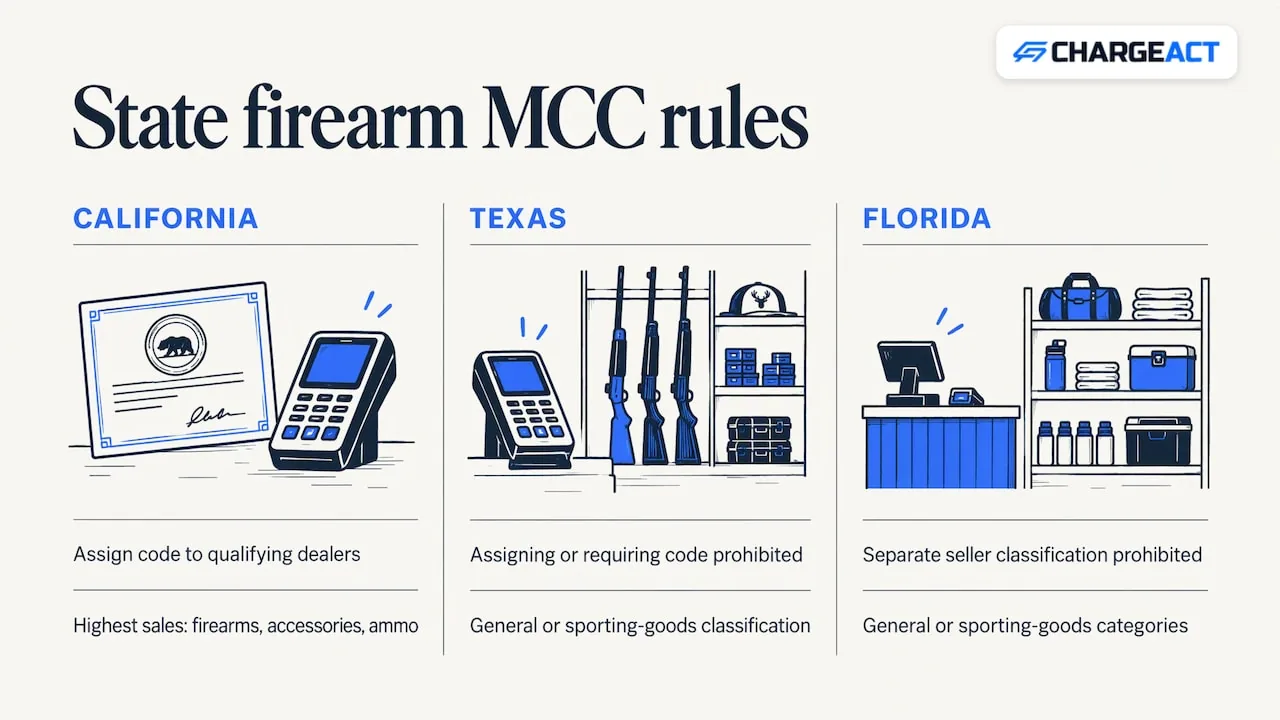
California. AB 1587, approved September 26, 2023, required payment networks to make the firearm-and-ammunition code available by July 1, 2024. Beginning May 1, 2025, acquirers must assign it to a California-licensed firearms dealer or ammunition vendor whose highest or expected highest California sales value is firearms, accessories or ammunition. The Attorney General enforces it, with 30 days' notice and a chance to cure before a civil penalty of $10,000 per uncured violation.
Texas. Business and Commerce Code chapter 610, effective September 1, 2023, goes the other direction. It defines a firearms code to include MCC 5723 and prohibits entities that facilitate or process electronic payments from assigning or requiring one. It limits a firearms retailer's classification to general-merchandise or sporting-goods categories, voids contrary contract provisions and sets a $10,000 civil penalty per violation after failure to cure.
Florida. Section 790.335 of the Florida Statutes prohibits payment settlement entities, merchant acquirers and third-party settlement organizations from classifying a firearms or ammunition seller separately from general-merchandise or sporting-goods retailers.
Read together, these show why a single national assumption fails. A retailer in California, one in Texas and one in Florida may be subject to different expectations about how their business is coded, and a multi-state online seller can touch several at once. This article summarizes the statutes and is not legal advice. Have your attorney confirm what applies to your licenses, your locations and your shipping footprint.
What to verify in a processor's terms
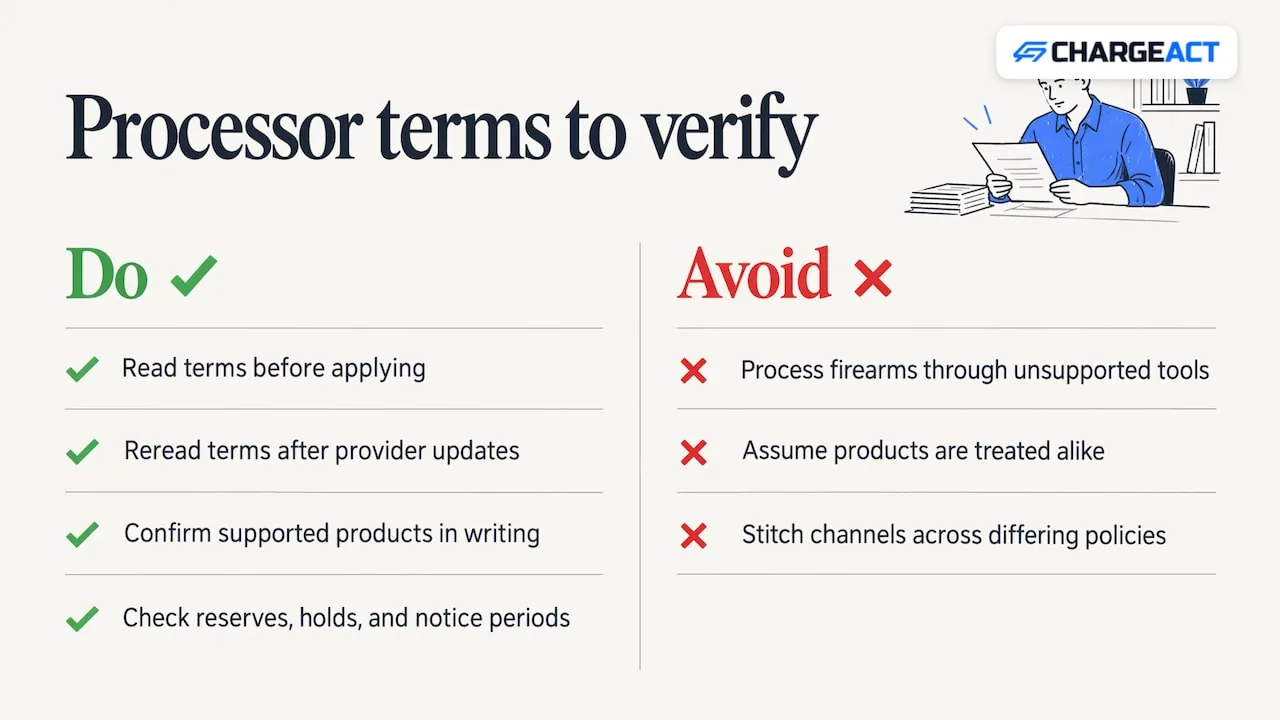
Many merchants learn about their processor's firearms policy only after an account is limited. The better habit is to read the terms before you apply, and again whenever the provider updates them. Four areas deserve attention.
Prohibited and restricted activity. General-purpose payment apps and some storefront payment tools restrict or prohibit transactions involving firearms, ammunition and certain accessories in their acceptable use policies. A merchant who processes through such a tool is relying on a service that was not designed for the category. Closure rights in those agreements are broad, and funds can be affected when an account is closed.
Product scope. Accessories, magazines, optics, apparel, training courses and range memberships are not always treated alike. Ask which of your product lines the provider supports, and confirm in writing.
Channel support. Counter sales, e-commerce checkout, phone orders and deposits on special orders each carry different risk handling. ChargeAct offers retail and POS payments, MOTO processing for mail and phone orders and gateway integration support for e-commerce stores, so a firearms retailer can run every channel under one relationship instead of stitching together tools with different policies.
Termination, reserves and fund holds. Read what the agreement says about reserves, holds and notice periods. The Visa manual notes that merchant agreements can provide for termination or closure after violations, so the contract language is where your real exposure sits. If you have already been frozen or dropped, our overview of what makes a merchant high risk explains how providers view the category and why it is often about the industry, not your conduct.
Records and controls that support payment compliance
Good payment records protect you in a bank review the same way good 4473 records protect you in an ATF inspection. A workable set includes:
- Your acquirer's written MCC determination and the date it was issued.
- A copy of the current merchant agreement and any amendments.
- A clear description of your product mix and sales channels, matching what you told the underwriter.
- Order records that connect each online payment to its transfer to a receiving dealer.
- A log of refunds, cancellations and chargebacks, with the reason for each.
One caution on federal paperwork. ATF's modernization page, updated September 25, 2026, describes proposed changes to Form 4473, electronic FFL records and retention periods. Proposals are not final obligations, so confirm the effective rule before changing how you keep records.
On the payment side, chargebacks deserve their own process. Firearms sales that fall through at the transfer stage, such as a buyer who fails the background check after paying online, can turn into disputes if the refund is slow or unclear. State your refund terms plainly at checkout, process them promptly and keep the documentation. ChargeAct provides chargeback defense and fraud protection as part of the merchant relationship, so these disputes have a defined handling path.
Why a high-risk merchant account fits firearms retail
Firearms is a category that mainstream processors often decline or restrict, and that is not a reflection of how carefully you run your store. It is a category-level policy. The result for merchants is a familiar pattern: approval on a general-purpose platform, steady growth, then a sudden freeze or closure when the platform's review catches the product category, often with funds held while it sorts itself out.
A high-risk merchant account is built for that situation. The provider underwrites you knowing what you sell, so the category is a starting point and not a surprise. Our guide on high-risk credit card processing walks through how that underwriting differs, and seven things to know about high-risk processing covers the points merchants most often miss.
A few features matter most for a firearms retailer:
- A dedicated account manager. Someone who knows your store, your seasonal peaks around hunting season and holidays, and the regulatory shifts in your state, so volume spikes are anticipated instead of flagged as anomalies.
- Backup placements. A second placement designed for continuity if a primary relationship is disrupted.
- Transparent interchange-plus pricing. Pricing aligned to your volume, with a clear separation between the network's cost and the processor's margin. We do not publish rates, because they depend on your business. Request a quote from our sales team for your specific store.
- Fraud tools and chargeback defense. Card-not-present firearms orders attract fraud attempts, and controls at the gateway protect both your margin and your standing with your acquirer.
No provider can promise approval in advance. Underwriting reviews each application on its own facts, and we do not guarantee acceptance for any business.
A quarterly routine for staying stable
Compliance is easier as a rhythm than as a scramble after a notice. A simple quarterly review looks like this.
1. Confirm your classification. Check that your MCC determination on file still matches what you sell. If you added ammunition, optics or an online channel, tell your account manager before the first transaction, not after.
2. Reread the agreement. Look for amendments to reserve terms, fees and prohibited activity. Providers update policies, and the update is binding once you keep processing.
3. Review your state's rules. Statutes on firearm codes have been moving in several states, so ask your attorney whether anything changed where you are licensed or ship. Note the effective dates and any cure periods.
4. Check dispute and refund data. A rising chargeback pattern is the earliest warning sign a bank sees. Fix the cause (unclear descriptors, slow refunds, unmet delivery expectations) before it becomes a review.
5. Plan for volume. Tell your account manager about promotions, new product launches and seasonal peaks so processing limits and monitoring are set with those in mind.
6. Keep backup capacity. If your only processing relationship were interrupted tomorrow, how long could you take card payments elsewhere? A backup placement turns that from a crisis into a switch.
This routine rewards the merchant who talks to the account manager early, which is the main reason the relationship model matters.
Work with a processor that knows firearms retail
If you have been frozen, limited or dropped, or you are opening a new store or online channel and want a stable setup from the start, ChargeAct builds merchant accounts around your actual operation. Our high-risk merchant accounts come with a dedicated account manager, backup placements and fraud protection, and our full range of payment services covers counter, online and phone sales. Because each application is reviewed individually, we cannot guarantee approval, and pricing is provided as a custom quote from our sales team.
To see where firearms sits among the industries we serve, browse our high-risk merchant services or the full list of industries we provide merchant accounts for.
FAQ
Is firearms payment compliance the same as ATF compliance?
No. ATF compliance covers the sale itself, including Form 4473 and the background check. Payment compliance covers card network rules, your acquirer's agreement and any state law on how your business is classified for processing. You need both in order, and they meet at record keeping and order handling.
Who decides my merchant category code?
Your acquiring bank assigns it, and Visa's manual says the acquirer is responsible for the correct code. Ask for the determination in writing and keep it with your account records. If your business changes, tell your account manager so the classification can be reviewed.
Why do general-purpose payment tools freeze firearms sellers?
Many of them restrict firearms and ammunition in their acceptable use policies, so a firearms sale can trigger a review no matter how well you run the store. A merchant account underwritten for your category avoids that mismatch, because the provider approved the business knowing what you sell.
How much does firearms payment processing cost?
Pricing depends on your business, including your sales mix, channels and volume. We use transparent interchange-plus pricing and do not publish rates. Contact our sales team for a quote specific to your store.
Can I take phone orders and online orders under the same account?
We offer MOTO processing for mail and phone orders, retail and POS payments, and gateway integration support for e-commerce stores. Ask your account manager how each channel is coded and configured so they are set up on purpose, not by default.
Sources
- ATF Form 4473 information collection notice
- ATF Questions and Answers
- Visa Merchant Data Standards Manual
- Mastercard Quick Reference Booklet
- California AB 1587
- Texas Business and Commerce Code chapter 610
- Florida Statutes section 790.335
- ATF modernization page
- NSSF
Recommended
How it works
Call us
Tell us where things stand today - your current processor, your rates, and what's not working.
We review where you stand
A real underwriter looks at your statements and account history - no black-box scoring.
You hear what's possible
We lay out your options in plain terms, including what we can and can't do for your business.
Why ChargeAct
We underwrite the businesses others decline
High-risk isn't a dirty word to us - it's the merchant category we specialize in every day.
A human reviews your account, not just an algorithm
Statements get read by people who understand your industry, not auto-rejected by a risk score.
A dedicated manager who knows your account
When something comes up, you call a person who already knows your business - not a queue.
Stop guessing what your processor will do next.
Talk to a real underwriter about where your business stands - no obligation, no runaround.
(888) 329-5717