Ecommerce Merchant Account: How It Works and How to Get One
What an ecommerce merchant account is, how it differs from a payment platform, what underwriting looks at, and how to keep your online store's payments stable.

An ecommerce merchant account is a dedicated account, set up through an acquiring bank and a processor, that lets your online store accept card payments and receive the settled funds in your business bank account. Unlike a pooled payment platform, it is underwritten for your business specifically, which is why it tends to be the more stable foundation once your volume, ticket size or industry makes you a target for freezes and held funds.
This guide explains how the account works, what it costs in broad terms, what underwriters look at, and how to keep your processing steady as you grow.
TL;DR
- An ecommerce merchant account is your own processing relationship, underwritten on your actual business, rather than a shared account where you are one sub-merchant among thousands.
- Underwriting is risk-based: the more complex or higher-risk your model, the more documentation and review you should expect.
- Costs usually combine per-transaction charges, monthly items and setup items. Exact pricing depends on your business, so request a quote from a sales representative.
- Most account problems (reserves, holds, terminations) trace back to chargebacks, fraud, sudden volume spikes or a mismatch between what you applied for and what you sell. Each is manageable with preparation.
- Approval is never guaranteed with any provider, so apply with complete, accurate information.
Table of Contents
- What an ecommerce merchant account actually is
- Merchant account vs. payment platform vs. business bank account
- Who most benefits from a dedicated account
- What the application and underwriting involve
- What an ecommerce merchant account costs
- Why reserves, holds and terminations happen
- Building fraud defenses that protect approval rates
- Preparing your payments for growth
- How to choose an ecommerce merchant account provider
- A dedicated account for your online store
- FAQ
- Sources
What an ecommerce merchant account actually is
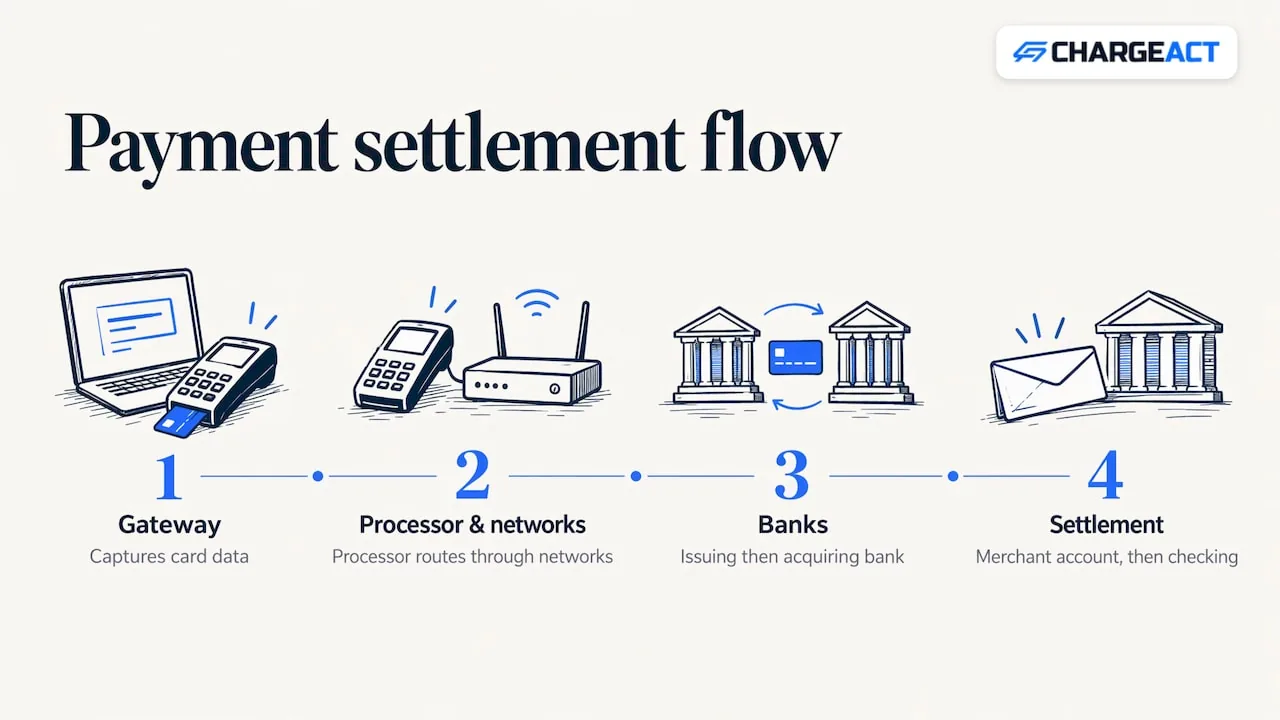
When a customer pays by card on your site, the money does not travel straight from their bank to yours. The payment moves through a gateway that captures the card data, a processor that routes it, the card networks, the customer’s issuing bank and your acquiring bank. The merchant account is the arrangement with the acquirer that makes you an approved receiver of those funds. Settled money lands there first and is then deposited to your business checking account.
For an online store, the account is tied to a few practical things: the website address you declared, the products you sell, the way you bill (one-time, recurring, phone orders), and your expected sales pattern. Those declared details feed the risk profile, so accuracy matters more than most new merchants assume.
The pieces that sit around it
Three components work together. The merchant account holds the underwriting relationship and settlement. The payment gateway is the software layer that connects your checkout to the processor, and it is where tools such as tokenization and fraud screening typically plug in. The processor moves transaction data between the parties. Some providers bundle all three; others let you connect the gateway you already use to a new account. If your store runs on a popular cart platform, gateway integration support is what keeps a migration from interrupting checkout.
Merchant account vs. payment platform vs. business bank account
The three get confused because they all touch money, but they do different jobs.
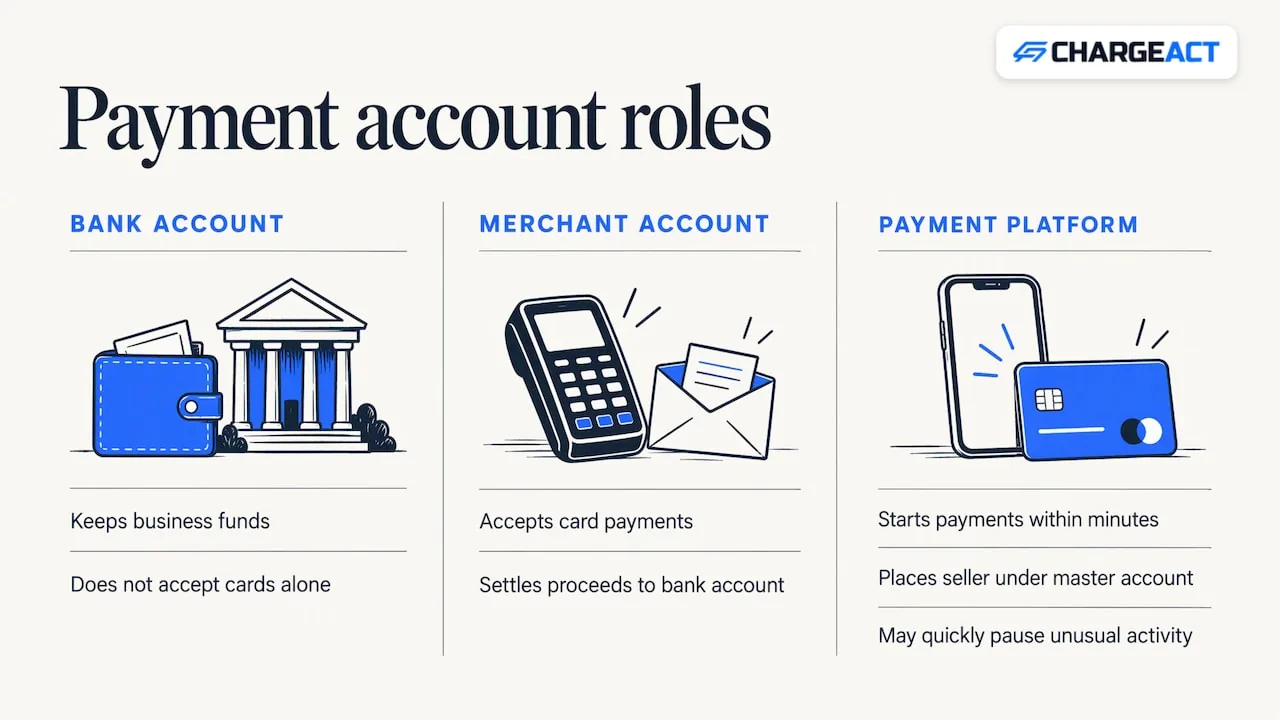
A business bank account is where you keep funds. It does not, by itself, let you accept cards. A merchant account lets you accept cards and settles the proceeds into that bank account.
A payment platform (the aggregator model) lets you start accepting payments within minutes by placing you as a sub-merchant under its own master account. That convenience comes with a trade-off: because the platform carries the risk for everyone beneath it, it sets broad, category-level rules and can pause or close a sub-merchant quickly when activity looks unusual. Popularity is not suitability. A tool that fits a low-risk store with steady, modest sales can become a liability for a store with seasonal spikes, high-ticket orders, subscriptions or a regulated product.
A dedicated account works the other way around. Underwriting takes more effort up front, but the provider evaluates your real operations instead of a label, and that is the basis for predictable treatment later. That is the reasoning behind our approach at ChargeAct: personalized underwriting on how your business actually runs, with a dedicated account manager who knows your sales patterns.
Who most benefits from a dedicated account
Many merchants start on a general-purpose platform and later find it no longer fits. The signs are familiar: sudden account reviews right after a strong sales month, funds held for days beyond what you expected, a reserve you did not plan for, or a notice that your product category is not supported. Others never fit in the first place because they sell firearms and related goods, CBD and hemp products, wellness and nutraceutical items, or run subscription and high-ticket models where chargeback exposure is naturally higher.
If you are in that group, a high risk merchant account built around your risk profile is usually the sturdier path. If you are not sure whether your business counts, our explainer on what a high risk merchant is walks through the factors underwriters weigh, and it is often not the category alone.
What the application and underwriting involve
Underwriting is the acquirer’s way of deciding whether, and on what terms, to take on your business. The U.S. Office of the Comptroller of the Currency’s Merchant Processing handbook (revised March 2025) lists what sound underwriting standards cover: a signed application and processing agreement, enough understanding of your business to assign the right merchant category code, verification of the business, credit reports on the principal, financial statements or credit reports on the company, analysis of recent processing statements where available, checks of trade and bank references, and screening against the OFAC sanctions list and the card networks’ terminated-merchant database.
In practice, a U.S. business should have these ready:
- Legal business name and tax ID (EIN, or SSN for some sole proprietors).
- Formation documents and any business license.
- Details for each owner.
- Business bank account details, usually a voided check or bank letter.
- Recent processing statements if you already accept cards.
- Business financial statements.
- Your website address, which the underwriter will review.
The same OCC handbook notes that many acquirers are moving to a risk-based approach: lower-risk merchants may go through a limited process, while higher-risk merchants get far deeper analysis and closer monitoring. So if you sell in a regulated or chargeback-prone category, a longer review is the normal pattern, not a signal that something is wrong.
How to make your file easy to approve
The most common self-inflicted delay is inconsistency. The product pages on your site, the description on your application and the way you actually ship should match. Clear refund and shipping policies, visible contact details, accurate descriptors on your site and a business model you can explain in two sentences all help the underwriter see a coherent operation. Be candid about prior processing history, including past terminations. Honest disclosure lets a provider place you appropriately, while omissions tend to surface later and cause the very disruption you were trying to escape.
No provider can promise approval in advance. What you control is the quality and completeness of what you submit.
What an ecommerce merchant account costs
Pricing varies by business, so the useful question is what the pricing is made of. Expect three families of cost.
Per-transaction costs. Each card sale carries charges that include the card networks’ interchange and assessments plus the provider’s own markup. Under interchange-plus pricing, those components are shown separately on your statement, which makes your true cost easy to audit. Bundled flat-rate pricing hides the breakdown, which is simple at low volume but harder to evaluate as you scale.
Monthly and annual items. These can include gateway fees, statement or platform fees, compliance-related charges and other recurring line items.
Setup and event-based items. Account setup, and fees triggered by events such as chargebacks or retrievals.
We do not publish rates, because they depend on your products, average ticket, card mix, chargeback history and processing method. Ask a sales representative for a quote based on your specific business, and compare quotes line by line rather than by a single headline number. Our pricing is transparent and aligned to volume, and a quote shows you exactly which components apply to you.
Why reserves, holds and terminations happen
Merchants rarely get blindsided without a trigger. The usual ones are:
- Chargeback ratio creeping up. Disputes cost you the sale, the product and a fee, and sustained elevated levels draw scrutiny from the card networks and your acquirer.
- Fraud events. Card testing, stolen-card orders and account takeovers all raise the alarm.
- Volume spikes. A product launch, flash sale or seasonal peak can look like fraud to an acquirer that was not told to expect it.
- Profile mismatch. Selling something other than what was underwritten, or adding a new product line without telling your provider.
- Delivery gaps. Long lead times, pre-orders and subscriptions create exposure because the customer pays before they receive value.
- Industry policy shifts. Some acquirers and platforms narrow what they support, regardless of how well you run your store.
A reserve is a portion of funds held as protection against future disputes or refunds, and a hold delays payout while a review runs. Both are risk-management tools. Merchants in higher-risk categories are more likely to see them, and the practical goal is to give the provider evidence that your operation is controlled.
What you can do about it
Tell your account manager about launches, promotions and new products before they go live. Keep refund and delivery communications clear, because a customer who understands the timeline is less likely to dispute. Respond to every dispute within the deadline with organized evidence: order confirmation, proof of delivery, customer communication and the terms the customer accepted. A structured chargeback and fraud prevention program covers both prevention and response.
It also helps to keep a backup. A secondary placement means a review or pause on one account does not stop your checkout. This is the idea behind backup placements: continuity planned before you need it. Our guide to seven things to know about high risk processing covers the continuity side in more depth.
Building fraud defenses that protect approval rates
Fraud controls protect your chargeback ratio, but heavy-handed ones cost you good customers. Visa’s eCommerce fraud defense guide recommends a layered approach: shared network intelligence, tokenization of card credentials, real-time detection such as behavioral analytics, velocity checks and device fingerprinting, customer authentication, and post-purchase monitoring. It also advises embedding risk management in the checkout flow so legitimate buyers feel little friction. Visa reports that merchants now screen orders digitally at an average rate of 52%, compared with 23% manually.
Authentication deserves particular attention. According to Visa’s 3D Secure guide, Visa Secure showed roughly a 45% reduction in fraud on authenticated transactions, with 11 basis points of fraud versus 20 for non-authenticated ecommerce transactions. The same guide explains that risk-based authentication lets the issuer wave low-risk purchases through frictionlessly and challenge only riskier ones with a one-time password or biometric check. For a growing store, that balance is the point: stop bad actors without turning checkout into an obstacle course.
Preparing your payments for growth
Sales growth stresses a payment setup in predictable ways. Volume rises, average order values shift, new channels appear, and chargebacks scale with transaction count even if your rate stays flat. A few habits keep the account healthy.
First, align the account with how you sell. If you take phone orders alongside web checkout, you need MOTO processing underwritten from the start, not improvised later. If you also sell in person, a retail payments setup lets one provider cover both channels, so reporting and settlement stay in one place.
Second, support the payment methods your buyers expect. Digital wallets reduce typing at checkout, which matters most on mobile, and they fit alongside card acceptance rather than replacing it.
Third, review your numbers monthly: authorization rate, chargeback ratio, refund rate and fraud attempts. Changes in these figures are the early warnings an acquirer also watches. If you see them first, you can act before anyone else has to.
Finally, plan for peaks. Share your seasonal calendar and campaign plans with your account manager so unusual volume reads as planned growth rather than an anomaly.
How to choose an ecommerce merchant account provider
Compare providers on the criteria that decide how the account behaves under pressure, not just on price:
- Underwriting depth. Does the provider evaluate your real operations, or just your category?
- Pricing structure. Are components itemized so you can audit them?
- Support model. Do you have a named person who understands your business, or a ticket queue?
- Continuity planning. Is there a backup option if one placement is paused?
- Integration. Does it work with your cart, your gateway and your subscription or phone-order flow?
- Dispute and fraud tools. Are prevention and chargeback response part of the offering?
A lower headline price loses its appeal quickly if the account is frozen during your best sales month. For stores with firearms, CBD, wellness, subscription or high-ticket models, the relevant comparison is stability and fit. The high-risk industries overview shows how we approach those categories, and if your store is a more conventional one, our low-risk processing page applies instead.
A dedicated account for your online store
ChargeAct provides merchant accounts and the full stack around them: online payments, gateway integration support for ecommerce stores, fraud protection, chargeback defense, digital wallets, MOTO, mobile and POS. Each merchant gets a dedicated account manager, and underwriting is built around how your business really operates. We design backup placements for industries that traditional processors decline, and our pricing is transparent and tied to your volume.
If you have been dropped, frozen or limited elsewhere, or you are about to launch and want a stable setup from day one, see our ecommerce payment processing page or talk to a sales representative for a quote specific to your business. Approval depends on your business profile and the underwriting review.
FAQ
Do I need a merchant account to sell online?
You need some way to accept card payments. A pooled payment platform lets you start without your own account, while a dedicated merchant account gives you your own underwriting relationship and more predictable treatment as you grow. Which fits depends on your industry, ticket size and sales pattern.
How long does it take to get an ecommerce merchant account?
It depends on your business and how complete your application is. Lower-risk merchants may go through a lighter review, while higher-risk merchants face deeper analysis, according to the OCC’s handbook. Having your documents ready is the best way to avoid delays.
What documents do I need to apply?
Typically your legal business name, tax ID, formation documents, business license, owner details, a voided check or bank letter, recent processing statements if you have them, financial statements and your website address. Your provider will confirm exactly what it requires.
Why would a provider hold funds or add a reserve?
Usually because of chargebacks, fraud signals, sudden volume changes or a mismatch between your declared and actual business. Sharing launch plans in advance and responding promptly to disputes lowers that risk.
How much does an ecommerce merchant account cost?
Cost depends on your products, average ticket, card mix and processing history, so we do not quote general rates. Request a quote from our sales representatives for your specific business.
Sources
Recommended
How it works
Call us
Tell us where things stand today - your current processor, your rates, and what's not working.
We review where you stand
A real underwriter looks at your statements and account history - no black-box scoring.
You hear what's possible
We lay out your options in plain terms, including what we can and can't do for your business.
Why ChargeAct
We underwrite the businesses others decline
High-risk isn't a dirty word to us - it's the merchant category we specialize in every day.
A human reviews your account, not just an algorithm
Statements get read by people who understand your industry, not auto-rejected by a risk score.
A dedicated manager who knows your account
When something comes up, you call a person who already knows your business - not a queue.
Stop guessing what your processor will do next.
Talk to a real underwriter about where your business stands - no obligation, no runaround.
(888) 329-5717