Firearms Payment Processing Rules: What FFLs Need to Know
Firearms payment processing rules for FFLs and gun retailers: federal sales rules, merchant category code laws, processor policies, and how to keep an account stable.
There is no single rulebook called "firearms payment processing rules." Your payments sit under three layers: federal firearms sales rules that govern how you complete a transfer, state laws on how card transactions are coded, and the private policies of the processors and banks that decide whether you can take cards at all. The third layer is where most firearms merchants lose revenue, through freezes, reserves and terminations, so a payment setup built around your actual operations matters as much as the paperwork on the counter.
This guide walks through each layer for firearms retailers, FFLs and online sellers, and shows what to look for in a processing agreement. It is general business information, not legal advice. For questions about your license or your state, talk to your attorney or ATF.
TL;DR
- Federal sales rules (licensing, Form 4473, NICS checks) govern the firearm transfer. Card processing is a separate layer governed by your processor's and bank's policies.
- Some states restrict how a firearms-specific merchant category code is assigned. California and Texas take opposite approaches, so your state matters.
- A general-purpose processor can freeze funds or close an account on policy grounds, even when your business is licensed and operating normally.
- Before signing, check the contract for reserves, termination terms, fee structure and how the processor treats firearms in underwriting.
- A high-risk merchant account with a dedicated account manager is designed to keep a firearms business processing steadily. Pricing is quoted for your specific business.
Table of Contents
- Layer one: federal rules for the sale itself
- Layer two: merchant category codes and state laws
- Layer three: processor and bank policy
- What a firearms merchant should expect at application
- How freezes, reserves and terminations happen
- Fees worth reading line by line
- Online, in-store and phone orders
- Why a high-risk account fits a firearms business
- A checklist before you sign anything
- Keeping payments steady with ChargeAct
- FAQ
- Sources
Layer one: federal rules for the sale itself
Payment rules do not replace firearms rules. The card payment is one step in a transaction that has to be legally complete first. Understanding that order helps you explain your business to an underwriter, because underwriters ask how you sell, ship and verify buyers.
Licensing. Under 18 U.S.C. § 922(a)(1)(A), a person who is not a licensed importer, manufacturer or dealer may not engage in the business of importing, manufacturing or dealing in firearms, or ship, transport or receive a firearm in interstate commerce in the course of that business. For a processor, your Federal Firearms License (FFL) is the baseline evidence that you operate as a licensed dealer.
Background checks and identity. ATF guidance explains that 18 U.S.C. 922(t)(1) and 27 CFR 478.102(a) require a licensee to contact the National Instant Criminal Background Check System (NICS) before completing a transfer to an unlicensed person, and to verify the buyer's identity with a valid ID document. The same guidance lists limited exceptions, such as qualifying state permits.
Form 4473 and records. ATF's open letter to licensees describes the process: the buyer completes and signs ATF Form 4473, the licensee verifies government-issued photo ID, and the licensee contacts NICS before the transfer. It also states retention periods: at least 20 years for a completed transfer and at least 5 years for an uncompleted check. Returning a stored firearm to its owner follows similar steps, including a Form 4473 and, with limited exceptions, a NICS check.
What this means for payments: a customer can pay online or by phone, but the transfer itself still follows these steps. Processors and banks look for a business that clearly keeps those two things apart, taking payment through its checkout or terminal while completing transfers in the way federal rules describe.
Layer two: merchant category codes and state laws
Every card merchant is assigned a four-digit merchant category code (MCC) that tells the card networks what kind of business it is. In 2022 the card networks established an ISO category code for firearms and ammunition retailers. That code is the source of a state-by-state split that affects how you are classified.
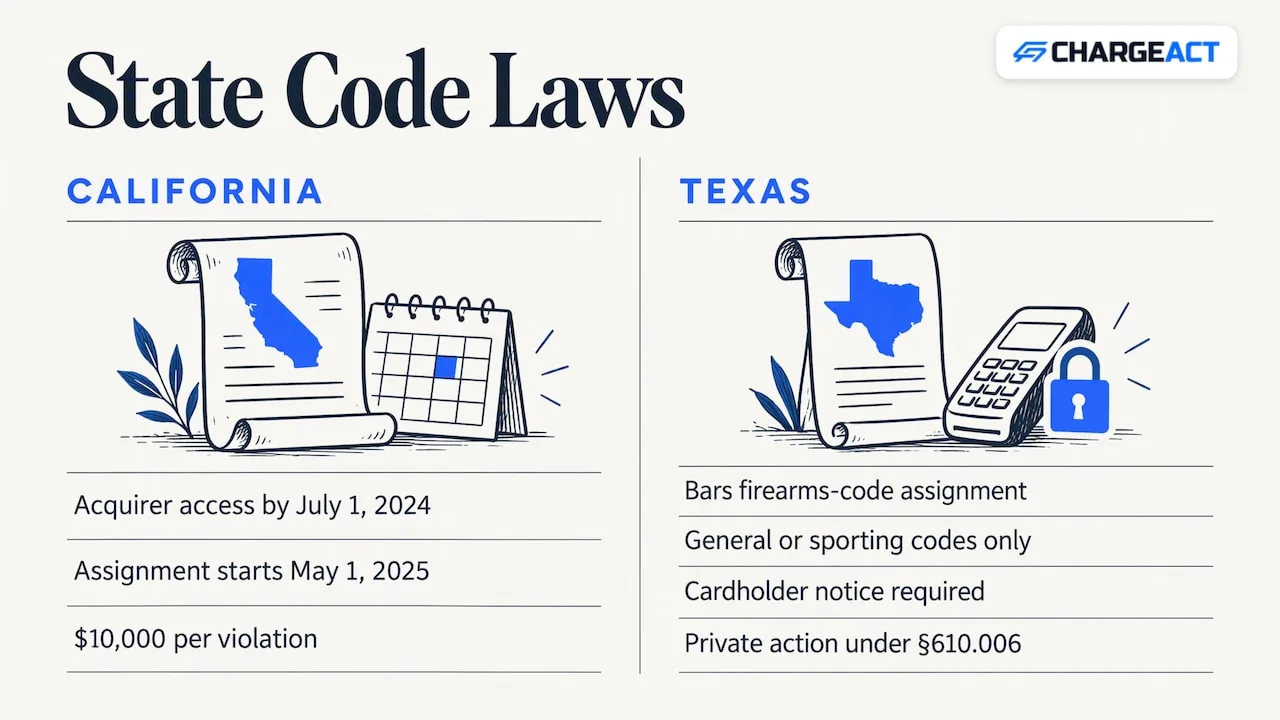
States that require the code. California's AB 1587 requires card networks to make the ISO firearms code available to acquirers (the banks that sign up merchants) by July 1, 2024. It then requires acquirers to assign that code to firearms merchants starting May 1, 2025. The bill gives the state Attorney General exclusive enforcement authority and a $10,000 civil penalty per violation.
States that prohibit the code. Texas goes the other way. Business & Commerce Code § 610.002 bars card issuers and networks from assigning or requiring a firearms code, and bars firearms retailers from using any code other than general merchandise or sporting goods codes. It also requires written notice to cardholders whenever a firearms code is assigned, and § 610.006 gives cardholders a private right of action.
Texas is not alone. According to an NSSF article from May 2025, 20 states had enacted laws against the use of a firearms-specific code, with Arkansas the most recent at that time. The trade group presents these laws as a privacy protection for lawful purchases, and it has also backed federal legislation on the subject. Because the list of states changes as legislatures act, check your own state's current statute rather than relying on a snapshot.
For a merchant, the practical point is that the same business can be coded differently depending on where it operates, and an acquirer that serves many states has to sort this out. Ask your processor directly how it assigns your category code, how it handles your state's law, and who at the company can answer that question. A processor that has a clear answer is a good sign.
Layer three: processor and bank policy
This is the layer that is not written in any statute, and it is the one that most often disrupts firearms sellers. Card acceptance is a private contract. A processor can set its own list of industries it serves, and those lists change.
A recent example: in a November 2025 NSSF report, a large general-purpose payments company moved firearms and related businesses from its prohibited category to a restricted one. That means firearms, regulated parts and accessories such as suppressors are allowed, but only with additional paperwork and an in-depth review by the company's risk team before services can be used. The lesson for any merchant is not about one company. It is that a firearms business on a general-purpose platform is operating inside a policy that can be revised, tightened or applied unevenly, and approval on day one does not settle how an account will be treated on day 300.
That is why merchants who were dropped, frozen or limited by a general-purpose processor or marketplace payment tool tend to share a story: the account worked until volume rose, a review was triggered, and funds were held. If that is you, the goal is a merchant account that was underwritten as a firearms business from the start, so a review has nothing new to discover.
What a firearms merchant should expect at application
Processors that serve firearms businesses generally ask what any underwriter asks, plus detail about how you sell. Expect to prepare:
- Business documents. Your entity details, ownership information and bank account for settlement.
- Your FFL. Underwriters want to see that you hold the relevant license and that it matches the business name and address on the application.
- Your sales model. Whether you sell in store, online, by phone, or all three; how online orders reach the buyer; and how transfers are completed through a licensed dealer.
- Processing history. Prior statements, if you have them, show volume, average ticket size and chargeback levels.
- Your website. Clear product descriptions, shipping and return terms, and contact information are part of a review.
The more consistent these items are, the smoother underwriting tends to go. Nothing can guarantee an approval, and any provider that promises one before reviewing your business should make you cautious. At ChargeAct, underwriting is personalized to your actual business operations, not just the category label attached to it.
How freezes, reserves and terminations happen
Three mechanisms account for most revenue disruption, and each is a contract term you can read before you sign.
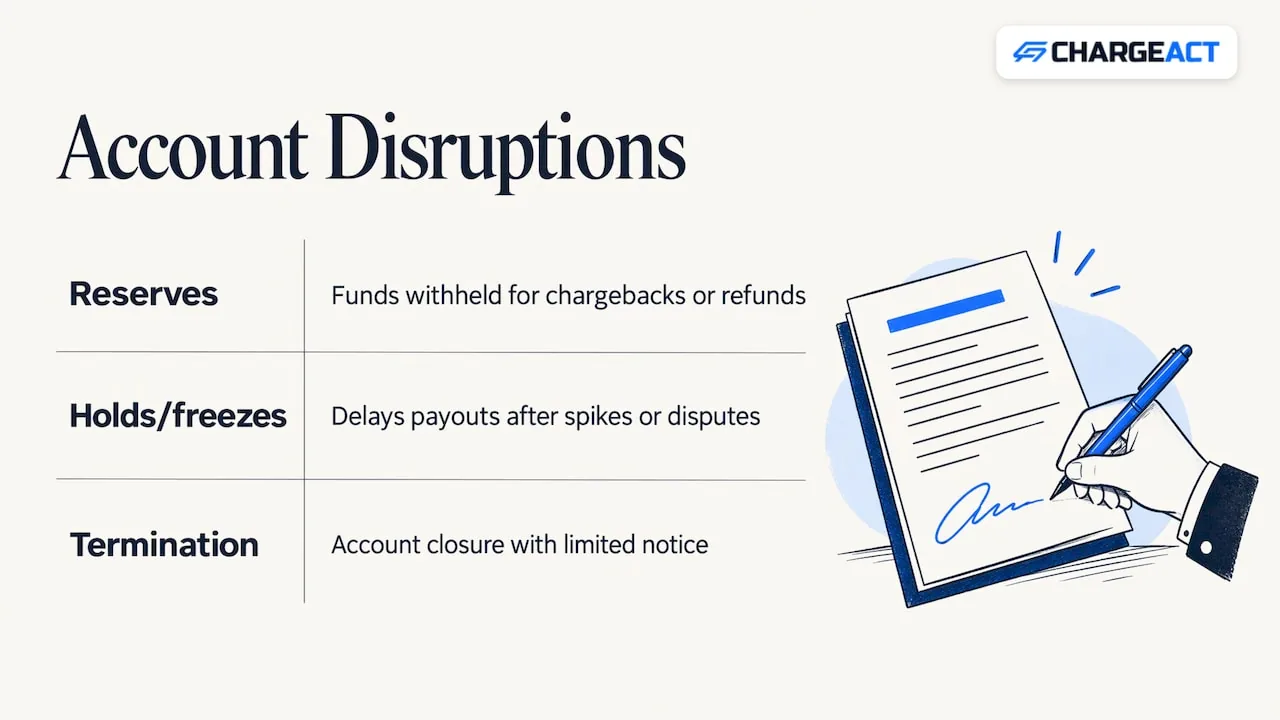
Reserves. A processor may hold back a portion of your funds as protection against chargebacks or refunds. Ask whether a reserve applies, how it is sized, whether it is fixed or rolling, and under what conditions it is released.
Holds and freezes. A processor may delay payouts when it sees a spike in volume, an unusual ticket size or a rise in disputes. This is especially painful for firearms sellers whose volume can jump around product launches, seasonal buying and news-driven demand. A processor that plans for those spikes in advance is far less likely to treat them as anomalies.
Termination. Many agreements allow the processor to close an account with limited notice. Look for the notice period, what happens to funds in transit, and whether you can be added to a shared list of terminated merchants. Being listed can make it harder to open a new account elsewhere, so the termination clause matters more than it seems.
In the contract, read the sections on reserves, early termination fees, notice periods, and what the processor says it may do if its policies change. This is also where backup planning helps: a second placement available if a primary account is interrupted keeps cards flowing while the problem is resolved. ChargeAct offers backup placements for this purpose.
Fees worth reading line by line
Fee structure is the second place firearms merchants get surprised. Many high-risk providers quote a single blended percentage that hides the underlying costs. Interchange-plus pricing separates the card-network cost from the processor's markup, so you can see what you pay for each part. ChargeAct uses transparent interchange-plus pricing aligned to volume.
Whatever provider you consider, check your agreement and your monthly statement for these items:
- Setup and application fees, and whether they are refundable if you are not approved.
- Per-transaction fees on top of the percentage, which add up on high-volume or low-ticket sales such as ammunition and accessories.
- Monthly and statement fees, gateway fees and any minimums.
- Chargeback fees, charged per dispute whether or not you win.
- PCI compliance fees, and any non-compliance charge. For background on the security standard behind these fees, see this guide to PCI compliance for small merchants.
- Early termination fees that make leaving a poor-fit account expensive.
We do not publish rates, because they depend on your sales model, ticket size, and processing history. To see what applies to your business, request a quote from our sales team.
Online, in-store and phone orders
Firearms merchants rarely use one channel. Each has its own payment setup.
In store. Counter sales need a card reader or POS system that connects to a merchant account that knows your business. ChargeAct's retail payments cover card machines and POS for in-person sales, and mobile payments cover card readers for shows and off-site sales.
Online. Ecommerce checkout needs a gateway that connects your cart to the merchant account. We provide gateway integration support for ecommerce stores, along with fraud protection tools. Our ecommerce payment processing page covers the online setup.
By phone. Many firearms and accessories sales start as phone calls. MOTO payment processing handles mail-order and telephone-order cards through a virtual terminal, so your team can take a card number without a storefront.
Across all three, chargebacks follow card-not-present sales more often than in-person ones. Our fraud prevention and chargeback protection tools and chargeback defense service are built for that exposure.
Why a high-risk account fits a firearms business
Firearms are often classed as high-risk by processors, not because of how any individual business operates but because of category policy, regulatory attention and reputational concerns at the bank level. If you want a deeper explanation, our guides on what a high-risk merchant is and seven things to know about high-risk processing go further.
The reasoning is simple. A general-purpose processor built for low-risk sellers treats you as an exception, and exceptions are what its risk systems are designed to flag. A provider that underwrites firearms as a normal part of its book treats your volume pattern, your sales model and your licensing as expected, and plans for them.
That is the idea behind a high-risk merchant account: an account structured around your actual risk profile, with a dedicated account manager who knows your business, a risk strategy that anticipates volume spikes and regulatory shifts, and backup placements for continuity. Our high-risk industries page lists the sectors we serve.
A checklist before you sign anything
Whoever you choose, work through these questions with the provider in writing:
- Does it underwrite firearms businesses as a standard category, and does it review your sales model and FFL before approving?
- How does it assign your merchant category code given your state's law?
- What reserve terms apply, and when are they reviewed or released?
- What is the notice period for closing the account, and what happens to pending funds?
- Is pricing itemized so you can match the monthly statement against the agreement?
- Who is your point of contact when a payout is delayed, and how fast can they act?
- Is there a backup plan if the primary account is interrupted?
- What does the provider do about chargebacks and fraud on card-not-present orders?
A provider that answers these clearly before you apply will usually answer them clearly when something goes wrong.
Keeping payments steady with ChargeAct
ChargeAct builds payment infrastructure for high-risk merchants, including firearms and FFL businesses, with merchant accounts tailored to your risk profile, a dedicated account manager, backup placements, fraud protection and chargeback defense, and transparent interchange-plus pricing. If you were dropped, frozen or limited by a general-purpose processor, or you are setting up before launch, the next step is to talk to our team about your specific business.
See our credit card processing and payment solutions or go to ChargeAct to request a quote. Approval is subject to review and cannot be guaranteed in advance.
FAQ
Is there a federal law that regulates how firearms merchants process cards?
The federal rules in the research above govern licensing, background checks and record-keeping for the sale itself, not card processing. Card acceptance is set by your processor's agreement, card network rules and, in some states, laws on merchant category codes. Ask your attorney about how these apply to your business.
Why do processors treat firearms sellers as high-risk?
The label reflects processor and bank policy, regulatory attention and dispute exposure, not a judgment on any single merchant. It is a category decision, which is why a provider that underwrites on your actual operations can matter so much.
Does my state's merchant category code law change anything for me?
It can. California requires acquirers to assign a firearms code to firearms merchants, while Texas prohibits assigning one. Check your state's current statute and ask your provider how it applies the law to your account.
What should I do if my current processor froze my funds?
Read the reserve and hold terms in your agreement and ask the processor in writing for the reason and timeline. In parallel, a replacement merchant account set up for your business, with a backup placement, lets you keep taking cards while the matter is resolved. For disputes over the contract itself, consult an attorney.
Sources
- 18 U.S.C. § 922: Unlawful acts
- ATF guidance on NICS checks and identity verification
- ATF open letter on Form 4473, NICS and record retention
- ATF guidance on returning stored firearms
- California AB 1587 bill text
- Texas Business & Commerce Code, Chapter 610
- NSSF: state-level momentum on firearms merchant category code laws, May 2025
- NSSF: payment company policy update, November 2025
Recommended
How it works
Call us
Tell us where things stand today - your current processor, your rates, and what's not working.
We review where you stand
A real underwriter looks at your statements and account history - no black-box scoring.
You hear what's possible
We lay out your options in plain terms, including what we can and can't do for your business.
Why ChargeAct
We underwrite the businesses others decline
High-risk isn't a dirty word to us - it's the merchant category we specialize in every day.
A human reviews your account, not just an algorithm
Statements get read by people who understand your industry, not auto-rejected by a risk score.
A dedicated manager who knows your account
When something comes up, you call a person who already knows your business - not a queue.
Stop guessing what your processor will do next.
Talk to a real underwriter about where your business stands - no obligation, no runaround.
(888) 329-5717