Merchant Reserve Release: How and When You Get Your Funds Back
Learn how merchant reserve release works, when rolling and fixed reserves are returned, what delays it, and the steps to take if your held funds are late.

A merchant reserve is released on the schedule written in your processing agreement, not on a schedule set by law. For a rolling reserve, each day's held funds typically come back after a fixed window, often somewhere between 90 and 180 days. A fixed or capped reserve usually returns after a defined period or when a review concludes. Whether the money arrives on time depends on three things: what your contract says, how much dispute activity is still open, and whether you have asked the right questions in writing.
This guide explains how release works, what delays it, how to confirm your own date, and what to do if the money does not show up.
TL;DR
- Release timing comes from your merchant agreement. Nothing in federal law fixes a universal date, so the contract language is the answer to "when."
- Rolling reserves release in a continuous lag, often 90 to 180 days after each transaction. Fixed reserves release on a set date or after a review.
- Open chargebacks, a closed account, a high dispute ratio or contract wording about a "hold period after closure" are the most common reasons release slips.
- Read the reserve clause, track each release in your statements, and put any request or complaint in writing.
- Ask your processor for a reserve review before the window closes, not after. A processor that sets terms around your actual operations is easier to work with.
Table of Contents
- What a merchant reserve is and why it exists
- When rolling and fixed reserves are typically released
- Do reserve funds release automatically, or do you have to ask?
- What can delay or reduce your release
- How to confirm your release date
- What to do if the reserve is not released on schedule
- How to keep reserves short and predictable
- How ChargeAct approaches reserves
- FAQ
- Sources
What a merchant reserve is and why it exists
A reserve is money your acquirer or processor holds back from your sales to cover costs it may owe if your transactions go wrong. Those costs are chargebacks, refunds that arrive after payout, fraud losses and card-network fines. Processors apply reserves most often to businesses in categories with higher dispute exposure, such as firearms, CBD, nutraceuticals, subscriptions and high-ticket ecommerce. If you are new to the idea, our guide to what a high risk merchant is explains how that label is assigned.
The reserve is your money. It sits outside the normal settlement timeline, which is why it feels like a delay, and it comes back to you under the terms you signed. That is why "release" matters as much as the reserve itself: a reserve with clear, predictable release terms is a cash-flow planning item. A reserve with vague terms is a risk to your business.
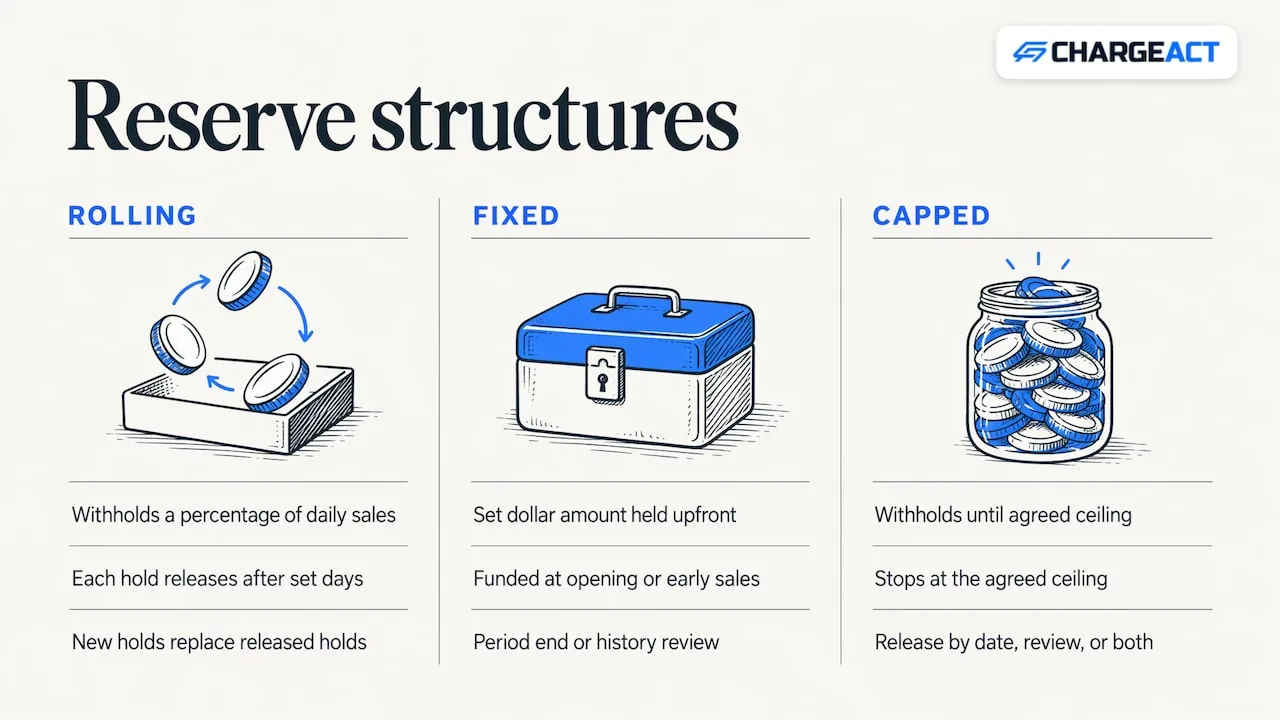
The three common structures
Rolling reserve. The processor withholds a percentage of each day's sales and releases each day's holdback after a set number of days. Because new holdbacks go in as old ones come out, the balance stays roughly steady. Our own explainer, the truth about rolling reserves, walks through how this plays out in practice.
Fixed (upfront) reserve. A set dollar amount is held, either deducted from early sales or funded at account opening. It is typically released at the end of a defined period or after a review of your processing history.
Capped reserve. Withholding continues until the balance reaches an agreed ceiling, then stops. Release follows the same logic as a fixed reserve: a date, a review, or both.
The percentages and dollar amounts vary by merchant and by risk profile. If you want to know what would apply to your business, you need a quote from a sales representative who has looked at your actual operations.
When rolling and fixed reserves are typically released
The industry convention for rolling reserves is a window of roughly 90 to 180 days. Analysis from Daily Intel Service describes that range as a convention drawn from card-network dispute timelines rather than a legal ceiling. In other words, 90 to 180 days is common, but your contract can say something else.
Here is how the timing usually plays out.
| Reserve type | How funds are released | What to look for in the contract |
|---|---|---|
| Rolling | Each day's holdback returns after a set number of days, so you see a daily or weekly lag-based release | The number of days, whether release is automatic, what happens on account closure |
| Fixed | One release at the end of a term, or after a review | The term length, review criteria, who initiates the review |
| Capped | Release after the cap period or when the account meets criteria | The cap amount, whether the cap can be lowered after good performance |
A worked example makes the rolling lag concrete. Say your agreement holds back part of each day's sales for 180 days. For the first six months you see a smaller payout every day and nothing comes back. On day 181, the first day's holdback returns, on day 182 the second day's, and so on. From then on the reserve balance stays flat as long as your volume stays flat. If your sales grow, the balance grows with them. If they shrink, the balance shrinks slowly, because you are still releasing older, larger holdbacks.
This is also why a seasonal business should plan ahead. A strong holiday quarter builds a bigger reserve balance, and that money does not return until the window passes, usually well into the following year. Floral shops around Valentine's Day and Mother's Day, event venues in wedding season and retailers around hunting season all see this pattern.
Do reserve funds release automatically, or do you have to ask?
It depends on the agreement, and this is the question most merchants never check until money is late. In a typical rolling arrangement, release is part of the payout cycle: older holdbacks are returned as they age out, and you see them in your settlement reports. Fixed reserves are different. Many agreements tie release to a review, and a review can require you to request it or to supply documentation first.
So treat release as automatic only if the contract says so in plain words. If the language says funds "may be released" or "will be reviewed," assume you need to start the process. A short written request a few weeks before the scheduled date costs you nothing and creates a record.
A request usually works best when it includes:
- The account name and merchant ID.
- The clause number that sets the release term.
- The date you believe the funds became eligible.
- Your recent chargeback and refund performance, in plain figures.
- A request for written confirmation of the release date and amount.
What can delay or reduce your release
Most late releases trace back to one of a handful of causes. Knowing them lets you manage them before they cost you cash.
Open or incoming chargebacks
Cardholders have a limited time to dispute a charge, and processors know it. According to Daily Intel Service, most agreements give the processor discretion to extend a hold if dispute activity is still coming in when the original window closes, and chargebacks under card-network reason codes can be filed well past 90 days in some circumstances. If your reserve window is 90 days and a dispute lands on day 110 for a day-20 sale, the processor may keep funds to cover it.
That is why reserve windows and dispute windows are linked. A business with strong prevention and a fast response process gives the processor less reason to extend. Our fraud protection and chargeback defense tools are built around exactly that goal: catching bad orders early and responding to disputes with the right evidence.
A high or rising dispute ratio
If your dispute or refund ratio climbs, the processor may increase the reserve, lengthen it, or pause release while it reviews. A reserve that was set to roll off in 90 days can quietly turn into a longer one if the contract lets the processor change terms based on performance. Check whether your agreement allows that and under what conditions.
Contract language about closure
This is where merchants get surprised. Some agreements allow a processor to hold reserve funds for a period after the account closes, because disputes can still arrive on past transactions. One 2026 operator guide from myPayAdvisor reports that some contracts measure the release window from the last transaction on the account, which can mean the oldest funds do not release while you keep processing. Read your closure and termination language before you sign, and ask about it in plain terms.
Missing documentation
When release requires a review, the processor often asks for recent statements, tax or business documents, proof of fulfillment or shipping, and customer-service policies. An incomplete package restarts the clock. Have these ready before you request anything.
Facilitator-style accounts
Some merchants hold reserves under a payment facilitator account rather than a dedicated merchant account. These providers often apply reserves with wide ranges of amount and duration and say they will reduce or remove the reserve if the risk drops. For example, a help-center article from Ticket Falcon describes reserves of roughly 45 to 180 days on that platform, with the provider monitoring the account over time. Terms like these are set per account and can change, so the useful habit is the same: read what your own account says and keep records.
If you landed in this situation after a payout freeze, our playbook on what to do when payouts are paused covers the first steps.
How to confirm your release date
Do not rely on memory or on what a sales rep said on a call. Confirm the date from documents.
Read the reserve clause
Open your merchant agreement and find the section on reserves, holdbacks or "security." You want four answers: the amount or percentage held, the release period measured from what event (the transaction date, the batch date, or the account close date), whether release is automatic, and what rights the processor keeps to extend or increase the hold. Write the answers down in one place.
Check the addenda and amendments
Reserve terms are sometimes changed by a later addendum, an email notice or a revised schedule. If you signed or accepted anything after the original agreement, read that too. The newest document usually controls.
Match the statements to the contract
Your monthly statements or dashboard should show reserve withholdings and releases as separate line items. Pick one day's holdback from the past and count forward by the release period. Then check whether a matching release appeared. If it did, your tracking works. If it did not, you have a specific date and amount to ask about, which is far more effective than a general complaint.
Keep a simple release ledger
A spreadsheet with four columns is enough: the date held, the amount, the scheduled release date, and the date actually received. Within a quarter you will see the pattern, and your finance team can forecast cash flow with real numbers instead of hopes.
What to do if the reserve is not released on schedule
Stay methodical. Escalation works better when each step is documented.
- Ask in writing, referencing the clause. Send the request through the portal or email your account contact, cite the clause and the date funds became eligible, and ask for a written explanation if release is delayed.
- Submit complete documentation. One analysis of processor-held funds, from LegalClarity, says most processors finish a review within three to five business days after receiving complete documentation, though complex cases take longer. Completeness is what moves the clock.
- Provide strong evidence on disputed orders. The same source notes that signed proof of delivery to the cardholder's billing address is among the strongest evidence in a dispute. For merchants who ship, that means tracking and signature records kept for every order.
- Escalate inside the company. Ask for a supervisor or risk-team contact and restate the request with your ledger attached.
- Put a formal demand in writing. If the portal process stalls, a written demand that lists the account, amount and dates sets out the facts clearly.
- Consider professional advice. Whether you have a right to the funds depends on your contract and your state, so a business attorney is the right person to ask if the amount is significant or the account has been closed.
If the account has been terminated, the same logic applies with one addition: ask for the post-closure hold period in writing, and calendar the date. Chargebacks can still arrive on old transactions, so the processor is likely to hold funds until the dispute window it relies on has passed.
How to keep reserves short and predictable
You cannot control every factor, but several levers are in your hands.
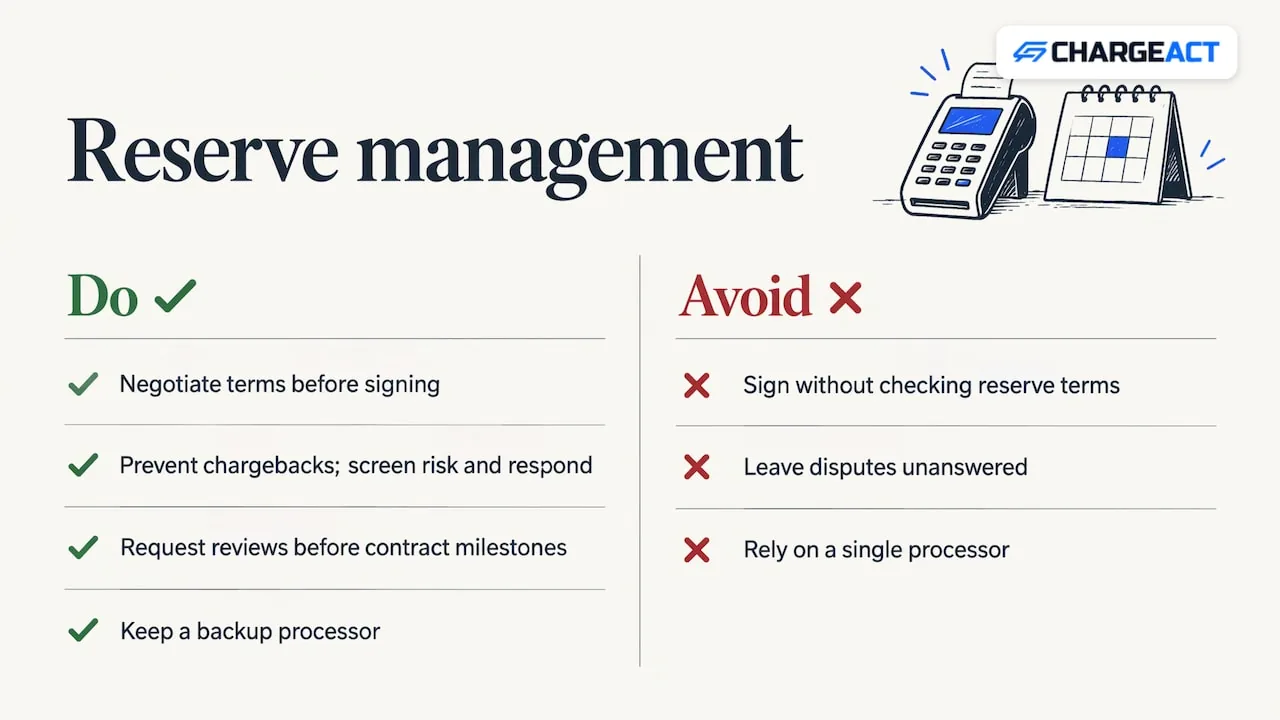
Negotiate the terms upfront. Before you sign, ask what the release period is, what triggers an increase, whether the reserve can be reviewed after a stretch of good performance, and what happens at closure. A processor that underwrites your real operations rather than just your category label has more room to set terms that fit.
Keep dispute activity low. Clear billing descriptors, fast fulfillment, easy refunds and accurate product descriptions prevent chargebacks before they exist. For subscriptions, clear cancellation paths and renewal reminders matter just as much.
Use fraud tools and respond to every dispute. Screening for risky orders and submitting evidence on time protects both your ratio and your reserve.
Ask for a review at set intervals. Put a reminder in your calendar for a few weeks before each milestone in your contract. A merchant with a clean record who asks politely and with data is in a better position than one who waits.
Have a backup. Concentration on a single processor is a risk in its own right. A backup placement means that a hold, a review or a closure at one provider does not stop your sales. For more on how this works across the category, see our seven things to know about high risk merchant processing.
How ChargeAct approaches reserves
We build high-risk accounts around how your business actually runs, not only the category it sits in. Every merchant has a dedicated account manager, which means questions about reserve terms, release timing and review requests go to a person who knows your account. Our high risk merchant accounts are designed to help firearms, CBD, wellness and high-ticket ecommerce merchants keep processing steadily, and we plan around volume spikes and regulatory shifts.
Reserve terms depend on your business, so we do not publish them. To see what would apply to you, talk to our sales team for a quote based on your processing profile. You can also browse our full range of payment processing solutions or see how we serve high-risk industries. Approval and terms are determined by underwriting for each business.
FAQ
How long does a merchant reserve release take?
It depends on your agreement. Rolling reserves commonly release each day's holdback after a window in the range of 90 to 180 days, but your contract may be shorter or longer. Fixed reserves release at the end of their term or after a review.
Is there a law that says when my reserve must be released?
Nothing in federal law sets one universal release date for reserves, according to Daily Intel Service. Your merchant agreement sets the timing. For questions about your specific rights, speak with a business attorney.
Do I have to request my reserve funds?
Sometimes. Rolling reserves often release as part of the payout cycle, while fixed or capped reserves frequently depend on a review. Read the clause, and when in doubt send a written request a few weeks before the scheduled date.
Why was my reserve release delayed?
Common reasons are chargebacks still arriving on older sales, a rising dispute ratio, incomplete documents for a review, or contract wording that extends the hold after account closure. Ask your processor for the specific reason in writing and match it to your agreement.
Can a reserve be lowered before the full term ends?
Often a processor will consider a review when your account shows consistent, low dispute activity. Whether that is possible depends on your agreement and your processor, so raise it with your account manager with your recent performance data in hand.
Sources
- Processor Termination in Nutra: Reserves, Holds, and Frozen Payouts, Daily Intel Service
- Negotiating Reserve Terms: 2026 Operator Guide, myPayAdvisor
- Why is there a reserve on my Stripe account? Ticket Falcon help center
- How Long Can a Credit Card Processor Hold Funds? LegalClarity
Recommended
How it works
Call us
Tell us where things stand today - your current processor, your rates, and what's not working.
We review where you stand
A real underwriter looks at your statements and account history - no black-box scoring.
You hear what's possible
We lay out your options in plain terms, including what we can and can't do for your business.
Why ChargeAct
We underwrite the businesses others decline
High-risk isn't a dirty word to us - it's the merchant category we specialize in every day.
A human reviews your account, not just an algorithm
Statements get read by people who understand your industry, not auto-rejected by a risk score.
A dedicated manager who knows your account
When something comes up, you call a person who already knows your business - not a queue.
Stop guessing what your processor will do next.
Talk to a real underwriter about where your business stands - no obligation, no runaround.
(888) 329-5717