Card-Not-Present Fraud: How Merchants Prevent It
Card-not-present fraud lands on the merchant. Learn how it works, the warning signs, and the layered defenses that protect your account and your revenue.
Card-not-present (CNP) fraud is the unauthorized use of card details for an online, phone or mail order purchase, and under card-network rules the loss usually lands on the merchant, not the bank or the cardholder. For high-risk sellers, that loss does double damage: the refunded sale, plus the chargeback pattern that can get an account frozen or reserved. The defense is a layered one, built around your own order data, and we build it with merchants through fraud protection and chargeback defense set up around each business's actual risk profile.
Reduce Fraud Risk, Support Account Stability
ChargeAct tailors fraud protection and chargeback defense to your business’s risk profile, helping high-risk merchants address payment challenges.
Get A QuoteTL;DR
- CNP fraud means card details are used without the physical card: websites, phone orders, mail orders and subscriptions are all exposed.
- Card-network rules generally place the liability for unauthorized CNP transactions on the acquirer and, through the merchant agreement, on you.
- No single tool stops it. Address checks, security codes and authentication each help, but approved authorizations can still be charged back.
- Layer order-level signals, risk-based authentication and exception reporting, then review the whole setup at least once a year.
- Fraud and chargeback ratios feed how your processor views you, so prevention is also account stability.
Table of Contents
- What card-not-present fraud is
- How fraudsters get and use card details
- Who pays when a CNP transaction is fraudulent
- Warning signs in a suspicious order
- The layers that reduce CNP fraud
- Why fraud signals go beyond chargeback ratios
- Why this matters more for high-risk merchants
- How we help CNP merchants stay stable
- FAQ
- Sources
What card-not-present fraud is
A card-not-present transaction is any purchase where the cardholder and card are not physically present. The Federal Reserve Bank of Boston lists internet, telephone and mail order purchases as the standard examples, and notes that the merchant cannot validate the buyer as the real card owner. CNP fraud is the unauthorized version: someone uses a stolen number, expiration date and security code to buy something the real cardholder never approved.
If you take orders by phone, a virtual terminal, a checkout page or a recurring subscription, all of it is CNP. That includes firearms accessories, CBD and supplement orders, gym memberships, event deposits and boat rental bookings.
How fraudsters get and use card details
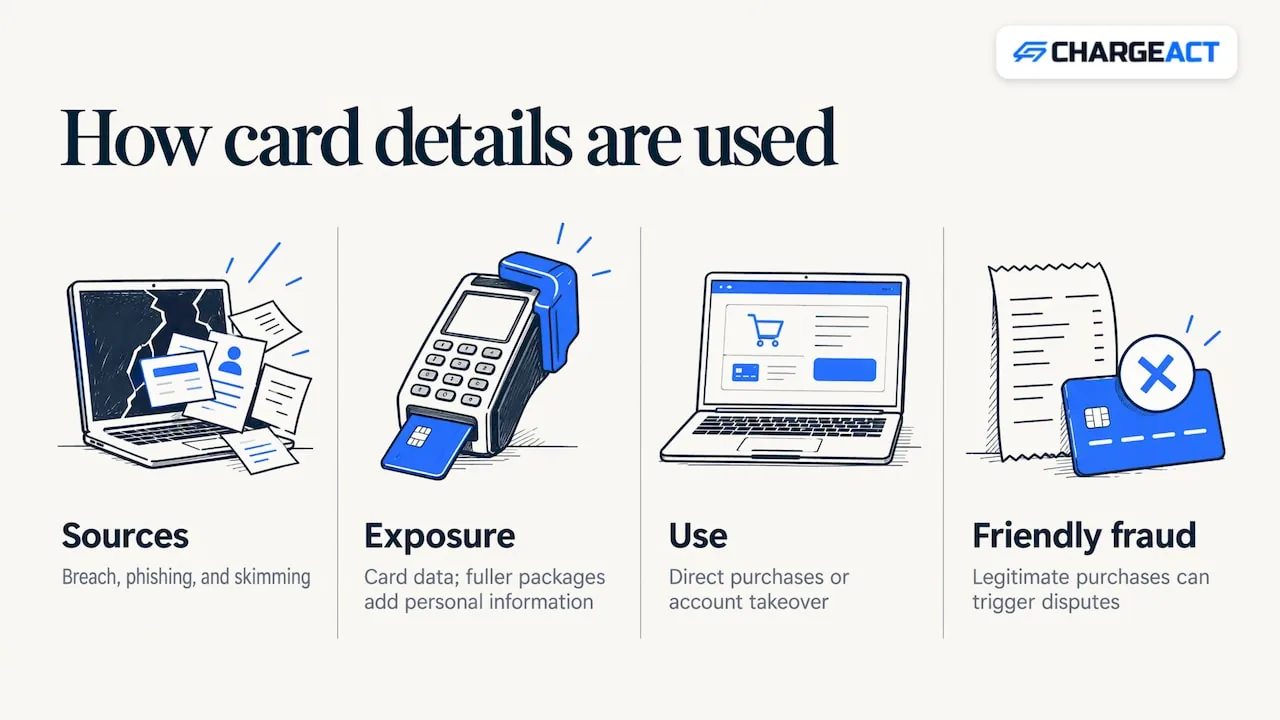
An academic study of CNP fraud published in Security Journal explains that criminals typically acquire details through data breaches, phishing and skimming. A breach may expose the number, expiration date, name and security code, or a fuller package that adds personal information. The details are then used for direct purchases or to take over an existing customer account.
The same study observes that as chip cards made in-store fraud harder, offenders shifted toward CNP methods. That is why online and phone sellers see steady attempts, and why a spike in volume, from a promotion or a launch, is exactly when attackers test cards.
Friendly fraud is the other side of the problem: a real customer disputes a legitimate purchase. The same research notes that chargebacks can be exploited this way, so a chargeback alone is an imperfect signal of fraud. You need order-level evidence for both.
Who pays when a CNP transaction is fraudulent
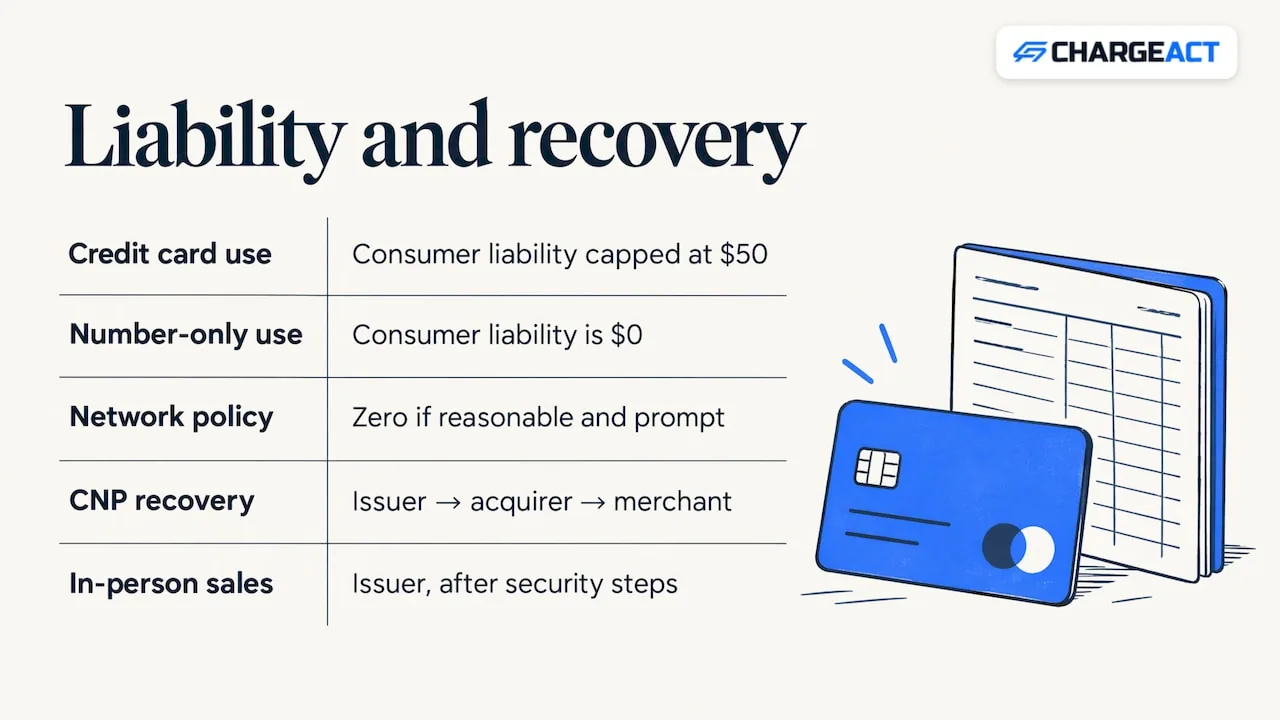
Consumers are well protected. Under federal law, as summarized in the Federal Reserve Bank of Minneapolis liability matrix, a consumer's liability for unauthorized credit card use is capped at $50, and is $0 when only the card number was used without the card. The card networks' own policies also give cardholders zero liability when they act reasonably and report promptly.
The loss has to go somewhere. The same matrix explains that the issuing bank recovers the funds from the acquiring bank, which then tries to recover from the merchant under the merchant agreement. A Brooklyn Law Review analysis by Adam Levitin describes how card-network rules place liability for unauthorized MOTO and internet transactions on the acquirer and, in turn, the merchant, whereas in-person sales that followed security steps leave it with the issuer.
The FDIC's card acceptance guidance adds that CNP merchants, particularly mail order and telephone order sellers, generally present higher chargeback risk to acquiring banks. In practice, that is why processors watch CNP merchants closely and why a fraud problem can turn into a reserve, a hold or a termination. Our guide to the signals that get merchants silently flagged covers that side in more depth.
Warning signs in a suspicious order
Visa's U.S. fraud guidance lists order patterns that merit a second look:
- First-time shoppers placing unusually large or multiple big-ticket orders
- Rush or international shipping requests
- Several cards shipping to one address, or many cards from one IP address
- Repeated transactions on a single card
- Similar card numbers across orders
- Free email addresses combined with the signals above
One signal rarely proves anything. A first-time buyer sending a large order to a freight forwarder is different from a returning customer reordering. Score signals together, and keep the rules tuned to your own customers.
Exception reports and monitoring
The FDIC guidance describes the exception report as a primary detection tool: it flags variances from the parameters set at account setup, including daily sales volume, average ticket size, repeated card numbers, keyed-transaction share, declines and after-hours authorizations. It also cautions that relying only on chargeback counts is a concern, because these other indicators can surface fraud earlier.
The Boston Fed's CNP brief adds a practical device-level check: legitimate customers rarely create a new account or use a new payment method for every transaction, so counting unique accounts, cards, locations or email addresses per device exposes testing behavior without adding friction for honest buyers.
The layers that reduce CNP fraud
The North Carolina Office of the State Treasurer describes three standard fraud-detection services for CNP sales: address verification, security code checks, and cardholder authentication. It also states plainly that none is a guarantee, since an approved authorization can still be charged back. That is the reason to stack them.
| Layer | What it checks | Where it helps most |
|---|---|---|
| Address verification (AVS) | Billing address against the issuer's record | Online checkout, phone orders |
| Security code (CVV2, CVC2, CID) | That the buyer has the code printed on the card | Every CNP sale |
| Cardholder authentication | Identity step-up through the issuer | Higher-risk or high-ticket orders |
| Device and velocity checks | Cards, accounts and emails per device or IP | Card testing, repeat attempts |
| Exception reporting | Variances from your normal sales profile | Early warning on volume anomalies |
Risk-based authentication
The Boston Fed recommends matching friction to risk: let low-risk repeat customers and small orders pass smoothly, and step up authentication for riskier ones. Active methods include one-time passcodes and biometrics, while passive methods include device fingerprinting, geolocation and behavioral analytics. Sending every customer through the same hurdle costs you conversions, especially for subscription and high-ticket sellers where a lost sale is expensive.
Visa's guidance also tells card-absent merchants to authorize every transaction and include the expiration date in each request, since a missing or invalid date can mean the buyer does not hold the card.
Set an acceptable fraud rate and review annually
The Boston Fed's takeaways from the industry's X9 technical report include understanding and setting an acceptable organizational fraud rate, using tokenization and encryption to protect data, working with issuers, and reviewing the whole mitigation strategy at least annually. The U.S. Payments Forum makes the same point in its white paper: the strongest systems combine passive and active controls and look at every point of the customer journey.
For a fuller operating routine, see our layered ecommerce fraud prevention playbook and the chargeback prevention playbook. If your checkout uses 3-D Secure and you see liability errors, our note on fixing a required liability shift for an enrolled card walks through it.
Why fraud signals go beyond chargeback ratios
The FDIC points out that the most effective protection against chargeback losses is thorough underwriting before a merchant is accepted. The same logic applies to how you run your store: acquirers look at the whole picture, not one ratio. Physical-world risk thinking carries over too. Retail operators who study loss prevention that catches errors before guards do will recognize the principle: fix the process that lets losses through, rather than reacting after the fact.
Why this matters more for high-risk merchants
If you sell firearms accessories, CBD, supplements, high-ticket goods or subscriptions, you may already have been through a frozen account or held funds at a general-purpose processor. Those providers tend to apply the same automated rules to everyone. A fraud spike at a business like that can trigger a shutdown before anyone looks at your actual operations.
One cost point is worth knowing. A Federal Reserve Board submission from a large online retailer noted that CNP interchange rates can be more than double card-present rates, and that internet merchants have absorbed most card fraud costs. Every fraudulent order therefore costs more than the sale. Pricing for your business should be quoted for your specific profile by a sales representative.
How we help CNP merchants stay stable
ChargeAct builds payment processing for high-risk merchants, with a dedicated account manager for each merchant and a risk strategy designed to anticipate volume spikes and regulatory shifts. Our underwriting looks at how your business actually operates, not just its category label. Relevant tools include fraud protection and chargeback defense, MOTO payment processing for phone and mail orders, gateway integration support for ecommerce stores, and backup placements. Approval depends on each business's review, and pricing comes from a quote from our sales team. To talk through your setup, start at chargeact.com.
FAQ
Can you give an example of a card-not-present transaction?
Any purchase made without the card physically present counts: a checkout on a website, an order placed by phone, a mailed order form or a recurring subscription charge. The Federal Reserve Bank of Boston names internet, telephone and mail order as the standard types.
Who is liable for card-not-present fraud, the merchant or the bank?
Consumers are generally protected by federal law and card-network policies. Between businesses, the card networks' rules typically pass the loss from the issuer to the acquirer and then to the merchant through the merchant agreement. Your own agreement sets the exact terms.
How did someone use my card without having it?
Usually the details were taken in a data breach, phishing attack or skimming incident, then used online or by phone. Cardholders who spot an unauthorized charge should report it to their card issuer promptly, since federal law and network policies limit their liability.
Does AVS or a security code check stop all CNP fraud?
No. State treasury guidance notes that these checks are not guarantees, because an approved authorization can still be charged back. They work best combined with device checks, risk-based authentication and exception reports.
Sources
- Federal Reserve Bank of Boston: Getting Ahead of the Curve, Assessing Card-Not-Present Fraud
- Federal Reserve Bank of Boston: Understanding the U.S. Card-not-Present Fraud brief
- Security Journal: Card-not-present fraud and crime scripts
- Federal Reserve Bank of Minneapolis: Payments Fraud Liability Matrix
- Brooklyn Law Review: Private Disordering? Payment Card Fraud Liability Rules
- FDIC: Merchant card acceptance guidance
- Visa: Fraud prevention for businesses
- North Carolina Office of the State Controller: Fraud detection services for card-not-present transactions
- U.S. Payments Forum: CNP Fraud Mitigation Techniques
- Federal Reserve Board: Submission of Dell, Inc.
Recommended
How it works
Call us
Tell us where things stand today - your current processor, your rates, and what's not working.
We review where you stand
A real underwriter looks at your statements and account history - no black-box scoring.
You hear what's possible
We lay out your options in plain terms, including what we can and can't do for your business.
Why ChargeAct
We underwrite the businesses others decline
High-risk isn't a dirty word to us - it's the merchant category we specialize in every day.
A human reviews your account, not just an algorithm
Statements get read by people who understand your industry, not auto-rejected by a risk score.
A dedicated manager who knows your account
When something comes up, you call a person who already knows your business - not a queue.
Stop guessing what your processor will do next.
Talk to a real underwriter about where your business stands - no obligation, no runaround.
(888) 329-5717