Wellness Merchant Account: How to Get One and Keep It Live
What a wellness merchant account is, how underwriting works, what to prepare, and how to keep processing stable when general platforms freeze or drop you.

A wellness merchant account is a merchant account underwritten for the way wellness brands actually sell: supplements, nutraceuticals, CBD and hemp products, subscriptions, telehealth-adjacent offers and high-ticket programs. The reason it matters is stability. General-purpose payment platforms often approve a wellness store quickly, then freeze funds or close the account once volume grows or a policy changes. A merchant account built around your real operations, with a named account manager and a backup plan, is how you avoid that cycle. At ChargeAct, our nutraceutical and wellness merchant accounts are built on exactly that approach.
Keep Wellness Payments Running
ChargeAct tailors payment processing for wellness and nutraceutical merchants, with a dedicated account manager focused on risk management and operational stability.
Get A QuoteTL;DR
- A merchant account is a contract-backed account with a processor that lets you accept card payments. A wellness version is underwritten for your product mix, marketing and billing model, not just a category label.
- Most freezes trace back to a mismatch between what was approved and what the business later does: new products, new offers, volume spikes, refund and dispute patterns.
- Preparation shortens underwriting: business verification, processor statements, bank references, a clear product list and your refund and subscription terms.
- Before you sign, confirm who holds the account, how reserves and held funds work, and what happens if the account is reviewed.
- Rates depend on your business profile, so the only reliable number is a quote for your specific business.
Table of Contents
- What a wellness merchant account actually is
- Why wellness brands get treated as high risk
- What underwriting looks at
- Why accounts get frozen, and how to lower the odds
- Merchant account, payment facilitator or general platform?
- What to confirm before you sign
- What it costs and how long it takes
- Preparing a profile that underwrites well
- How ChargeAct supports wellness merchants
- FAQ
- Sources
What a wellness merchant account actually is
In plain terms, a merchant account is the arrangement that lets a business take credit and debit card payments. The Federal Trade Commission, in a 2020 stipulated order involving a major processor, defines a merchant as a person authorized under a written contract with a payment processor to accept or process credit card payments. The merchant account is the account tied to that merchant that lets it obtain processing services.
"Wellness" is not a formal card-network category. It is a working label for a cluster of businesses: dietary supplements and nutraceuticals, CBD and hemp, weight-management products, sports nutrition, telehealth wellness programs, and the gyms, studios and clinics that sell memberships. What unites them from a processor's point of view is a handful of risk features: recurring billing, strong marketing claims, higher refund and dispute exposure, and products that sit near regulated categories.
That is why the type of account matters. There are two broad structures:
- Your own merchant account, with underwriting done on your business and a processing agreement in your name.
- A pooled or aggregated account, where many sellers process under one master account and onboard in minutes.
The second is convenient for a new store. The first is what a growing wellness brand tends to need, because the approval reflects your actual business rather than a shared set of rules that can change for everyone at once.
Why wellness brands get treated as high risk
The card ecosystem prices risk in a few ways: the chance of chargebacks, the chance of fraud, and the chance that a merchant stops delivering before customers are served. Wellness sellers trip several of these at once. Subscription and free-trial offers produce disputes when customers forget a renewal. Results-driven marketing can attract complaints. Supplement and CBD products can sit at the edge of what some banks are comfortable sponsoring.
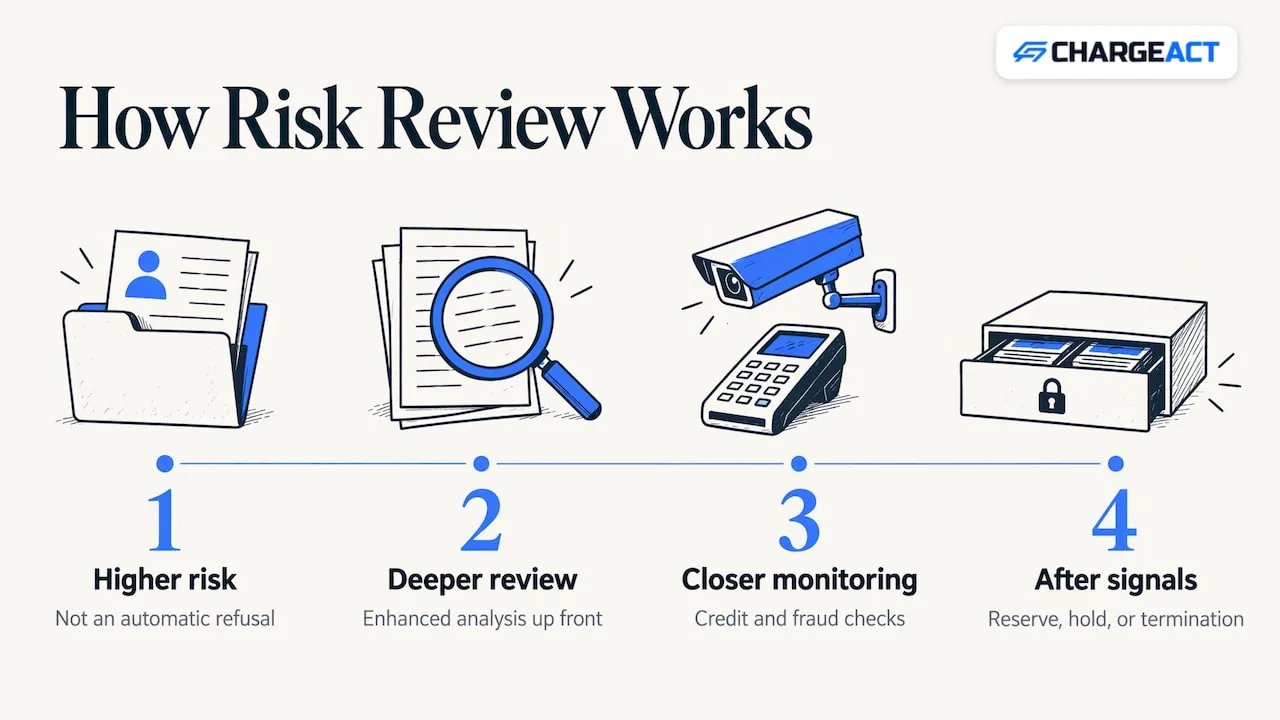
The Comptroller of the Currency, which supervises national banks, spells out the logic in its Merchant Processing handbook. Banks are expected to keep formal underwriting policies that specify eligible merchant types and selection criteria, such as time in business and location, and higher-risk merchants may receive substantially more analysis and enhanced credit and fraud monitoring than lower-risk ones. In other words, being labeled higher risk does not mean being refused. It means a deeper review up front and closer monitoring afterward.
That monitoring is the part many founders underestimate. A platform that approved you in ten minutes did not do the deeper review, so it relies on after-the-fact signals. When those signals fire, the result is a reserve, a hold or a termination. If you have lived through that, you already know the cost: payroll, inventory and ad spend all depend on funds you cannot reach.
What underwriting looks at
The same OCC handbook lists the minimum standards a bank-sponsored underwriting process should include: a signed application and processing agreement, enough understanding of the business to assign the right merchant category code, verification of the business, financial or credit information, recent processor statements when available, bank and trade references, and checks against sanctions and the MATCH list of terminated merchants.
Translated into a wellness checklist, expect to be asked for:
- Business verification: formation documents, EIN, a working website with clear contact details, and ownership information.
- Product detail: a complete list of what you sell, ingredient or formulation information where relevant, and who manufactures and fulfills it.
- Financial information: business and owner credit information and bank references.
- Processing history: recent statements from your current or previous processor, which show your dispute and refund patterns.
- Customer terms: refund policy, shipping times, subscription and trial terms, and how customers cancel.
- Marketing: the pages and ads that drive sales, because they show what customers are promised.
On that last point, federal guidance is clear that health-related claims need support. The FTC's Health Products Compliance Guidance states that claims about the health benefits or safety of foods, dietary supplements and similar products require substantiation in the form of competent and reliable scientific evidence. Underwriters read your site with that in mind. A page that stays measured and consistent with your documentation is easier to approve and less likely to be flagged later.
Why accounts get frozen, and how to lower the odds
Freezes rarely come from nowhere. The patterns below are the usual triggers, and each has a practical counter.
Volume that jumps without warning. A successful promotion, an influencer mention or a Black Friday weekend can multiply daily volume. To an automated monitor, that looks like a change in risk. The fix is to tell your processor about expected spikes before they happen, which is exactly the kind of conversation a dedicated account manager exists for.
Drift from the approved business. You were approved for supplements and then add a CBD line, a telehealth consultation or a coaching program. Each addition changes the risk profile. Disclose product changes before launch so the account is underwritten for what you actually sell.
Dispute and refund patterns. High dispute counts are the fastest route to a review. Clear billing descriptors, easy cancellation, reminder emails before renewals and fast refunds for unhappy customers all reduce disputes before they become chargebacks. A chargeback defense process, with documentation of delivery and customer agreement, helps with the ones that remain.
Fraud exposure. Card-not-present sales attract testing and stolen-card use. Layered fraud screening protects approval rates and your dispute ratio at the same time.
Nested relationships. The FDIC's payment processor guidance notes that nested processor and aggregator relationships can be difficult to monitor and control, significantly elevating risk. When your account sits several layers away from the sponsoring bank, the party that decides your fate may be one you have never spoken to. A direct relationship shortens that chain.
None of this removes risk entirely, and no provider can promise that an account will never be reviewed. What you can control is how clean your profile is and how early you communicate with the people reviewing it.
Merchant account, payment facilitator or general platform?
The choice usually comes down to speed versus stability.
| General platform or facilitator | Dedicated wellness merchant account | |
|---|---|---|
| Onboarding | Minutes, light review | Fuller review of your business |
| Underwriting basis | Shared rules for all sellers | Your products, model and history |
| Behavior at scale | Reviews triggered by automated signals | Planned around your volume and risk |
| Contact | Support queue | Named account manager |
| Continuity | One account, one point of failure | Backup placement possible |
A facilitator makes sense on day one of a small store. The trouble starts when revenue depends on that account. Many merchants arrive at ChargeAct after a platform limited, froze or dropped them, and the lesson is the same each time: the speed of the first approval is not the same thing as the stability of the second year.
What to confirm before you sign
A processing agreement is a long document, and several clauses decide how safe your cash flow really is. Read for these:
- Who holds the account. Is the account in your name, or are you a sub-merchant under someone else's? This determines who can close it and who you can appeal to.
- Reserves and held funds. Does the agreement allow reserves, on what triggers, for how long, and how and when funds are released? Get the mechanics in writing.
- Termination terms. Notice periods, early termination fees and what happens to funds in transit.
- Fee structure. Whether pricing is transparent interchange-plus or bundled, and which monthly, gateway, chargeback and compliance fees apply. Interchange is the fee set by the card networks and paid to the issuing bank, and it is the base layer of every card transaction.
- Chargeback handling. Who fights disputes, what evidence is needed, and what the fee per dispute is.
- Gateway and integration. Whether your cart, subscription billing tool or virtual terminal works with the processor.
- Backup options. Whether a secondary placement can be arranged so a single review does not stop sales.
Card-network rules also shape what you can do at checkout. Visa's U.S. rules generally prohibit minimum or maximum transaction amounts, though U.S. merchants may set a credit card minimum of up to $10, and surcharging on credit cards is permitted in most states under Visa's surcharging requirements. Federal law on the minimum purchase point is in 15 U.S.C. § 1693o-2. The American Express Merchant Operating Guide was updated in October 2026, expanding fraud-prevention tools and industry-specific requirements, so confirm with your account manager which version applies to you when you accept that card.
What it costs and how long it takes
Two questions every founder asks, and two where an honest answer is "it depends on your business."
Approval time depends mostly on how complete your file is. Missing statements, unclear product descriptions or an incomplete website are what slow underwriting, not the wellness label itself. Prepare the documents listed above before you apply and the process moves faster.
Cost depends on your product mix, average ticket, billing model, dispute history and expected volume. Processing is typically built from interchange, a processor markup, and a set of account fees. Because those inputs differ so much between a protein powder store and a high-ticket subscription program, we do not publish rates. The reliable way to know your cost is to request a quote for your specific business and compare line by line against the agreement checklist above.
Preparing a profile that underwrites well
A few habits make a wellness merchant easier to approve and keep:
- Make the website match the application. Product names, prices, contact details, shipping and return policies should be consistent everywhere.
- Keep claims supportable. Align product pages and ads with the substantiation standard in the FTC guidance above.
- Show your subscription mechanics. Clear terms at checkout, an easy cancel path and renewal reminders show an underwriter you are managing dispute risk.
- Document fulfillment. Know who ships, how long it takes and how you track delivery. This is your evidence when a customer disputes a charge.
- Plan your peaks. Share your promotional calendar so volume spikes are expected rather than alarming.
- Keep a clean separation of lines. If CBD, supplements and coaching are all part of the business, tell the underwriter about each from the start.
Our own guide to what high-risk processing involves goes deeper on the mechanics, and our explainer on what makes a merchant high risk is useful if you are unsure where your business falls.
How ChargeAct supports wellness merchants
ChargeAct builds high-risk merchant accounts for industries that traditional processors decline, including wellness, nutraceuticals and CBD. Underwriting is personalized to your actual business operations rather than a category label, and each merchant has a dedicated account manager who works on a risk management strategy designed to anticipate volume spikes and regulatory shifts. Pricing is transparent interchange-plus, aligned to your volume, and backup placements are part of the approach so one review does not halt your sales.
The wider stack covers online payments, merchant accounts, POS systems and gateway integration for ecommerce stores, plus fraud protection and chargeback defense. For phone and mail orders, there is MOTO payment processing, which suits consultation-led and high-ticket sellers. If your store sells online, see our ecommerce payment processing page. Approval depends on underwriting, and we do not guarantee any account, but a conversation about your business is the quickest way to see where you stand: get a free quote.
FAQ
What is a wellness merchant account?
It is a merchant account underwritten for wellness businesses such as supplements, nutraceuticals, CBD and hemp, and wellness subscriptions. The review looks at your products, marketing, billing model and processing history, so the account reflects how you actually operate.
How much does a wellness merchant account cost?
Cost depends on your business profile, including product type, average ticket, billing model and dispute history. For that reason, pricing is quoted for your specific business by a sales representative rather than listed publicly.
Why do payment platforms freeze wellness accounts?
Usually because the account's activity no longer matches what was approved: a sudden volume jump, new product lines, high disputes or refunds, or nested account structures that are harder to monitor. Disclosing changes early and keeping disputes low reduces the chance of a review.
What documents do I need to apply?
Expect to provide business verification, ownership and credit information, bank references, recent processor statements, a product list, your website and your refund and subscription terms. Having these ready before you apply helps underwriting move more smoothly.
Sources
- FTC, First Data Merchant Services stipulated order (2020)
- OCC, Comptroller's Handbook: Merchant Processing
- FTC, Health Products Compliance Guidance
- FDIC, Payment Processor Relationships Revised Guidance
- Visa, Rules and policies
- 15 U.S.C. § 1693o-2
- American Express Merchant Operating Guide, October 2026
Recommended
How it works
Call us
Tell us where things stand today - your current processor, your rates, and what's not working.
We review where you stand
A real underwriter looks at your statements and account history - no black-box scoring.
You hear what's possible
We lay out your options in plain terms, including what we can and can't do for your business.
Why ChargeAct
We underwrite the businesses others decline
High-risk isn't a dirty word to us - it's the merchant category we specialize in every day.
A human reviews your account, not just an algorithm
Statements get read by people who understand your industry, not auto-rejected by a risk score.
A dedicated manager who knows your account
When something comes up, you call a person who already knows your business - not a queue.
Stop guessing what your processor will do next.
Talk to a real underwriter about where your business stands - no obligation, no runaround.
(888) 329-5717